HSS Study: These Solutions Shine in Removing TKA Biofilm

By elizaabethhofheinzmphmed 0 views 0 comments

Advertisement

HSS Study: These Solutions Shine in Removing TKA Biofilm

Researchers from Hospital for Special Surgery (HSS) and Weill Cornell Medical College in New York have found that one particular antiseptic solution has topped the list in terms of effectiveness against methicillin-sensitive Staphylococcus aureus and Escherichia coli biofilms.

Their work, “Not All Antiseptic Solutions Are Equivalent in Removing Biofilm: A Comparison Across Different Orthopaedic Surfaces,” appears in the January 15, 2025, edition of The Journal of Bone and Joint Surgery.  

Biofilm is the Key

“Periprosthetic joint infection continues to be the leading reason for revision hip, and knee replacement in the United States,” said co-author Alberto Carli, M.D., a hip and knee replacement surgeon at HSS.

“Despite our increasing experience in fighting these infections, our success rates have remained fairly dismal over the last 10 years. Although the chance of treatment success increases when we remove infected implants, this process is associated with a high rate of disability and complications. Leaving implants in place and improving our ability to clean them free of bacterial biofilm is an attractive option.”

“Unfortunately, our treatment success rates are lowest when implants are left in place. Therefore, we are evaluating which antiseptic solutions work best in removing biofilm; if we can employ these intraoperatively on a routine basis, our treatment success rates (especially when implants are left in place) could improve.”

“Our lab has previously tested a variety of antiseptic solutions on porous titanium and polymethylmethacrylate, but this study was the first to utilize orthopedic materials commonly seen in total knee replacements, such as cobalt chromium and oxidized zirconium. These are commonly found in femoral implants in total knee arthroplasty.”

Study Methodology

For this study, researchers grew methicillin-sensitive Staphylococcus aureus and Escherichia coli on cobalt-chromium, oxidized zirconium, and polymethylmethacrylate discs for 24 and 72 hours.

Biofilm-coated discs were treated with control or various antiseptic solutions for 3 minutes. They tested the following solutions:

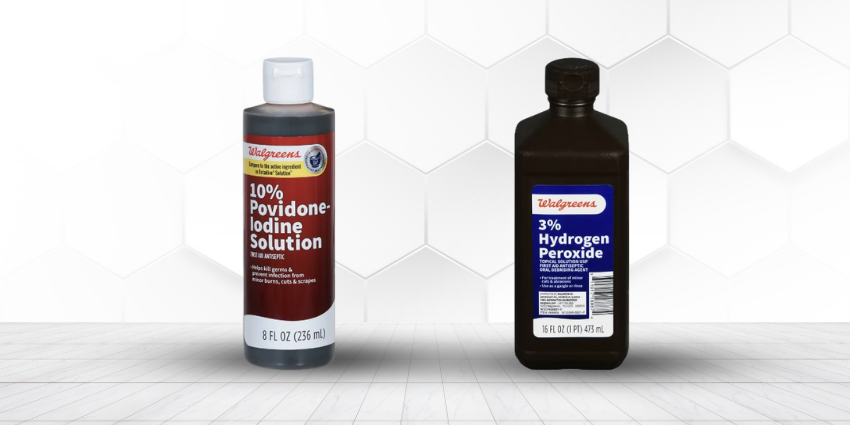
  • 10% povidone-iodine,
  • a 1:1 mixture of 10% povidone-iodine plus 3% hydrogen peroxide,
  • diluted povidone-iodine, 0.05% chlorhexidine gluconate,
  • and a surfactant-based formulation of ethanol, acetic acid, sodium acetate, benzalkonium chloride, and water.

The solution that performed best on both oxidized zirconium and cobalt-chromium was the 10% povidone-iodine with 3% hydrogen peroxide.

According to the research team, it eradicated all methicillin-sensitive Staphylococcus aureus—and it achieved clinical efficacy on polymethylmethacrylate at both 24-hour methicillin-sensitive Staphylococcus aureus biofilm and 72-hour methicillin-sensitive Staphylococcus aureus biofilm.

On 72-hour methicillin-sensitive Staphylococcus aureus, 10% povidone-iodine (without hydrogen peroxide) eradicated all bacteria on oxidized zirconium and cobalt-chromium, and it achieved clinical efficacy on polymethylmethacrylate.

On 24-hour methicillin-sensitive Staphylococcus aureus biofilm, 10% povidone-iodine (without hydrogen peroxide) achieved efficacy on all surfaces.

The surfactant-based formulation only achieved clinical efficacy on 72-hour methicillin-sensitive Staphylococcus aureus biofilms on cobalt-chromium and oxidized zirconium.

On 72-hour E. coli biofilm, 10% povidone-iodine with or without hydrogen peroxide achieved clinical efficacy on all surfaces. No other solution achieved clinical efficacy on either methicillin-sensitive Staphylococcus aureus or E. coli.

Study Conclusion

“Our results show that not all antiseptic solutions act equivalently on orthopedic surfaces,” explained Dr. Carli to OTW.

“Diluted povidone iodine may be useful when preventing infection through eliminating planktonic (floating) pathogens, but only non-diluted povidone iodine with or without hydrogen peroxide was sufficient in actually providing a meaningful reduction in bacterial numbers when they were in biofilm (adherent to the surfaces, as seen in chronic infections). This means that surgeons have to consider using different antiseptic solutions when preventing infection versus treating infection.”

“This should signal surgeons that there are important differences in how bacteria behave when they are free floating versus when they are in biofilm. Although there are understandable concerns that undiluted solutions may have local effects on healthy tissues, unless the offending pathogen in biofilm is eradicated, an infection will persist, and local soft tissues will suffer anyways.”

“When infections become chronic and recurrent, the treatment becomes more of a 'scorched earth' effort: using more potent solutions which may cause temporary local toxicity but will be successful in sterilizing implants. This effort is worth it, especially when we are trying to retain well fixed implants.”

OTW asked Dr. Carli if it was surprising that the 10% povidone-iodine solution with or without hydrogen peroxide consistently removed methicillin-sensitive Staphylococcus aureus and E. coli biofilms on all these surfaces. Dr. Carli noted, “I was not necessarily surprised because we have seen similar results with this mixture in our previous work. This mixture is what I routinely used when treating chronic infections and this result reinforces this practice. The next step in our research, in addition to testing it in a validated mouse model of infection that we have developed in our lab, is to also publish our clinical data showing the safety of using 10% povidone iodine with peroxide.”

React:

Comments (0)

Sign in and subscribe to join the discussion.

No comments yet. Be the first to share your thoughts.