
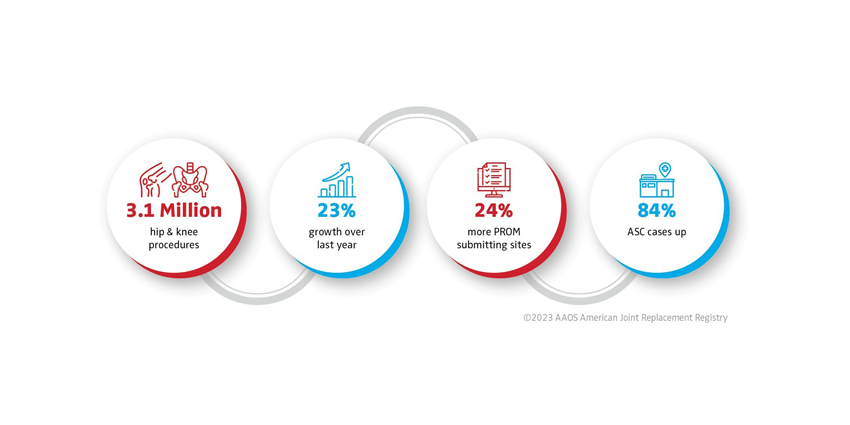
The American Joint Replacement Registry (AJRR), representing more than 3.1 million primary and revision hip and knee arthroplasty procedures performed between 2012 and 2022 (a 23% rate of procedural growth from the last annual report!) is now available.
Insights From American Joint Registry’s Annual Report
3 min read Premium comments
Secondary#americanjointreplacementregistry
According to James I. Huddleston, III, M.D., FAAOS and chair of the AJRR Steering Committee, “The information in this year’s Annual Report gives the most comprehensive picture to date of patterns of hip and knee arthroplasty practice and outcomes in the U.S.”
Specifically, the 2023 AJRR Annual Report presents a decade’s worth of data and in that dataset are illuminating insights, national trends and risk-stratified outcome analyses related to Medicare patients who undergo hip and knee arthroplasty procedures.
Added Dr. Huddleston, “This provides a more complete picture of our patient population and their associated comorbidities and outcomes, including longitudinal outcomes of patients who receive care at non-AJRR participating sites.”
Leveraging the Power of Registry Data to Improve Patient Care
Indeed, this data is meant to be put to work—by the research community, hospital and clinic managers, suppliers, and regulators—all members of the broader musculoskeletal community. Indeed, as the report itself makes clear, its aims are to deliver valuable information to orthopedic surgeons, hospitals, ambulatory surgery centers (ASCs), private practices, device manufacturers, payers and most importantly patients.
Ultimately, its grandest purpose of all is to help clinicians change practice and improve patient outcomes.
The AJRR is the largest orthopedic registry by annual procedure count.
Here are a few intriguing details.
- Patient-Reported Outcome Measures (PROMs) are increasingly being utilized to evaluate the success of a hip or knee arthroplasty procedure. By the end of 2022, 496 participating sites submitted PROMs, which is a 24% increase compared to the previous year. Collection of PROMs data through the KOOS, JR. score revealed that 86% of patients achieved a meaningful improvement after total knee arthroplasty (TKA).
- Ambulatory surgery centers (ASCs) continue to play an increasingly important role in the delivery of total joint arthroplasty care in the U.S. There are now 42,228 procedural cases reported by ASCs, an 84% increase since 2022.
- Hospital discharges to home versus a skilled nursing facility trend upward – Approximately 93% of patients are now being discharged to home following elective primary total hip arthroplasty (THA) with far fewer patients (8%) being discharged to skilled nursing facilities compared to just a few years ago.The percentage of patients being discharged to skilled nursing following primary total knee arthroplasty (TKA) also continues to decrease and now represents less than 6% of all discharges.
- Rate of technology use for assistance in elective primary total hip arthroplasty has increased substantially – Over the past 6 years, the utilization of robotics in TKA has increased over 6-fold and is now reported in over 13% of procedures, whereas computer navigation use has remained relatively stable.According to Dr. Huddleston, the continued collection and analysis of robotic data will eventually allow surgeons to assess the value proposition of these technologies.
- New analyses offer new perspectives on patient outcomes – Additional analyses provided for the first time in the 2023 AJRR Annual Report including hip and knee survivorship comparisons between pre- and post-COVID-19 emergency declaration, revision outcome following revision THA between dual mobility and standard designs, and survivorship among fracture patients treated with THA vs. hemiarthroplasty.
These new analyses offer critical insights into the impact of COVID-19 on patients and shed light on the performance of new technologies and treatment paradigms.
“The publication of the 10th edition of the AJRR Annual Report further validates the commitment of healthcare institutions, clinicians and patients to improving the quality of musculoskeletal care,” says James A. Browne, M.D., FAAOS, chair of the AJRR Publications Subcommittee and editor of the AJRR Annual Report. “The ever-growing submission and compilation of data is driving new insights and fueling our desire to improve the value of care for our patients.”
For slides with figures and data tables as featured in the report, email media@aaos.org.
AAOS Registry Program
The AAOS Registry Program’s mission is to improve orthopaedic care through the collection, analysis, and reporting of actionable data. The American Joint Replacement Registry (AJRR), the Academy’s hip and knee replacement registry, is the cornerstone of the AAOS’s Registry Program, and the world’s largest national registry of hip and knee joint replacement data by annual procedural count, with more than 3 million procedures contained within its database. Additional registries include the Fracture & Trauma Registry (FTR), the Musculoskeletal Tumor Registry (MsTR), the Shoulder & Elbow Registry (SER), and the American Spine Registry (ASR), a collaborative effort between the American Association of Neurological Surgeons (AANS) and the AAOS.
Author
React:
Discussion
This is a fascinating development. In my practice we've seen similar outcomes with the revised protocol. The key differentiator seems to be patient selection criteria. Has anyone else noticed the correlation with BMI thresholds?
Great point. I'd push back slightly on the conclusion, the sample size in the cited study is too small to draw population-level inferences. That said, the directional signal is compelling and worth a larger RCT.
We implemented a similar approach last year. Early results are promising but we're still gathering 12-month follow-up data. Happy to share our protocol if anyone is interested.
Join the conversation
Orthopedic professionals are discussing this. Sign in and upgrade to read every comment and add your voice.