
The FDA has just cleared for commercial sale a novel, 3D printed integrated cervical plate. Just looking at the design, it is clear that this implant is unique.
FDA Clears Novel, 3D Printed Integrated Cervical Plate
2 min read Premium comments
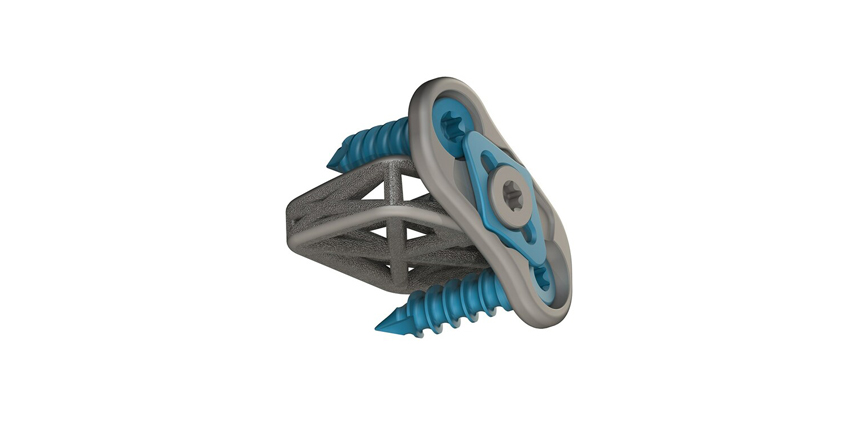
Secondary#4web#cervicalspinetrusssystem#csts
The implant, brand named Cervical Spine Truss System (CSTS) Integrated Plating Solution, is indicated for degenerative disc disease (DDD) of the cervical spine at one or two contiguous levels. This is an anterior implant at C2 to T1 levels of the cervical spine and, as you can see from the design image, each integrated plate is secured to the anterior portion of the cervical spine using two screws.
The manufacturer, 4WEB of Frisco, Texas, told OTW that this design is part of its proprietary Truss Implant Technology™ and is the latest addition to 4WEB’s implant portfolio.
Jonathan Hires, 4WEB’s Director of Research and Development explained some of the key features of the Cervical Spine Truss System (CSTS) Integrated Plating Solution to OTW.
- Plate heights which are sized to the CSTS interbodies – Interbody specific Integrated Plates allows for the plate to be sized and paired with the height of each the CSTS interbodies, no guesswork required by the surgeon.
- Recessed and flush plating options – Depending on surgeon preference, the built in recessed feature of the Integrated Plates allows the interbody to be placed 2mm deeper than the flush plate option.
- Streamlined surgery – The implant can be attached on the OR back table, implanted as a single construct and locks down in a single-step.
- Offset design – The offset design allows for adjacent level implantation without having to worry about screws interfering with each other.
Furthermore, said Hires, “With two product launches in Q3 and regulatory clearance for the integrated plate, we have built significant momentum towards completing the company’s comprehensive cervical portfolio by the end of the year.”
The CSTS Integrated Plating Solution clearance follows several recent milestones including the launch of a non-integrated cervical plating solution and a second-generation cervical interbody fusion device which came to market in Q3. Additionally, the company has previously announced plans to launch an integrated anchor fixation system in early Q4. The expanded suite of products will provide a variety of cervical fusion constructs for varying anatomical needs. With this portfolio expansion and continued product development, 4WEB has established itself as a leader in the cervical interbody fusion market.
“The launch of the CSTS Integrated Plating Solution builds on an already robust product portfolio. We are excited to launch several new cervical products before the end of the year and look forward to capitalizing on this success with significant growth in 2024,” said Geoff Bigos, Vice President of 4WEB Medical’s Spine Division.
About 4WEB Medical
4WEB Medical, founded in 2008 in Frisco, Texas, is an orthopedic implant company. Thirty years of research in topological dimension theory led to the discovery of a novel geometry, the 4WEB, that can be used as a building block to create high-strength, lightweight web structures. The company leveraged this breakthrough to develop 4WEB Medical’s proprietary Truss Implant Technology™. 4WEB was the first company to receive 510(k) clearance for an implant manufactured with 3D printing technology. The 4WEB Medical product portfolio includes the Cervical Spine Truss System™, the Stand Alone Cervical Spine Truss System™, the Stand Alone Anterior Spine Truss System, the Anterior Spine Truss System™, the Posterior Spine Truss System™, the Lateral Spine Truss System™, the Osteotomy Truss System™.
Author
React:
Discussion
This is a fascinating development. In my practice we've seen similar outcomes with the revised protocol. The key differentiator seems to be patient selection criteria. Has anyone else noticed the correlation with BMI thresholds?
Great point. I'd push back slightly on the conclusion, the sample size in the cited study is too small to draw population-level inferences. That said, the directional signal is compelling and worth a larger RCT.
We implemented a similar approach last year. Early results are promising but we're still gathering 12-month follow-up data. Happy to share our protocol if anyone is interested.
Join the conversation
Orthopedic professionals are discussing this. Sign in and upgrade to read every comment and add your voice.