
In the busy, controlled chaos of a leading trauma center, as Dr. Evengy Dyskin, Clinical Assistant Professor of Orthopaedics, University of Buffalo, explains; “It is critical that we respond quickly to manage the damage to the impacted limb,” and, the innovation of all-inclusive sterile kits, “eliminates spatial constraints, enabling application in a trauma bay or intensive care unit setting, which would not be possible with a traditional pin-to-bar system.”
Novel Sterile Kits for Orthopedic Trauma Launched
2 min read Premium comments
Secondary#orthofixmedical#anklefracturetrauma#calcaneusfracture
Sterile kits are one of the key innovations in orthopedics and are improving patient safety and care from ambulatory surgery centers to, in this case, acute trauma, military and humanitarian crisis settings.
Sterile kits eliminate the need for sterilization of trays which takes an average of 139 minutes1 to process and adds cost to healthcare facilities. Sterilization of trays also results in increased operating room (OR) delays and costs due to packaging, restocking, and tray contamination. Average cost to a facility for OR delays related to tray contamination is $1,0811 which can be avoided through the use of prepacked sterile kits.
Galaxy Fixation Gemini System
The system Dr. Dyskin was referring to above is from Lewisville, Texas-based Orthofix Medical Inc. It was recently launched and has completed its first few cases.
The new system is an extension of Orthofix’s Galaxy fixation line. The Gemini™ system is a stable external fixation system that comes in several sterile procedure kit configurations. They are quick, off-the-shelf solutions for treating fractures that result from trauma in the lower and upper limbs.
Ankle Trauma Fixation
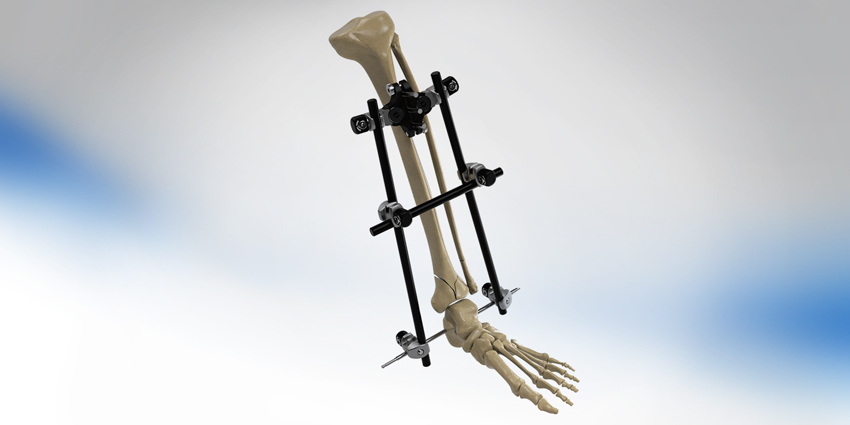
In cases of ankle trauma, the Galaxy Fixation Gemini™ ankle kit is the only pin-to-bar system with specific clamps in a sterile kit configuration. For surgeons, that means greater efficiency—particularly when time matters most.
The ankle kit includes a double multiscrew clamp for rapid insertion of tibial half-pins and includes the foot support and first metatarsal sterile kits—in case you need a more robust construct.
How big a deal is this? Well, there are, Orthofix estimates, 187 ankle fractures per 100,000 persons per year in the U.S.2
“We are excited to expand our external fixation offerings in the U.S. for trauma through the introduction of the Galaxy Fixation Gemini System in several sterile packed configurations,” said President of Global Orthopedics Kim Elting. “This streamlined pin-to-bar configuration is the latest example of our leadership in sterile kit solutions, which improve OR efficiencies and meaningfully decrease costs for the hospital and also for our business.”
Sterile Calcaneal Fracture Kits, Too
In addition to the Galaxy Fixation Gemini ankle kit, the company rolled out, earlier this year, a sterile kit for calcaneal fractures. The kit is brand named, CalcFix Plus Calcaneal Minifixator™ System and it is the latest version of Orthofix’s CalcFix Fixator device—which was originally designed to treat calcaneal fractures using a more minimally invasive external fixation approach compared with internal fixation.
All in all, Orthofix offers an impressive portfolio of more than 50 sterile kit procedural solutions.
A large part of Orthopedic’s future is about just these kinds of off-the-shelf solutions that meet the time and cost needs as well as the never-ending demand for better outcomes in the acute trauma, military and humanitarian crisis settings.
1 Ly JA, Wang WL, et al. Arch Bone Jt Surg, 2022 May; 10(5): 420-425.
2 Source (SmartTrack, 2023).
Author
React:
Discussion
This is a fascinating development. In my practice we've seen similar outcomes with the revised protocol. The key differentiator seems to be patient selection criteria. Has anyone else noticed the correlation with BMI thresholds?
Great point. I'd push back slightly on the conclusion, the sample size in the cited study is too small to draw population-level inferences. That said, the directional signal is compelling and worth a larger RCT.
We implemented a similar approach last year. Early results are promising but we're still gathering 12-month follow-up data. Happy to share our protocol if anyone is interested.
Join the conversation
Orthopedic professionals are discussing this. Sign in and upgrade to read every comment and add your voice.