
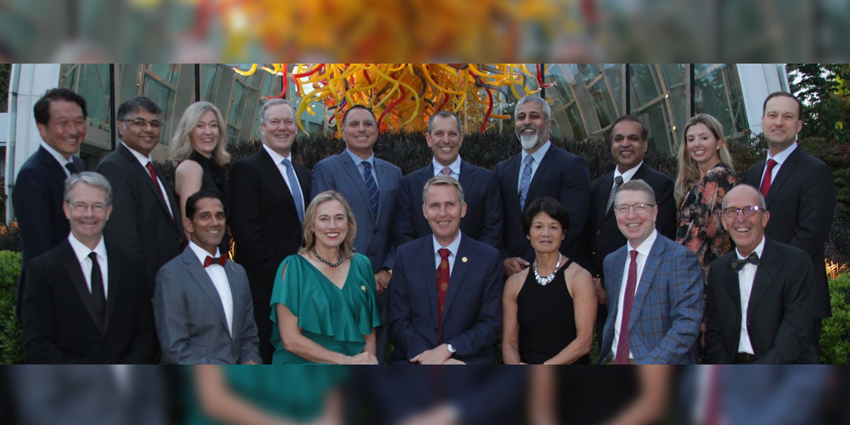
One of the oldest and most revered spine surgery societies, The Scoliosis Research Society (SRS), has elected a new president and present—in honor of its 60th year of exemplary research, advocacy, education, and innovation in the field of spinal research and surgery—its new board of directors.
Congratulations SRS on a Magnificent 60 Years!
2 min read Premium comments
#scoliosisresearchsocietySecondary#marinusdecleuver
Each year, the society advances a Board of Directors who are dedicated to furthering innovation and education for physicians treating spine deformity. SRS’s board represents leading spine surgeons and researchers from Europe, Asia, Canada, and the U.S.
On September 9, 2023, in Seattle, Washington, Marinus de Kleuver, M.D., Ph.D., accepted the role as SRS’s new president.
Prof. de Kleuver is the third international president for the Society.
Here are the members of SRS’s 2023-2024 Board of Directors.
- Marinus de Kleuver, MD, PhD, President
- Laurel C. Blakemore, MD, President Elect
- Suken A. Shah, MD, Vice President
- Serena S. Hu, MD, President I
- Christopher I. Shaffrey, MD, Past President II
- David Skaggs, MD, MMM, Treasurer
- Ferran Pellise, MD, PhD, Secretary, Governance Council Chair
- Parveen V. Mummaneni, MD Secretary Elect
- Ron El-Hawary, MD, Communication Council Chair
- Munish C. Gupta, MD, Education Council Chair
- Douglas C. Burton, MD, Research Council Chair
- Justin Smith, MD, Research Council Chair Elect
- Lindsay Andras, MD, Director at Large
- Firoz Miyanji, MD, FRCSC, Director at Large
- Kota Watanabe, MD, PhD, Director at Large
- Eric O. Klineberg, MD, Director at Large
- Micheal G. Vitale, MD, MPH, Director at Large
- Michelle C. Welborn, MD, Director at Large
For 60 years, the Scoliosis Research Society has been an essential society for spine and neurosurgeons. At its first annual meeting, hosted by Dr. John Moe and Dr. Robert Winter, 37 physicians laid down the foundation for this exceptional society. They approved a constitution and bylaws and decided to call themselves the Scoliosis Research Society.
Very quickly, this society became a font of research, innovation, and rigorous scientific inquiry. In 1968 SRS published the first natural history study of scoliosis, Dr. Alf Nachemson’s “A Long Term Follow-Up Study of Non-Treated Scoliosis.”
The publisher was Acta Orthopaedica Scandinavica. It was the first paper to report on a large series of untreated scoliosis patients. While it did not have x-ray information nor, we now know, accurate diagnoses, it still was an influential report and documented mortality rates for untreated severe scoliosis due to cardiopulmonary disease. That same year, Dr. G. Dean MacEwen presented the first SRS morbidity report which included neurological complications in scoliosis.
From those auspicious and hopeful beginnings has come this magnificent non-profit, world leading educational and research organization dedicated to understanding and treating spinal deformity.
To join or contribute, please visit www.srs.org for further information.
Author
React:
Discussion
This is a fascinating development. In my practice we've seen similar outcomes with the revised protocol. The key differentiator seems to be patient selection criteria. Has anyone else noticed the correlation with BMI thresholds?
Great point. I'd push back slightly on the conclusion, the sample size in the cited study is too small to draw population-level inferences. That said, the directional signal is compelling and worth a larger RCT.
We implemented a similar approach last year. Early results are promising but we're still gathering 12-month follow-up data. Happy to share our protocol if anyone is interested.
Join the conversation
Orthopedic professionals are discussing this. Sign in and upgrade to read every comment and add your voice.