
Dr. Mark Reiley, best known as the creative engine behind Kyphon (bought by Medtronic), Archus (bought by Globus), Reiley Orthopedics, (triangular fusion rods for hands and feet—bought by Wright Medical), IN-BONE Total Ankle, (also Wright Medical), SI-BONE triangular fusion rods for the Sacra-Iliac Joint (IPO October 2018) and Reiley Pharmaceuticals (agent to exactly locate the source of pain using beta-camera), is also an artist who has produced—we kid you not—more than 400 gallery-quality works of art.
The Creative Force Named Mark Reiley, M.D.
6 min read Premium comments
#Markreiley
In fact, during that period in his life when Reiley was writing several hundred patents and founding or co-founding nine medical device companies, he was churning out incredible paintings. At his moment of greatest device and corporate productivity, his artistic output literally doubled.
The life of Reiley is a creation story.
The Etiology of Art and Creation
The root word in ‘creativity’ is “create.” As in the “act of creation.” It’s hard work. Really good artists and engineers can look at the world in new ways, find hidden patterns and connect seemingly unrelated spatial phenomena in order to create something.
Their processes are profound, subjective and complex because they are derived from personal perceptions, emotions, memories and both formal and informal education. In Reiley’s case, what emerged made hundreds of thousands of patients lives better but also, through his glorious art, thrilled and inspired.
One of the jokes about former President Bill Clinton, is that as a child in Hot Springs, Arkansas, he was so smart that his friends used to come over to his house just to watch him think.
The joke is that thinking is invisible. It becomes visible, in reality, when an artist or engineer engages in the reductive act of converting ideas into things.
In reverse, when we look at art, or read a book or hold in our hands an innovative implant, we receive a bit of the creator’s gestalt and can, sometimes, experience a new way of thinking, seeing or empathizing.
Engineers and artists, despite possessing different aims, use reductive processes to turn vague, perhaps disorganized complex thinking and feeling into specific works of art or inventions.
Another way of saying this is: artists use a particular language, medical device inventors use a different language, but their creative processes are related.
Mark Reiley finds both refuge and inspiration in the language of form, line, color and light—which, in turn, informs his other language. Mark’s inner world flows through his hands, his brushes, pens and CAD/CAM to create…things that rise to “art” in its broadest and most profound sense.
Jeff Dunn has been CEO of three companies that were based on Mark Reiley inventions, most recently SI-BONE. Jeff is Mark’s longest and arguably most successful business partner. “I think Mark is about as out of the box, as unfollowing as any person I’ve ever met on earth,” said Dunn to OTW. “He really doesn’t care what other people think, he is a pioneer in the truest sense of that word.”
“His brain is packed with processing power. Ninety eight percent of his focus is trying to figure out new things, spatially. Mark is a spatial thinker. In the device world, one size doesn’t fit all. God made everyone’s body parts differently. People need different solutions. To invent an implant, you have to think spatially and functionally.”
“There’s very few people who make that link like Mark Reiley does. That is what makes Mark special.”
Mark Reiley the Visual Artist
Mark and his wife spoke to OTW about his art. They explained that his visual work represents and reflects who Reiley was and what he was thinking at the time of each painting. His paintings reflect his personal trials; his sentiments, empathy, nostalgia, moods and feelings for anything around him.
Early in his medical career, Mark’s painting reflected the sentimental and solitary side of his life at the time. For example, “The Surgical Internship,” “Going Home,” “A Walk in the Rock Creek Park,” represent him dealing with his private side while becoming a surgeon and medical innovator.
The more pressure he had as a surgeon and inventor, the more prolifically he painted. That’s the decade from 1985 to 1995. No matter how busy and crazy his day job was, every Tuesday evening and Saturday (if no ER calls arose), he would be in front of canvas or studying art history.
Painting has become a part of him. The process, the creation, the finished painting—all came to represent that most intimate and revelatory of human needs—solace, peace, nature, and beauty.
“Painting gave me a sense of who I was at that time. It made me a better medical intern and allowed ideas to flow in naturally from God knows where to see inventions.”
Getting Started
“I began painting in 1971, on the average ten paintings a year” said Reiley. “That starts to mount up to quite a few paintings in a pretty short period of time. Even if one is throwing away half the paintings every year, they still mount up quickly. By the time I started medical school I had over fifty framed and finished paintings. That was still less than five percent of the paintings I was yet to do over the next forty-five years. It got to be a standing joke with the framers and I, who knew I didn’t show or sell any work, and would say, ‘Oh you don’t want to spend much framing this one.’”
“During my internship I painted one piece. It took fifty-two weeks—the same length as the internship. It was a painting of a huge glacier at night, one tiny campfire, and a guesstimated temperature of forty-eight Kelvin. That was the way I felt as a surgical internal at UCSF.”
“The next three years I shot out of the blocks so to speak. I was cranking out three paintings a week. I had a new teacher who knew the Impressionists inside and out. She even knew how to mix their colors from raw pigments. Learning that instruction allowed no confusion for matching up a color from week to week. Monet, Caillebotte, Sisley, and Renoir invented the greatest movement in art of all time. And remember they were fighting rigid art critiques like George Beaumont who said a good painting should be like a good violin—all brown.”
Mentors and Inspiration
“My mother will always be my greatest inspiration. She painted for no reason. She just needed to paint. She was a good painter and did one or two exceptional paintings, but the overwhelming influence if her artistic expression became the bulk of pieces she left behind.”
Pieter de Hooch: “I painted a piece as a tribute to Pieter de Hooch. A brilliant painter in his own right and there was more than a little controversy whether he had more influence over Vermeer or vice versa. That comparison to me is unimportant. Pieter de Hooch lost his vision at a young age. I painted him a house with no ceiling and a telescope so he could look outside when he could.”
Georges Braque: “The only other artist I painted a tribute for was Georges Braque because of his injury in World War I and his subsequent loss of friendship with Pablo Picasso.”
David Hockney: “For the living artist, David Hockney is a jewel and I wish he did more work.”
The Mark Reiley Collection

There is a book which is a retrospective of Reiley’s major artworks, and it shows his evolution over the last forty years. About 50% of Reiley’s works over the last forty years have wound up in this 2014 book.
The book also includes Reiley’s medical inventions as they occurred during the flow of his paintings. It loosely illustrates the two languages and how, in Mark Reiley, they’ve supported each other to create this art and these amazing medical innovations.
More of Mark Reiley’s art is available at www.RZARTs.com.
Artwork:
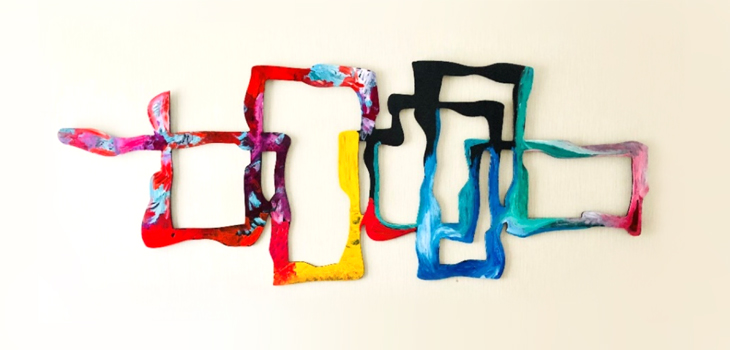
1) “Whatever Happened to the Starship Enterprise?” Multimedia on canvas, over a year in the making—I’m not sure how I did it.
2) Truly a study of when to finish a painting. I was about to render a bridge over the Deft River in form of a De Hooch. This far through the sketch my wife told me to stop.
3) This is part of seven-part series on wine. Multimedia on canvas. The EUA is the last part of Chateau Margaux. It is also water.
Author
React:
Discussion
This is a fascinating development. In my practice we've seen similar outcomes with the revised protocol. The key differentiator seems to be patient selection criteria. Has anyone else noticed the correlation with BMI thresholds?
Great point. I'd push back slightly on the conclusion, the sample size in the cited study is too small to draw population-level inferences. That said, the directional signal is compelling and worth a larger RCT.
We implemented a similar approach last year. Early results are promising but we're still gathering 12-month follow-up data. Happy to share our protocol if anyone is interested.
Join the conversation
Orthopedic professionals are discussing this. Sign in and upgrade to read every comment and add your voice.