
Kyocera, whose founder Kazuo Inamori built one of the world’s foremost material sciences companies with a ‘yes, we can’ engineering philosophy, is (unbeknownst to most U.S. orthopedic surgeons) one of Japan’s leading orthopedic implant suppliers.
Here Comes Kyocera
7 min read Premium comments
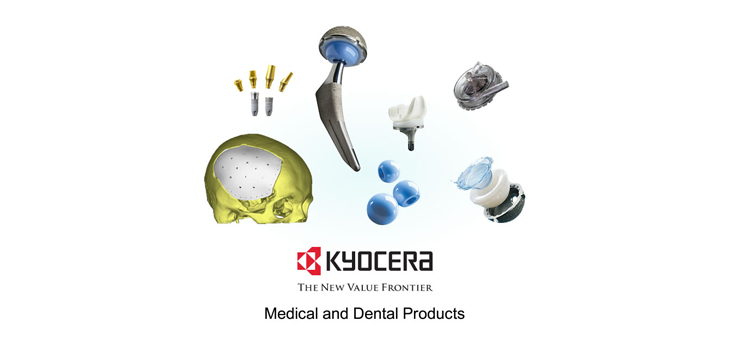
#kyoceracorporation
The company supplies innovative yet affordable large joint, trauma and extremity implants—and courtesy of a 2019 asset purchase from U.S. spinal implant company Renovis, spinal implants too.
In its 2019 annual report, Kyocera announced that entering the U.S. orthopedics market was a top strategic priority.
We spent two days at Kyocera, listening to senior managers and checking out the U.S. product portfolio. We were “wow-ed” and we think you will be too. U.S. surgeons, we believe, are in for a real treat in 2020.
Material Sciences in Orthopedics
Our industry, of course, relies on material sciences to deliver ever-improving patient outcomes.
Charnley’s “eureka” moment, for example, was courtesy of ultra-high-molecular-weight polyethylene. Later, titanium replaced stainless steel. Ceramics extended longevity of articulating components. Hydroxyapatite, bioglass and other biologically active materials improved the implant bone interface. Porous metals and ceramics took osseointegration to the next level.
Today, powdered titanium is fueling the 3D-printed implant revolution.
In the world of material sciences, Kyocera is the company to get to know.
Kyocera’s Journey to Medicine and, Specifically, Orthopedics
Kyocera built its reputation in the engineered ceramics and the legendarily brutal semiconductor components businesses.
Kyocera founder Kazuo Inamori was the first in Japan to synthesize forsterite, which he used to create a unique “kelcima” insulator in early television picture tubes. His “yes, we can” engineering philosophy fueled a steady stream of advanced technology ceramic components for, first, the exploding television market and then, in the 1960s, 70s and 80s, the massive electronics, computer and integrated circuit chip industries.
Kyocera’s ceramics were part of NASA’s space programs from Apollo to the Mars Rovers. Kyocera was the first company to tackle the impossible problem of building a portable, battery powered computer (the legendary TANDY Model 100 notebook PC). The company Inamori built became part of virtually every iteration of the integrated circuit chip since 1969—and semiconductor components remain among Kyocera’s core businesses today.
You likely have Kyocera’s ceramics in your smartphone.
(Of course, having grown up in the semiconductor industry, Kyocera knows more than little bit about pricing pressures).
Inert, biocompatible and durable, ceramics are a natural material for orthopedic implants. Kyocera, with roughly 10,000 patents in ceramics science and other technologies, is an equally natural supplier to the orthopedic industry.
Kyocera’s first medical device was a ceramic dental implant launched in 1978—in Japan.
Hip, knee, shoulder and other implants followed—all with advanced material technologies, and virtually all in Japan.
In 2004 Kyocera teamed with Kobe Steel to create new medical device synergies. Two years ago, Kyocera bought out Kobe’s share and pulled the enterprise into Kyocera proper.
Four decades on, Kyocera has become a leading supplier of orthopedic implants in Japan. Remarkably, U.S. surgeons are largely unaware of Kyocera’s truly unique orthopedic implants.
In March 2019, as part of the priority to build a presence in the U.S., Kyocera bought the assets of Redlands, California-based Renovis Surgical Technologies, a manufacturer and supplier of orthopedic implants.
It is worth noting that Kyocera’s “succeed-first-in-Japan, then-come-to-the-U.S.” approach is a path many other Japanese companies have followed. Toyota in cars, Panasonic in electronics and Nintendo—located just down the street from Kyocera in Kyoto—to name three great success stories.
Three Cool Technologies We Saw at Kyocera…
Three Kyocera technologies which are sold exclusively in Japan will, when introduced to U.S. surgeons, we think, trigger thousands of “aha” moments. They are: Aquala, AG-PROTEX and BIOCERAM AZUL.

Aquala – smoother, reduced friction articulation. Imagine (or just look at the embedded video) a better, smoother articulating hip implant. Kyocera’s Aquala hip socket uses hydrophilic and biocompatible polymers that, in effect, create a thin layer of water between ball and socket.
That water layer creates a smoother, reduced friction articulation and less component wear.
Kyocera’s innovative MPC polymer features biomimetic “synthetic phospholipids” that replicate the surface of human cartilage. MPC is the Aquala liner.
Other liners are hydrophobic—they repel water, thereby forcing the ball to articulate directly against the liner surface.
Kyocera’s Aquala with the MPC polymer has an affinity for water (hydrophilic) and so the body’s fluids naturally form a thin layer of water between ball and socket.
In July 2018, Aquala won Japan’s top scientific prize, the “Prize of the Minister of Economy, Trade and Industry.” It was presented to Kyocera during the 2018 National Invention Awards by the Japan Institute of Invention and Innovation.

AG-PROTEX – The chemical symbol for silver is AG. AG-PROTEX is a hydroxyapatite (HA) coated implant which elutes silver ions—very clever.
Silver ions interfere with the ability of planktonic bacteria to adhere to the surface of the implant—thereby reducing the risk of biofilm and ultimately, peri-prosthetic infections.
Silver is a well-known antibacterial agent and is routinely used to treat burns and heal chronic ulcers.
Combining silver with HA is, as we said, clever. HA, of course, is another ceramic which has the well-known effect of improving osseointegration and enhancing the bone-implant interface.
Finally, both of these materials are applied to the implant using Kyocera’s advanced thermal spraying techniques.

BIOCERAM AZUL – a tougher ceramic joint. In 2000 Germany’s CeramTec received FDA approval for a new generation of ceramic heads—zirconia toughened alumina. Kyocera’s AZ209, also a zirconia toughened alumina, received FDA clearance in 2016.
Both products represented a significant improvement in hip component durability.
In the U.S., CeramTec’s BIOLOX dominates ceramic head sales. In Japan, Kyocera’s BIOCERAM AZUL rules.
What’s the difference?
According to Kyocera, the unique mechanical characteristics and phase stability of BIOCERAM AZUL’s is due to the following key attributes:
- Fine grain
- A particular alumina/zirconia ratio
- Unique intended additives
- Homogeneous dispersion of the zirconia grain
- An optimized sintering and HIP (hot isostatic press) treatment
During manufacturing, both firms are under a strict requirement to control alumina grain size and to keep it as fine as possible.
Kyocera addressed that issue (see chart below) by using Cobalt ions, which are chemically stable, to form platelet-shaped grains between the zirconia and alumina particles. The result, according to Kyocera, is a more stable ceramic head.
Finally, CeramTec’s BIOLOX is pink, Kyocera’s BIOCERAM AZUL is blue.
Kyocera vs. CeramTec. Blue or Pink?

…And One We Saw in America

Assets Kyocera acquired from California-based Renovis include a unique form of 3D-printed implant. It is called Tesera Trabecular Technology (T3) and as you can see in the accompanying image, it creates a solid titanium base and then during the same additive manufacturing process builds a porous section at the surface where the implant meets bone.
This is NOT A COATING, but rather an integral part of the implant. T3’s modulus is within the range of cancellous bone.

Presently, T3 is available in Kyocera’s spinal and the large joint implants and, soon, in the extremity implants as well.
Finally, Most Importantly, a Few Words About Kyocera’s Founder, Kazuo Inamori
We close this article about Kyocera with three anecdotes about its founder, Kazuo Inamori. These small stories illustrate the quality of the culture Inamori built at Kyocera and why, we think, it is well suited to the Orthopedic Industry, your hospital and you.
- Inamori founded Kyocera with 28 employees and just $28,000 in capital. He operated his company by encouraging innovation and pushing decision making down to the lowest possible levels of management—so-called “amoeba management.” This allowed Kyocera to be a rapid and nimble innovator. Among Inamori’s admirers was an early Bill Gates, who partnered with Inamori and Kyocera to create the legendary Tandy 100.
- Inamori retired from Kyocera shortly after turning 65 to become a Buddhist monk. He wrote at the time that he was studying Zen Buddhism “not for the benefit of corporate management” but to “elevate [his] mind [and] purify [his] soul,” in preparation for death.
- In his 78th year, the Japanese government asked Inamori to save Japan Airlines (JAL), which had plunged spectacularly into bankruptcy. Inamori transformed JAL by applying his famous “amoeba management” style. In 2012, JAL returned to the public market, pricing its IPO at $8.5 billion—top of the range.
Inamori’s philosophy, which permeates Kyocera, is best described as “Doing the right thing as a human being.” The medical division has applied Inamori’s style by adopting the following core business practice precepts:
- We provide products which we would use on our own family members
- We conduct business guided by the view that patients are no different from our own families
- We gain fulfillment when patients feel well, their smiles the source of our energy
- We offer peace of mind and reliability to surgeons striving to do their best for the well-being of patients.
So, in 2020, take a moment to stop by the Kyocera Booth at AAOS or any of several other meetings. Ask about Inamori. Ask them “What’s new?” And enjoy the process of getting to know one of the more interesting and innovative “new” players in the U.S. orthopedic industry.
Author
React:
Discussion
This is a fascinating development. In my practice we've seen similar outcomes with the revised protocol. The key differentiator seems to be patient selection criteria. Has anyone else noticed the correlation with BMI thresholds?
Great point. I'd push back slightly on the conclusion, the sample size in the cited study is too small to draw population-level inferences. That said, the directional signal is compelling and worth a larger RCT.
We implemented a similar approach last year. Early results are promising but we're still gathering 12-month follow-up data. Happy to share our protocol if anyone is interested.
Join the conversation
Orthopedic professionals are discussing this. Sign in and upgrade to read every comment and add your voice.