
Julius Wolff, born 1836, postulated that bone, a living tissue, will adapt to stresses and strains. If loading forces increase, bone, he said, will remodel and become stronger. The opposite is also true. If loading decreases, then bone becomes less dense and weaker.
3D Printed Implants – Wolff’s Law in Action?
7 min read Premium comments
#spinesurgery#4webmedical#wolffslaw
In short, Wolff’s Law states that mechanical stimulus is a key requirement for bone growth.
The phenomena of converting forces or other mechanical signals into biochemical signals is known as ‘mechanotransduction.’
There are four basic steps from simple loading (like lifting weights) to bone thickening. They are: mechanocoupling, biochemical coupling, signal transmission and cell response.
Scientists who’ve studied Wolff’s Law say that when loads are applied to healthy living bone, fluid flows away from areas of high compressive loading. Osteocytes, the most abundant cells in bone, are also the most sensitive to such fluid flow caused by mechanical loading.
When osteocytes sense a load, they transmit signals to osteoprogenitor cells, which then may differentiate into osteoblasts or osteoclasts.

Do 3D-printed spine implants trigger mechanotransduction?
Spine implants are currently experiencing a renaissance of design because of advances in additive manufacturing techniques, also known as 3D printing.
Such 3D-printed implants, notably those with a strut-based architecture, appear to behave differently than legacy ring-shaped implants with solid material construction.
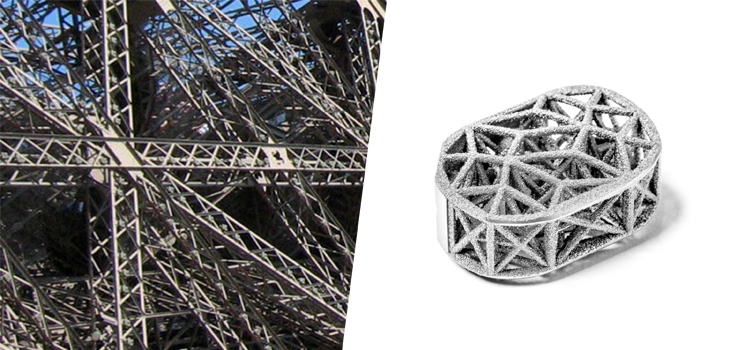
A number of biomechanical experts, clinicians and researchers are now saying that the natural load that the patient would place on the implant is being distributed through the struts and truss structures of these new designs and that the localized strain that the struts transfer to adjacent cellular material appear to be putting Wolff’s Law to work in the intervertebral space.
To find answers, OTW posed this question: “Do 3D printed spinal implants, and more specifically, Truss based implants trigger a mechanotransduction response?” to Jessee Hunt, CEO of 4WEB Medical, one of the earliest suppliers of 3D or additive printed spinal implants.
He told OTW: “We use a term, ‘mechanobiology’ to describe what is happening in vivo at the interface of biology and engineering and describes how physical forces can affect cells, tissues and stimulate cell differentiation, gene expression, physiology and healing.”
“This is Wolff’s Law at work, in other words. Wolff’s Law describes how bone senses strain which then triggers a remodeling response to optimize its structure in order to exist in its environment efficiently.”
“Under normal loading conditions, our implants, which are based on a truss design, distributes load through the struts in the implant’s web structure. These struts then transfer that strain to adjacent tissues triggering a cellular mechanobiologic response. We have studies that show cells and cellular matrices, that are attached to the implant struts, receiving strain forces and responding via mechanotransduction.”
“It’s that transduction and osteogenic cellular response that we believe accelerates the healing process. This is what Truss Implant Technology is all about.”
The Surgeon’s Perspective
We checked in with one of the orthopedic spine surgeons at the Rothman Orthopaedics Institute, Kris Radcliff M.D. Dr. Radcliff is an associate professor in the Department of Orthopedic Surgery at Thomas Jefferson.
When we asked him how the new truss-based implants have a qualitatively different way of interacting with boney interface and fusion bone growth, he immediately started talking about motion—or lack thereof
“I learned early in my orthopedics residency about the importance of motion to bone healing. There was tremendous euphoria when locking plates for periarticular fractures emerged during my orthopedic residency. However, with early locking plates, there were problems with nonunion due to excessive rigidity. Our specialty took a step back and realized that you have to have some controlled micromotion for bone healing.”
“Compared to traditional cages, truss implants permit controlled micromotion. One of the unique features of additive manufactured implants is that they exploit strain distribution creating small, localized deflections that help bone grow.”
“The truss thickness can be engineered for a specific bony strain. It is an established principle in orthopedic surgery that small amounts of controlled strain or deflection stimulates bone growth.”
We asked Dr. Radcliff if there was something innate in this architecture that makes this interface more “bone friendly” than other implants.
“Implants,” Radcliff pointed out, “are, in essence, about two basic properties—the material they are made from and their structure. Modulus is a material property that is dependent on whatever the implant is made of—whether carbon fiber, titanium, PEEK, or even PMMA. Each one has a specific unique set of properties.”
“Rigidity is a structural property which can be independent of the material. Additive manufacturing has allowed for the development of really unique, smart structures. For example, some of these new designs (and I use 4WEB’s Truss design) distribute compressive and tensile forces evenly throughout the implant.”
“Let’s say the left side of the cage is being loaded more than the right side and disc space is a little bit tighter on the left. The implant’s struts redistribute the load throughout the rest of the web structure, even on the right side of the implant and thereby help to normalize forces throughout the implant.”
Can 3D printed implants reduce biologics use?
It occurred to us as we were talking with Dr. Radcliff that these new truss-based 3D-printed implants, by creating a new kind of bone/metal interface, could affect the need for advanced biologics. We posed the question to Dr. Radcliff and here is what he said.
“Yes, I think it does, indeed, enable me to use kind of a simpler, less expensive biologic. There is an increasing resistance from the payers and hospital value analysis committees about biologics. I regularly get insurance denials of cellular biologics. Since the 4WEB cage is actively involved in stimulating bone differentiation, I feel much more comfortable with just a simple DBM [demineralized bone matrix] biologic or local bone in many of my cases.”
“I’ve been using these implants for about probably 5-6 years in the cervical spine. I was an allograft user before I switched to 3D-printed truss-based cages. The problem with allografts is that every now and then there would be an allograft that would not fuse properly. You wonder what exactly is going on there. I like the fact that these additive manufactured implants not only provide the structural support but will also transmit mechanical stimuli to improve and potentially accelerate bone growth.”

“We just completed a study that was accepted to SMISS [Society for Minimally Invasive Spine Surgery] that compares markers of osteoblast differentiation with titanium discs manufactured with the 4WEB process versus smooth titanium and PEEK. Even without any mechanical loading the 4WEB surface showed a significant increase in gene expression. So, the surface roughness alone is stimulating a cellular response and then that response is amplified through the mechanobiologic properties of the truss implant design.”
“I’m especially impressed with 4WEB Medical’s truss design because it can deliver compression and tension forces throughout the entire construct. In many ways, the design optimizes the bones biologic response.”
The “Snowshoe” Effect
4WEB’s Jessee Hunt also mentioned something to us that kind stuck. And that is this idea of a “snowshoe” effect their 3D printed implants have.
“If you think about the top and bottom web structure of the 4WEB implant we have a web structure that spans across the entire bone interface in contrast to ring-shaped implants that have concentrated amounts of material around the rim. Our bone interface web structure distributes load over a larger surface area and essentially behaves like a snowshoe. This helps to prevent the implant from sinking into the adjacent bone and reduces the chance of subsidence.”
“It’s really exciting that we can engineer an implant that can withstand the significant strain that the human body can have on an implant, have that implant participate and accelerate the healing process, knowing that these implants mostly of air. The truss design allows for a minimal amount of structural material with an optimal amount of strength. In some designs only 25% of the implant volume is titanium and the rest is open space for graft material and bone to grow.”

How well do 3D implants handle the loads in the spine?
According to Hunt, the Truss Implant TechnologyTM, which is the foundation of the 4WEB family of implants, is “based on a triangular unit cell that is not susceptible to shear failure. When you load a triangle-based space truss the geometry resists that load no matter what direction the load is coming from. If you look at the more generic micro lattice structures that are in the market, they’re mostly rectangular or square based unit cells. If you have a square and you apply load to one of its corners, the square will collapse. It’s about the efficiency of the geometric unit cell.”
“Truss structures and truss technology are at the core of almost every building, bridge and highway that exists. When done right structures designed with these well-established engineering principles are extremely reliable and efficient. Due to advances in additive manufacturing we can now apply structural engineering principles such as truss design to the human body for the first time.”
Bottom Line
Five years ago, perhaps longer, the conventional wisdom among orthopedic spine surgeons and neurosurgeons was that advanced biologics, living cell implants for example, would be the next generation of osteoinductive implants.
And several of those did, indeed, come to market.
Today however, focus appears to be less on biologics and more on creating novel, open architecture implants with surface features that create a bioactive response which can be amplified through a mechanobiologic mechanism … essentially putting Wolff’s Law to work.
This, ultimately, may well prove to be a more cost effective, simpler strategy that drives the healing process towards successful fusion surgeries.
Author
React:
Discussion
This is a fascinating development. In my practice we've seen similar outcomes with the revised protocol. The key differentiator seems to be patient selection criteria. Has anyone else noticed the correlation with BMI thresholds?
Great point. I'd push back slightly on the conclusion, the sample size in the cited study is too small to draw population-level inferences. That said, the directional signal is compelling and worth a larger RCT.
We implemented a similar approach last year. Early results are promising but we're still gathering 12-month follow-up data. Happy to share our protocol if anyone is interested.
Join the conversation
Orthopedic professionals are discussing this. Sign in and upgrade to read every comment and add your voice.