
After 45,000 implants outside the United States and 16 years of hard work, the elegantly designed M6 Artificial Cervical disc has been approved for sale in the U.S. The study that supported the FDA approval reported that patients who’d received the M6 experienced statistically significant pain relief which was higher than that reported by study patients receiving the standard anterior cervical disc fusion (ACDF).
Here Comes Orthofix’s M6 Cervical Disc
7 min read Premium comments
#orthofix#discarthroplasty#m6cerficaldisc
The M6 Cervical Disc Implant
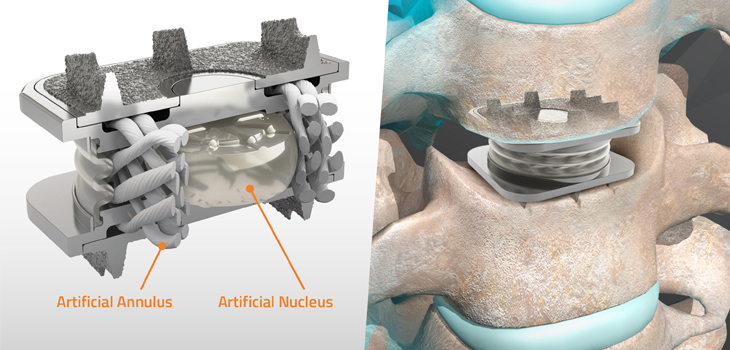
The M6 is a one-of-a-kind motion preserving spinal disc implant.
It is the only artificial disc with an artificial nucleus (made from polycarbonate urethane) and a virtual annulus (made from polyethylene). It is also the only motion preserving disc implant whose original design objective was to mimic as closely as possible the “natural” movement—in all planes and all axis—of the native spine disc.
Here is how the engineers who created the M6 accomplished that design objective.
 | Artificial Nucleus
|
 | Artificial Annulus
|
 | Sheath
|
 | Fixation
|
The M6 Clinical Study
The M6 received CE mark approval for sale in Europe in 2006 and, prior to receiving FDA approval in February 2019, had been implanted in more than 45,000 patients. So, even before this study’s outcomes were available to physicians in the U.S., there was a significant amount of clinical information about this disc.
The U.S. Investigational Device Exemption (IDE) study stood, in many respects, on the shoulders of the international investigators who have been using M6 since 2005.
The U.S. IDE study for M6 was a prospective, concurrently controlled, multi-center study. Among the sites that participated were Hospital for Special Surgery, Indiana Spine Group, Midwest Orthopaedics at Rush, Carolina Neurosurgery and Spine, Texas Back Institute, Stanford University Hospital and the Desert Institute for Spine Care in Phoenix.
The main objective of the study was to evaluate the safety and effectiveness of the M6-C artificial cervical disc at 24 months post-surgery. The control in the study was anterior cervical discectomy and fusion (ACDF).
Investigators enrolled patients with degenerative cervical radiculopathy which was confirmed clinically and radiographically, at one vertebral level from C3 to C7. A total of 258 subjects were enrolled at 13 sites.
The first patient was enrolled in May 2014.
Here is a summary of the results.
- Pain
- 91% of the M6 patients reported arm pain relief that qualified as clinically meaningful
- Versus 78% of the control arm patients (ACDF) reported clinically meaningful arm pain relief
- 91% of the M6 patients reported neck pain relief that was clinically meaningful
- Versus 80% of the ACDF patients reported neck pain relief that was clinically meaningful
- Pain Medication Use
- Before surgery more than 81% of the patients were taking pain medication
- After M6 Cervical disc, 14% of the patients continued taking some type of pain medication
- After ACDF, 38% continued taking some type of pain medication
In earlier M6 studies, the length of stay for patients receiving M6 averaged four hours.
“Elegant Implant”
Rick Sasso, M.D., founding member and president of Indiana Spine Group, professor and chief of spine surgery at the Indiana University School of Medicine, Department of Orthopaedic Surgery, was one of the investigators for the M6 trial. He also was its most prolific patient enroller.
He described the M6 cervical artificial disc to OTW. “The M6 is the most elegantly designed disc. It has the advantage of providing axial compression and dampening properties. All the other discs with the single exception of the Bryan disc, do not allow compressive motion in an axial plane. I love this design.”
“When we decide to use a motion preserving implant, we are striving to restore ‘normal’ motion in the cervical vertebral segment. One aspect of that motion that all the other discs ignore is the importance of dampening motion in the axial plane. The other cervical motion preserving discs are hard-on-hard—meaning they are metal on metal or metal on polymer and therefore do not absorb compressive loads.”
In one of the early reports on the M6 IDE study, Dr. Sasso and his investigational colleagues had reported that the average patient length of stay was approximately four hours. We mentioned that to Dr. Sasso, and he said, “The M6 is super easy to put in. My normal length of stay for patients receiving the M6 cervical disc implant was four hours.”
Wall Street Took Notice
Within hours of Orthofix’s press announcement, two the largest investment banks on Wall Street were alerting their institutional clients to the news.
Craig Bijou, senior analyst at Cantor Fitzgerald Equity Research wrote, “As we have noted in the past, the M6 disc has generated a significant amount of surgeon and sales rep interest in OFIX since the disc was acquired in the Spinal Kinetics acquisition. With the approval, we expect surgeon and rep interest to continue to build and believe that the recent realignment of OFIX’s spine businesses should help the company capitalize on the M6 and OFIX’s other differentiated products, particularly in the cervical spine.”
“We expect the M6, even in a limited launch, to be a key catalyst for OFIX’s spine franchise. Given the earlier than expected approval, we think the M6 could provide upside to our 2019 estimates, but we will wait to hear from management on expected revenue contribution. OFIX expects mid-single digit revenue growth in 2019 and double-digit organic growth in 2020, largely driven by the M6 disc.”
Jeff Cohen, managing director, Equity Research Healthcare & Medical Technologies at Ladenburg Thalmann & Co. Inc.—one of the oldest and largest investment banks in the world—said this: “Recall, the M6-C is developed to replace cervical disc damage caused by degeneration as an alternative to cervical fusion. The artificial disc restores the physiologic motion of the spine. The M6-C is designed to mimic the anatomic structure of a natural disc with a visco-elastic nucleus and fiber annulus which allows the disc to absorb naturally-occurring shock while also providing a controlled range of motion.”
Earlier, Mr. Cohen had put a BUY rating on Orthofix stock and specifically mentioned the M6 as a key driver behind his rating.
Tom Afzal
In 2003, with $600,000 in seed funds, Tom Afzal started Spinal Kinetics (acquired by Orthofix in 2017 for just over $100 million) to bring to market the idea that a spinal implant could, in fact, mimic natural disc motion. The original technology was licensed from Stanford University. Afzal’s engineering team at Spinal Kinetics developed its current design.
Tom achieved first-in-man M6 implant 16 months after funding the company. By 2017, two years before FDA approved the implant for sale in the U.S., he had sold 45,000 M6 cervical and lumbar disc’s in the international markets.
Tom led his company through product development, regulatory approval in Europe, a sale to Orthofix and more trials and tribulations than we can recount on these pages.
We called him to see how this news felt. We could hear him smile over the phone.
But the first words out of his mouth were, “The team did a great job.”
His team, Tom explained to OTW had been together with him for practically the entire 15 years. He had, he explained, almost no employee turnover over a decade and a half—an impressive track record in any industry, but especially in the medical technology industry in the middle of Silicon Valley.
Tom has spent half of his work-life in the cardiovascular industry and the other half in orthopedics. His start in the world of implants and devices came with American Hospital Supply Corp. His start in orthopedics came with Sulzer Orthopedics.
Tom Fogarty, the legendary Silicon Valley healthcare investor, backed Tom on a couple of ventures, including Spinal Kinetics. In all, Tom has been a senior executive in eight start-up companies and as a founder and CEO in four of them.
Today, he is the general manager of Orthofix’s Motion Preservation business.
M6 is now sold in 20 countries. It holds the #1 market share in virtually every market.
And, backed by a team with almost 16 years’ experience with this implant, it is now available in the United States.
Author
React:
Discussion
This is a fascinating development. In my practice we've seen similar outcomes with the revised protocol. The key differentiator seems to be patient selection criteria. Has anyone else noticed the correlation with BMI thresholds?
Great point. I'd push back slightly on the conclusion, the sample size in the cited study is too small to draw population-level inferences. That said, the directional signal is compelling and worth a larger RCT.
We implemented a similar approach last year. Early results are promising but we're still gathering 12-month follow-up data. Happy to share our protocol if anyone is interested.
Join the conversation
Orthopedic professionals are discussing this. Sign in and upgrade to read every comment and add your voice.