
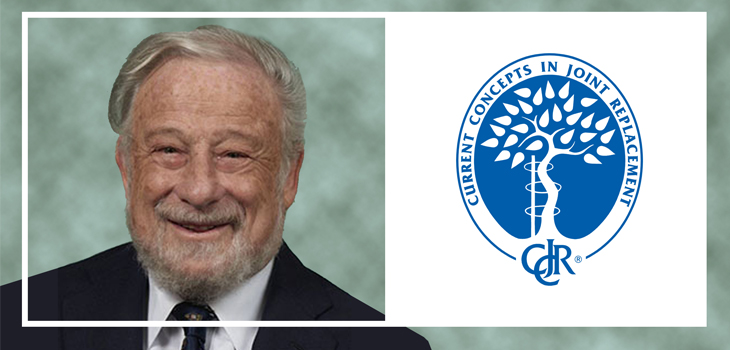
Dr. A. Seth Greenwald, founder of the Current Concepts in Joint Replacement® (CCJR®) meetings, has agreed to sell his educational asset—now the largest independent education meeting dedicated solely to joint arthroplasty in the world—to The Hip Society and The Knee Society, in partnership.
Dr. A. Seth Greenwald Sells CCJR®
8 min read Premium comments
#sethgreenwald#ccjr#currentconceptsinjointreplacement
The Hip Society, which started in 1968 to advance the knowledge and treatment of hip disorders to improve the lives of patients, will co-own CCJR with The Knee Society, which was organized to advance the care of patients with knee disorders through leadership in education and research.
Notably, eight members of the Knee Society’s board and seven members of the Hip Society’s board as well as numerous Society members are contemporary faculty members for the CCJR meetings.
This combination has a sense of inevitability.
“We’re very excited” said Douglas E. Padgett, M.D., president of The Hip Society. “The significance of this milestone in the history of both organizations cannot be overestimated. We are embarking on a new chapter in pursuing our mission of leadership in arthroplasty education.”
Dr. Padgett has been a CCJR faculty member for more than a decade.
Robert Barrack, M.D., president of The Knee Society, who’s been a CCJR faculty member for almost 30 years, chuckled when we asked him about this deal.
“I remember when Seth first asked me to be a faculty member. He called me up and we talked for three hours about the meeting agenda. I felt as though Seth and I were creating the CCJR agenda. When I arrived at the meeting, however, I found that he’d spent three hours with each of the other 20 faculty members and they all thought that they had created the program.”
Dr. Greenwald agrees. “I’m relentless on the telephone and by email. My interactions with the faculty do create the program, foster my orthopaedic education and the growth of the meetings reflects their ongoing commitment to orthopaedic education.”
As does CCJR’s reputation. Today, getting Seth’s phone call, lending your hand to the agenda and being asked to serve as a member of the CCJR faculty is an honor. No accident that so many of the board members of these top societies are also CCJR faculty.
As Dr. Barrack told OTW, “CCJR’s legacy is the gold standard in arthroplasty education, nationally and internationally.”
Furthermore, said Dr. Barrack, “Merged with The Knee Society, and its partner, The Hip Society, creates an unprecedented opportunity for us to collaborate and to carry that legacy successfully well into the future.”
Greenwald’s two annual CCJR meetings (Spring and Winter, Las Vegas/Cleveland and Orlando) are literally treasured by the global community of orthopedic physicians, nurses and suppliers for their independence, quality of lectures, debates and ability to remain clinically relevant for 36 years.
Here’s how a surgeon from Chile, who’d paid $850, plus airfare, hotel and other expense to attend, described CCJR to OTW:
“This is the most up-to-date meeting in the world for surgeons. Everyone on the podium is an expert. This is different from AAOS [American Academy of Orthopaedic Surgeons] where the speaker’s level of expertise is more uneven. Seth’s meeting is free of commercial bias. At other meetings, market forces cause devices to be introduced to surgeons without critical judgment. At this meeting, experts debate and we can make up our minds.”
A Typical CCJR
Sitting in a CCJR meeting is like learning from a curriculum designed by an educator. Not a surgeon. Not a committee. Not a manufacturer.
That’s because CCJR is the singular vision of Oxford University and M.I.T educated, bushy-haired, crinkly-eyed A. Seth Greenwald, D.Phil.(Oxon).
Greenwald starts every meeting by calling his 1,000 – 1,500-member class to order. On time. In 36 years, he’s never been late.
CCJR typically opens with three debates. Point. Counterpoint. One faculty member affirms one side of a current issue. Another takes the other side. Full contact. “This is going to be like taking candy from a baby.” “Are you kidding me? Get real!”
That is only the first step in Dr. Greenwald’s master plan. Step two is a literature critique and review or as Seth puts it, “What do the outcomes tell us?”
A panel of his faculty members dissect the latest studies. “This data is at odds with my clinical experience.” “Solid study design, sample size is bit small.” “While the numbers may not be on target, the conclusion mirrors my own outcomes.”
Step three is live surgery. Not just any live surgery. At one memorable CCJR, Russell Warren, M.D., from the Hospital for Special Surgery performed a reverse shoulder reconstruction live, in full color with Evan Flatow, M.D., providing colorful commentary and channeling questions from the audience for Dr. Warren while he was operating.
That was as much performance art as surgery.
Thirty-six years of CCJR have educated, we estimate, 15,000-20,000 orthopedic surgeons, nurses, and, yes, company executives, engineers and sales people as well as regulatory agency personnel from all over the world and—helped the careers of more than a few faculty members.
A Little History
Turn the clock back to 1967 when a young M.I.T-educated aeronautical engineer from New York and his young wife (expecting their first child) have just arrived in the United Kingdom. Seth Greenwald had been accepted at Oxford University to study the effects of vibration on nuclear power plant cooling towers and, in the process, read for a Doctorate from one of the most prestigious educational institutions in the history of man.
But, waiting for engineer Greenwald was a note from his would be mentor saying, in effect, “sorry old chum, but I’m off on my sabbatical and you’ll have to fend for yourself.” Stranded and abandoned Seth walked into a pub, The King’s Arms, to mull his future with the assistance of a pint of best bitter. This is Oxford, England, of course, and the denizens of pubs are not exactly like those in, say, Oxford, Mississippi.
Joining Seth that very day, at the specific hour and at that exact pub were two other gentlemen with their own set of problems. Mr. John Goodfellow (orthopedic surgeon) and Dr. Peter Bullough (pathologist) were wallowing in the deep end of a conceptual question: “How does weight bearing across articulating human hip joint surfaces contribute to cartilage degeneration resulting in arthritis?”
A pint or so later and young Mr. Greenwald found himself signing up to work on a doctoral thesis in orthopedic and engineering sciences—the first received at Oxford University in this newly emerging cross discipline.
Starting CCJR
We asked Dr. Greenwald how he started CCJR. Here’s his story.
“After I returned to the United States, I was, as with any scientist, dependent on the federal government to help support my research activities. My only funding came from either NIH [National Institutes of Health] or the Department of Defense. By the early 1980s, I had three grants going for me. One from the Department of Defense and two from NIH.”
“Then one was deferred for six months because they ran out of money. I went to my institution and asked if they’d carry me and they said ‘no.’ They didn’t mind paying my salary, but not my lab assistants. I had to let two people go.”
“I said to myself that’s the last time I’m ever going to be dependent on anybody to facilitate my ongoing research interests.”
“I love to teach. So, I said to myself, why can’t I put an educational meeting on? I put my first CCJR on in 1982 or ’83 at the Americana Hotel in Miami Beach. Looking back, I realize it was a shot in the dark.”
“Twenty-eight people showed up—including faculty.”
“It wasn’t exactly a success. I tried a second time and, I believe, 30 people came. I was about to quit when somebody said to me, ‘You know Seth, they have a new theme park in Orlando, and you might want to go up there.’ The theme park was Disney World. If a change to Orlando didn’t work, I was going to give up—250 people came.”
“After that the meeting just began to grow.”
Today, CCJR meetings host 1,500-2,000 attendees annually from, literally, all over the world.
There are two every year in the United States. One in the Spring in Las Vegas/Cleveland. The other in Winter in Orlando. International meeting venues inclusive of Greece, China and Brazil have added to the recognition of the CCJR brand.
CCJR’s DNA
“Over the years CCJR’s program has reflected innovations in orthopedics. We began many years ago teaching cemented hips and then we went to cementless hips. We’ve gone from cemented knees to, now, cementless knees are on the rise. We’ve moved through dozens of different surgical approaches, innovative instrumentation inclusive of today’s emerging interest in robotics.”
“As physicians become more familiar and more sophisticated about the nuances of what it takes to drop the knife and minimally assault the soft tissues, orthopedic surgery outcomes consistently improve.”
“A CCJR meeting comes down to three ingredients. 1) You have to have an appreciation of orthopedics as an emerging discipline and how it is always changing. You have to be up on that. 2) You also have to figure out how you can get people to sit in a room from 7:30 in the morning to 6:00 at night and come back for 2-1/2 days. You have to have a diverse program. Presentations, debates, literature reviews, problem cases where you’re trying to stump the experts, live surgeries and video surgical techniques. 3) The sine qua non of each successful CCJR meeting is the staff around me that for over 30 years has continually contributed to optimizing the meeting logistics. They have bought into it, in much the same way as the faculty, recognizing that CCJR’s continued success rests, in large measure, on all of their shoulders.”
What’s Next?
The terms of the sale were not disclosed, but we do know one thing.
The most important condition of the sale was that Greenwald’s reputation for being the “Switzerland” of orthopedics—unbiased and unbought—would remain the foundation of the meeting.
Greenwald is not retiring. He will continue to play his customary role of rounding up the faculty and with their help crafting each meeting’s agenda.
“I’m remembering Robert Frost, a great American poet, and I’m dating myself, but back in the 1960s, shortly before he died, I had a chance to hear him speak. He recounted his life as an American poet laurate. Then he read one of his most famous poems called The Road Not Taken.”
“It really stuck in my gut. Life is like that. You’re in the woods, you come to a bifurcation, crossroads in the road, and they are pathways. Which one are you taking? Go left? Go right? You can’t really see beyond the trees. Sometimes you just go and take a chance.”
Early in his career, Seth reached a bifurcation on his road and has paraded on it for more than four decades.
No doubt spending dozens of hours on the phone with each faculty member, he and they put together what is essentially the succession plan for CCJR. The faculty, who understand the unique and monumental value of the educational experience he has created, will make sure it will always be Seth’s meeting.
Author
React:
Discussion
This is a fascinating development. In my practice we've seen similar outcomes with the revised protocol. The key differentiator seems to be patient selection criteria. Has anyone else noticed the correlation with BMI thresholds?
Great point. I'd push back slightly on the conclusion, the sample size in the cited study is too small to draw population-level inferences. That said, the directional signal is compelling and worth a larger RCT.
We implemented a similar approach last year. Early results are promising but we're still gathering 12-month follow-up data. Happy to share our protocol if anyone is interested.
Join the conversation
Orthopedic professionals are discussing this. Sign in and upgrade to read every comment and add your voice.