
In all candor, we don’t understand why every orthopedic, sports medicine or pain physician hasn’t already switched to an extended release corticosteroid—particularly now that Centers for Medicare and Medicaid Services (CMS) issued a reimbursement code and new clinical data indicates that it may also be used with diabetic patients and, if the FDA agrees, may also be indicated for repeat administrations.
Time to Switch to an Extended Release Corticosteroid
3 min read Premium comments
Secondary#cms#flexiontherapeutics#zilretta
J-Code for an Extended Release Corticosteroid
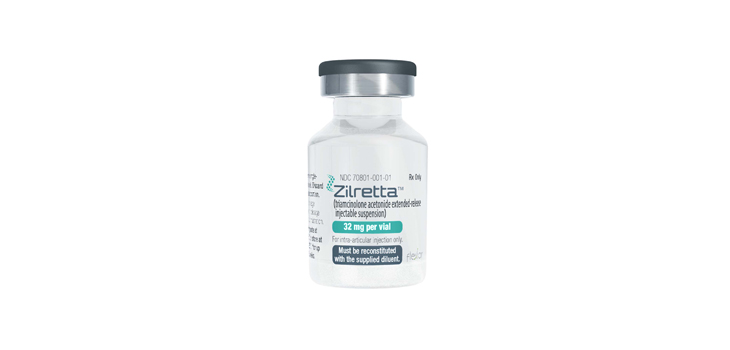
Effective January 1, 2019, the Centers for Medicaid and Medicare Services assigned a J-code for the extended release corticosteroid, Zilretta.
Zilretta is the first extended release corticosteroid approved by the FDA (approved October 2017) for use in patients with knee osteoarthritis (OA).[1]
The drug, which was originally approved by the FDA in 2008 is triamcinolone acetonide(TA) and was formulated by Flexion TherapeuticsInc.into a suspension of microspheres measuring approximately 45 microns in diameterfor extended TA release.
How Zilretta Prolongs Pain Relief
After the Zilretta microspheres of TA are injected, they immediately begin releasing TA into the arthritic knee. The rate at which TA is released is both consistent and prolonged enough to deliver pain management for as long as three months.
The company used a scanning electron micrograph to track the mechanism of action and found that the microspheres form nano-channels after injection of approximately 500 nanometers in diameter. These nano-channels limit both egress of TA from the microsphere’s interior and internal hydration of the polymer, which prolongs TA’s release into the knee joint. Finally, Zilretta’s PLGA (poly(lactic-co-glycolic acid)matrix degrades to lactic and glycolic acids—which are eliminated by the body as carbon dioxide and water.
The Clinical Data
In one recent study, which enrolled 586 patients with knee OA, the investigators compared the duration of the analgesic effects in 159 patients who had received an extended release intra-articular corticosteroid (IACS) treatment and 427 patients who had no previous treatment with IACS. “The results suggest ZILRETTA may provide extended analgesic benefit effect when utilized as the initial intra-articular treatment in patients with knee OA.”
Another randomized, double blind, placebo and active-comparator (immediate-release triamcinolone acetonide (TA)) controlled trial enrolled 484 patients at 37 centers worldwide. Data from the trial showed that Zilretta demonstrated a highly significant (p<0.0001) reduction in average daily pain versus placebo at week 12 (primary endpoint), with durable and clinically meaningful pain relief in patients with moderate to severe OA knee pain. In addition, compared to immediate-release TA, the most commonly injected intra-articular corticosteroid, Zilretta achieved statistical significance through 12 weeks on WOMAC A (pain), WOMAC B (stiffness) and WOMAC C (function)…”
Finally, a THIRD study found that “…ZILRETTA demonstrated significant improvement compared with placebo. When assessed using the WOMAC-A instrument, ZILRETTA demonstrated significant improvement over both PBO and triamcinolone acetonide crystalline suspension (a well-known intra-articular corticosteroid).”
On the Horizon – Hip and Shoulder Indications and Repeat Administrations (!)
In December 2017, Flexion initiated a randomized, open-label Phase 2 clinical trial to evaluate ZILRETTA in patients with OA of the shoulder or hip.
In May 2018, Flexion initiated an open-label study assessing the effect of a single administration of ZILRETTA on synovitis in patients with OA of the knee.
The company has also submitted an sNDA to revise Zilretta’s label (remove limitation of use language) with the Phase 3b open-label X-ray data in >150 patients that demonstrated repeat administration was safe and well tolerated.
Flexion also just announced that has started to enroll patients in the Phase 3 hip OA registration study (n=440). This study will compare Zilretta to placebo with the primary endpoint the WOMAC A pain score at week 12 and will also have an open label extension where patients can receive a second injection (if eligible).
And finally, Flexion is initiating additional Phase 2 studies in OA of shoulder and adhesive capsulitis in the second half of 2019.
Bottom Line
With the J-code in place and Zilretta’s extensive library of clinical study data, we don’t understand why every orthopedic, sports medicine or pain physician isn’t calling their rep to get Zilretta, the first extended release corticosteroid into the clinic.
Eventually, there will likely be other extended release corticosteroids (what took so long?). But right now, Zilretta is the only game in town and it has built up an impressive clinical study library.
Author
React:
Discussion
This is a fascinating development. In my practice we've seen similar outcomes with the revised protocol. The key differentiator seems to be patient selection criteria. Has anyone else noticed the correlation with BMI thresholds?
Great point. I'd push back slightly on the conclusion, the sample size in the cited study is too small to draw population-level inferences. That said, the directional signal is compelling and worth a larger RCT.
We implemented a similar approach last year. Early results are promising but we're still gathering 12-month follow-up data. Happy to share our protocol if anyone is interested.
Join the conversation
Orthopedic professionals are discussing this. Sign in and upgrade to read every comment and add your voice.