
We get a lot of PowerPoints crossing our desk.
Can “Boiling Stone” Replace Titanium, Stainless Steel and PEEK?
6 min read Premium comments
#boylecheng#derrickjones#paulkraemer#peekdifusion#rickrandall
A couple weeks ago we read one about a ‘boiling stone’ that is intended to replace titanium, stainless AND PEEK in spinal and other orthopedic implants.
The PowerPoint was a preview of an upcoming North American Spine Society (NASS) presentation (September 29, 2018 in Los Angeles) and it came from a small Texas-based R&D company.
We were surprised at how strong the data was. If the data we saw is both accurate and holds up under scrutiny, then titanium, stainless steel and PEEK suppliers should be concerned—and manufacturers should visit these guys at NASS to get the lowdown in person.
We called the young company (DiFusion Technologies, Inc.) to ask permission to share their pre-NASS data and we found some old industry hands were funding and managing this little company. (More about them later.)
The CEO, Derrick Johns, gave us permission and, yes, he confirmed, his company intends to replace titanium, stainless steel and PEEK with an entirely new implant material.
Here’s the preview. After you read this, let us know what you think. Could this be the most important new implant material since PEEK?
Zeolite
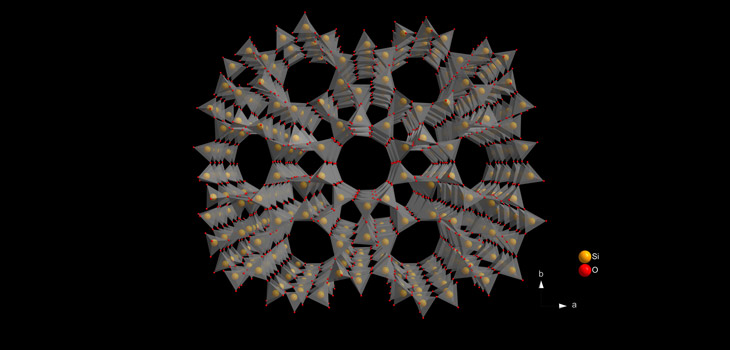
In 1756 Swedish mineralogist Axel Fredrik Cronstedt heated a stone he thought was stilbite (calcium sodium and aluminum silicate) and, much to his surprise, it began emitting clouds of steaming water! The rock ‘boiled’ so Cronstedt named it zeolite, from the Greek word for “to boil” and líthos, meaning “stone.”
Since then zeolite rocks have become extremely popular due to their microporous aluminosilicate structure as industrial strength absorbents and, because of zeolite’s unusual propensity to attract positive cations via its negative charge, a near universal catalyst.
Zeolite’s ions are loosely packed which means that this material will readily go dancing with other materials. Commercially zeolite is, literally, everywhere. Like laundry detergent. It bonds with dirt and removes it.
In medicine it’s used in oxygen concentrators to capture oxygen from the atmosphere, trap the impurities and kick out highly purified oxygen. It’s an extremely effective hemostatic agent known as QuikClot. It’s a source of slow releasing potassium. Since it’s also loaded with ammonium, it can slow release nitrogen for agricultural use. It can absorb up to 55% of its weight in water and then slow release it.
Because of its affinity for positive ions, zeolite integrates with a wide variety of other atoms, so it can incorporate with such minerals as germanium, iron, gallium, boron, zinc, tin, titanium and PEEK.
Computer calculations have predicted that millions of hypothetical zeolite structures are possible.
Including, apparently, a more versatile and biologically active yet also structural robust orthopedic and spine implant material.
Why Zeolite Can Be Better Than Titanium or PEEK
DiFusion’s version of zeolite is called ZFUZE. This table shows why DiFusion believes ZFUZE will be a better orthopedic and spinal implant material than titanium or PEEK.

According to DiFusion, ZFUZE is more osteoconductive, bioactive, hydrophilic than titanium, PEEK or either of those materials with coatings or surface modifications. ZFUZE has a modulus of elasticity that is similar to bone, it is radiolucent, has no delamination risk and can be revised easily.
Ambitious claims.
Can they back it up?
Here’s the data, so far.
The Sheep Study
The principle investigators for ZFUZE (Boyle Cheng, Ph.D., Paul Kraemer, M.D.., Daniel George, M.D.., Derrick Johns, Joseph Crudden, Ph.D., Sriram Sankar, MS) chose the classic sheep spine fusion model to test the limits of zeolite in the spine—but, with a couple of interesting tweaks.
First, they went for a cervical fusion test, not lumbar. Sheep necks have a greater range of motion than human necks. If ZFUZE can fuse a grazing sheep’s neck then, hypothesized the researchers, it should have no problem in a computer facing human neck.
Second, the researchers stipulated that in an effort to “challenge the material itself” there should be NO supplemental fixation like cervical plates.
Third, the implants were sized or optimized for the ovine disc space and the endplates were kept intact, unlike more common lumbar ovine models where endplates are violated, and ample amounts of bone removed to “fit” human implants in the ovine disc space.
Twenty-six sheep were tested. Each had a peek implant and a ZFUZE implant.
Here is how the implants performed. This is also the data DiFusion plans to unveil at NASS…and now in Orthopedics This Week.
The Immune Response Question
Inert materials like titanium and PEEK implants can be viewed as a foreign body by the patient’s immune system and, when that happens, clinicians have noticed “fibrous encapsulation” around the implant. Would ZFUZE have the same outcome?
The researchers performed a comprehensive histology and immunochemistry battery on both ZFUZE and PEEK alone.
Result (see table below) minimal response to ZFUZE, but prolonged inflammatory immune response at 26 weeks for “plain PEEK.”

|
ZFUZE vs. PEEK in a 12, 26-week Sheep Model | |
|
PEEK at 12 WEEKS: “For the first 12 weeks, the plain PEEK shows relatively little bone formation around the graft early and more bone but no real bridging late, as well as development of a fibrous layer around the implant. This what we see clinically as well. There is also a lot of erosion of the endplates around the graft, suggesting excess motion.” |  |
 | |
|
ZFUZE at 12 WEEKS: “In the ZFUZE slides we saw clear bone formation early and bridging late. We did not see fibrous layer development around the implant.” |  |
 | |
|
PEEK at 26 WEEKS: “While there was more bone on the PEEK side at 26 weeks, there is still no bridging and erosion has increased.” “PEEK at 26 weeks, both histologically and on CT, looks like what we see clinically – an attempt to fuse but doesn’t quite get there.” |  |
 | |
|
ZFUZE at 26 WEEKS: “By contrast, the ZFUZE looks solid, including through the middle and right up to essentially all surfaces. The peek 26, both on histo and CT, looks like what we see clinically- an attempt to fuse, but doesn’t get there.” Commentary by Paul Kraemer M.D., study investigator and co-author. |  |
 | |
DiFusion’s Leadership Team
DiFusion started when Joe Crudden, Ph.D.., former senior R&D executive at AW Chesterton, WR Grace, Hampshire Chemical and Dow Chemical called Derrick Johns and asked in his thick Irish brogue “would you have use for this zeolite molecule in spine?”
Derrick asked, “Can we put it in polymers and ‘tune It’ for elution?” Dr. Crudden said, “It’s like an FM radio man, you can tune it to whatever station you want.”
And ZFUZE was born.
Dr. Crudden is now VP of R&D for DiFusion.
Derrick Johns, the company’s CEO, is a self-described “recovering Investment Banker from Morgan Stanley”. He got into the orthopedic and spine business by way of Medtronic Spine where he was the product manager for the M8 screw system. He later moved to Biomet and then to Texas, where DiFusion is based, to manage marketing at Abbott Spine.
He was part of DiFusion’s founding group in 2008—shortly after Zimmer bought Abbott Spine.
More recently Rich Grant joined DiFusion’s board. Rich is the founder and CEO of BreakAway Technologies LLC (O-Arm), which was acquired by Medtronic.
DiFusion’s Business Model
Given the versatility of zeolite, the biggest risk for DiFusion is probably too many opportunities. We asked CEO Derrick Johns about that. He told OTW, “Our model has always been to provide a superior biomaterial platform to a single vendor such that they can use it to exclusively capture market share. In 2014 PEEK commanded a 73% market share with a single drawback—osteointegration. The ovine data suggests we have solved that issue; our partner could exploit a large portion of that 73% share with ZFUZE.”
In the meantime, DiFusion has launched a TLIF, ALIF and Lateral implant through their distribution network. The company has also a 4 510Ks for a pure PEEK implant and is applying for 510Ks on the same designs, but with the zeolite material.
Like many of our readers, we also look forward to seeing DiFusion in person at the September 29, 2018 NASS meeting in Los Angeles.
Author
React:
Discussion
This is a fascinating development. In my practice we've seen similar outcomes with the revised protocol. The key differentiator seems to be patient selection criteria. Has anyone else noticed the correlation with BMI thresholds?
Great point. I'd push back slightly on the conclusion, the sample size in the cited study is too small to draw population-level inferences. That said, the directional signal is compelling and worth a larger RCT.
We implemented a similar approach last year. Early results are promising but we're still gathering 12-month follow-up data. Happy to share our protocol if anyone is interested.
Join the conversation
Orthopedic professionals are discussing this. Sign in and upgrade to read every comment and add your voice.