
Allograft implants are a $3.0 billion (annual sales) industry in the U.S. and Alachua, Florida-based Regeneration Technologies, Inc., (RTI), now known as RTI Surgical, Inc., was one of a handful of innovative companies (along with MTF, CryoLife and AlloSource) that pioneered the industry.
Solving RTI Surgical, Inc.
7 min read Premium comments
#rtisurgical#allograftimplants
RTI’s original two innovations were engineered bone allografts and a tissue cleaning process, BioCleanse, which ensured that allografts could be safely and routinely implanted in any patient.
RTI sold its first share of common stock to the public in April 2000. The allograft industry was generating $410 million in annual revenues at the time and RTI accounted for $122 million or 30% of that total.
Since 2000, allograft industry sales have septupled (7x) and RTI has grown to $200 million in tissue (allograft and xenograft) sales and about $80 million in spine hardware sales. RTI is about 6% of the allograft market today.
This chart shows RTI’s sales and market value growth in the 18 years since going public in 2000.

RTI had a lot of activity in 18 years, but no forward motion.
Sales rose 128% over that time, but the value of the company fell 16%. RTI was worth less in 2017 than it was in 2000.
The company lost money in 10 of those 18 years.
If each year’s earnings or losses were added up, it would total a negative $250 million. The fastest growing category between 2000 and 2018 was marketing, general and administrative expenses, which rose 551%.
Over the course of those 18 years a handful of employees left to form innovative allograft companies based on living cell allografts, nerve allografts or amniotic tissue allografts. The combined market value of those companies, as we write these words, is $2.9 billion.
The board of directors finally decided to make a change in 2017. The former CEO, Brian Hutchison, was let go and Camille Farhat, a veteran leader and executive from GE, Medtronic, Baxter and American Medical Systems took on the job of leading and, yes, fixing Regeneration Technologies.
Since joining RTI, investor interest and confidence in the company appears to have made a small recovery. It could be a honeymoon, but it feels more durable than that. It is also noteworthy that Mr. Farhat’s compensation is tied to the stock price appreciating well beyond its current trading range.
Who is Camille Farhat and what is his plan for solving the puzzle that is RTI?
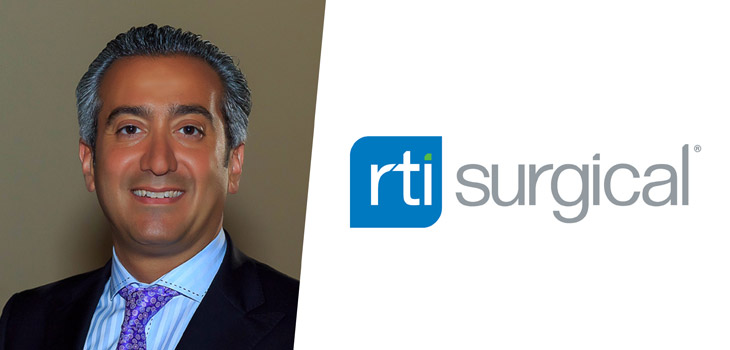
Introducing Camille Farhat, CEO, RTI Surgical, Inc.
When asked, Camille Farhat starts with his tenure at General Electric (GE) during Jack Welch’s tenure.
“CAT scanning was a mature, saturated market in those days. Radiologists who needed a scanner had it.”
“So, in order to grow the business, we decided to use an approach similar to the Nintendo model. In other words, what do you want to play today?”
“That changed the game. By designing faster and thinner scanning, our business began expanding into cardiology, wellness, (e.g., virtual colography, lung nodule detection) and oncology.”
How to Change the Game for RTI?
RTI is in a difficult strategic box. The business of selling products for spine surgery has been in a deflationary cycle for several years and annual industry growth rates are around 1-2%. Growing spine by even a modest rate of 5% means taking share from someone.
In such a challenging environment, maintaining profit margins—much less raising them—is difficult.
For RTI, those issues are compounded by the fact that it has a significant allograft OEM (original equipment manufacturer) business with Medtronic spine—so any initiatives in the spine hardware business could stimulate a reaction from its single largest customer.
As Farhat noted to OTW, “Growing spine is a delicate task.”
So, as he has done several times in his career, Farhat is looking at all his options. Including something that worked for him at GE—changing the game in a mature market by expanding customer options.
In Farhat’s view, RTI needs to pursue niche, differentiated spine products, supported by clinical data, and gain scale which would lead to portfolio pull-through.
Farhat is also thinking carefully about the demand side of the equation. “Creating demand in this market is a game-changer. We want to train doctors on these new therapies and products. We want to increase RTI’s value to the surgeon.”
Is Past Prologue?
Farhat’s success with GE’s CAT scan business prompted Medtronic to come calling. In 2003, Farhat joined Medtronic as global general manager of its urology and gastroenterology divisions formed through multiple, disparate acquisitions that needed to be integrated.
One of Farhat’s initiatives was to, in effect, re-purpose and commercialize a proven Medtronic implantable pacemaker technology to stimulate nerves and treat disorders in urology and gastroenterology.
“Market receptivity was tremendous and the business experienced rapid growth as a result. It gave us the leverage we needed to then branch into the obesity space and create new category leadership opportunities for Medtronic.”
Farhat then moved to Baxter International to lead their Global Infusion Systems division under a consent decree and subsequently led Baxter Pharmaceuticals & Technologies during the Heparin supply chain crisis. He then became CEO of American Medical Systems and led the company through its mesh challenges and sold the men’s health division to Boston Scientific in 2015.
Choosing RTI
OTW: As you looked at RTI, where were the strengths, the things you could work with?
Farhat: This company has a lot of untapped potential laying underneath the many subscale businesses. There is a lot of technology here. My goal is to build a growing and sustainably profitable business that will treat more patients, create growth opportunities for employees and value for investors.
OTW: What do you build and what direction do you take RTI from here?
Farhat: I’ve outlined three transformation objectives for the company: Reduce complexity, drive operational excellence, and accelerate growth. We assembled a world-class management team to enact this transformation and we’ve made significant progress in just over a year since I joined the company. Culturally, we need to take RTI back to its roots with patient and customer intimacy, relevant and disciplined innovation, and a strong collaborative winning spirit.
And, as he did at GE and Medtronic, Farhat is sifting through RTI’s IP bank looking for clinically relevant technologies he can, perhaps re-purpose, or just introduce in new ways to new market niches.
“There is a part of the market that will be motivated by our knowledge of biologics, tissue and hardware, combined. It puts RTI in a unique position, I think, to re-think what healing is and what we need to do.”
“I believe the only way for a small company to succeed in spine today is to decide what you’re going to compete on, stay focused and defend it with your life.”
The Zyga Purchase
Farhat’s first significant strategic move was to acquire a small, Minnesota based spine company named Zyga in January 2018.
OTW: Why did you buy Zyga?
Farhat: Zyga brings us into the SI Joint [sacroiliac] market where you have, based on our research, about 850,000 patients in the U.S. that are getting SI injections, but less than 20,000 surgical procedures. The growth potential is phenomenal.
Zyga’s SImmetry system is highly differentiated and supported by clinical data—it is the only minimally invasive procedure that drives SI joint fusion through decortication.
With SImmetry, we’re aiming to help patients get back to their normal, active and pain-free lives. We’re not about simply treating a symptom.
OTW: Originally, treating the SI joint was a diagnostic problem.
Farhat: It still is a diagnostic problem. In some cases, physicians aren’t there. We continue to study the patient flow from a pain physician to a qualified surgeon to help patients address their problem.
We’re pleased with the data on SImmetry so far, which show fusion, pain reduction, reduction in use of opioids and other pain medications, and improvements in disability and quality of life.
We believe the decortication factor is driving strong clinical outcomes and sets us apart in the market.
This link between decortication and fusion of the SI Joint is something we’re going to explore more.
Spine Culture Shock
“There’s plenty of art in spine surgery—to an extent I didn’t see in cardiology, neurology, urology or critical care,” said Farhat.
He also noted, “The spine industry doesn’t do much marketing to generate demand for treatment. The list of strong marketers in spine is pretty short.”
“Titan Spine, SI BONE and NuVasive are noted exceptions for what they’ve done.”
Can a Tissue Company With Hardware Succeed?
OTW: Looking at the resources you’ve got in RTI, how do you get RTI flying again?
Farhat: First, tissue is central to our business today and going forward. The reliability and cash generated by tissue is what funds spine. In terms of spine revenues generated, smaller companies like us have a difficult time making money, being cash flow positive. So, we decided to focus on the tissue part of the business first. We’ve taken a hard look at our operations and how we manage costs. This included taking $25 million of expenses out and monetizing $14 million this year. It has also meant collaborating with our partners, including organ procurement organizations (OPOs), to control costs.
Our profit margins have improved. Our OEM contracts now have predictable cash flow coming in making the OEM franchise a stable source of cash.
We want to take that cash flow and plow it into high growth, high margin, differentiated Spine M&A and R&D. The Zyga acquisition and expansion of Fortilink series with TETRAfuse 3D Technology are great examples.
Past Is Not Prologue
Farhat continues: “We feel that the way to win in spine is through channel management, relevant and disciplined innovation and patient access. In doing so, we intend to get better at reimbursement, clinical evidence, and demand generation.”
“At RTI we’re going to prove our competence in things that enable our strategy.”
“Our strategy is to continue to have an economically viable and sustainably growing business, that generates more than 20% EBITDA, and our goal is by 2022 to have treated 1 million patients and generate $500 million in sales. In my mind, it is clear what we need to do to reach those goals.”
Camille Farhat is certainly not afraid of ambitious goals.
But, more importantly, he thinks innovatively about RTI’s challenges and appears to be systematically shedding the limitations that kept RTI’s value so low for so long.
Author
React:
Discussion
This is a fascinating development. In my practice we've seen similar outcomes with the revised protocol. The key differentiator seems to be patient selection criteria. Has anyone else noticed the correlation with BMI thresholds?
Great point. I'd push back slightly on the conclusion, the sample size in the cited study is too small to draw population-level inferences. That said, the directional signal is compelling and worth a larger RCT.
We implemented a similar approach last year. Early results are promising but we're still gathering 12-month follow-up data. Happy to share our protocol if anyone is interested.
Join the conversation
Orthopedic professionals are discussing this. Sign in and upgrade to read every comment and add your voice.