
Last September news broke that Centinel Spine, LLC had acquired the cervical and lumbar artificial disc systems ProDisc-C, ProDisc-L, ProDisc-C Vivo, ProDisc-C Nova, ProDisc-O and Discover from Johnson & Johnson’s DePuy Synthes division.
Six Month Update on ProDisc and Centinel Spine
5 min read Premium comments
#centinelspine#prodisc#viscogliosi
ProDisc is the best known and arguably most widely implanted disc arthroplasty system in history.
Since buying ProDisc back (the owners of Centinel Spine had sold ProDisc to Synthes in 2003), surgeons and industry observers were hoping that Centinel Spine would reinvigorate the product category.
It is worth noting that Centinel Spine’s owners—the Viscogliosi Brothers—brought disc arthroplasty to the U.S. from Europe, funded the original clinical studies and for all intents and purposes taught the entire industry about motion preserving disc implants.
The initial reaction from physicians was upbeat.
“Centinel Spine’s acquisition of ProDisc is absolutely positive for ProDisc as well as for spinal arthroplasty in general”, said Jack Zigler, M.D., one of the principals at The Texas Back Institute and the first U.S. surgeon to implant ProDisc L.
“The Viscogliosi Brothers were instrumental in recognizing the value of spinal arthroplasty and bringing that technology into the U.S. They have personal experience with several of the pivotal IDE [investigational device exemption] studies for both cervical and lumbar arthroplasty, as well as with the benefits of non-fusion technologies.”
“Their involvement will re-energize the field of spine arthroplasty.”
125,000 Motion Preserving Implants, So Far
In the six months since buying ProDisc, Centinel has almost tripled the size of the company in terms of employees (engineers, scientists, administrators, marketing and regulatory personnel). In addition, management has engaged several key outside vendors (MCRA, MDMA, MMI, etc.) to navigate the regulatory and reimbursement gauntlet in the U.S.
The news that the VB’s were back in the disc arthroplasty space did trigger a spate of new interest if not also increasing podium presentations. Speakers now had audiences who were ready to take a closer look at disc arthroplasty.
Most notably, we now can see the full scope of Centinel’s ProDisc purchase.
By acquiring ProDisc, Centinel brought a legacy of 125,000 motion preserving implants, 25 years of lumbar disc arthroplasty clinical history and more than 15 years of cervical disc arthroplasty clinical history into the firm.
To put that in perspective, the results with 13,000+ ProDisc patients have been reported on in clinical studies. Centinel Spine’s ProDisc is, literally, the most studied disc replacement implant in the world.
Payers take note: It is probably more studied than most fusion implants with 400 published papers and 48 long-term follow-up papers.
According to the data, patients who receive a ProDisc implant have four times LESS risk of re-operation as compared to ACDF (anterior cervical discectomy and fusion) at 7-year follow-up. And for those who keep track of adjacent level disease, it is also four times less likely to trigger that at 7-year follow up.
With over 30 years of clinical experience, West Chester, Pennsylvania-based Centinel Spine is the largest privately held spine company focused on anterior column reconstruction. Not many people remember this, but Centinel encompasses the old Raymedica, Surgicraft and Spine Solutions companies.
And now it has ProDisc.
The To-Do List
The post purchase honeymoon is over so Centinel’s to-do list is where the action is.
First up is nailing down indications and patient selection.
For cervical, that’s relatively well established. The clinical objective is to address discogenic pain, restore disc height, and preserve functional motion between two vertebral bodies in patients with symptomatic cervical disc disease.
And, of course, reduce the risk of subsequent adjacent disc degeneration.
Next is updating the cervical product offering.
Since the Viscogliosi Brothers sold ProDisc to Synthes, cervical disc arthroplasty has become a comparatively hot area in the otherwise slow growth spine industry.
Both LDR’s Mobi-C and Medtronic’s Prestige are approved for two levels. Orthofix is buying Spinal Kinetics M-6 cervical implant and will likely have FDA approval for a single level in the coming 12 months.
Each of these companies have successfully brought impressive designs for fixation and articulation to spine surgeons and have market momentum.
Synthes had two new ProDisc cervical disc arthroplasty designs in Europe and now Centinel Spine is laying the groundwork to bring them to the U.S. and through the FDA approval process.

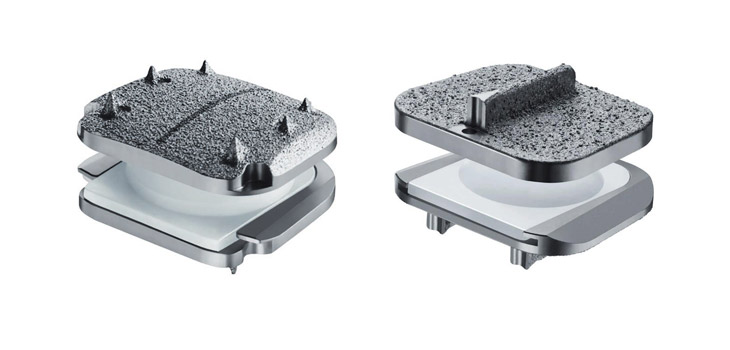
They are ProDisc-C Vivo (Figure 1) and ProDisc-C Nova (Figure 2).
While the basic articulating mechanism of action is the same for both implants, the fixation is different.
ProDisc-C Vivo uses teeth fixation and anatomic endplates to provide high primary stability and multilevel capability for patients with domed endplates. The ProDisc-C Nova uses an updated version of the classic ProDisc keel and it is intended for patients with a relatively flat endplate contour.
Neither are currently available on the U.S. market. Centinel is starting the IDE FDA study programs, including 1- and 2-level trials as well as Vivo/Nova and STALIF-C hybrid construct studies.
ProDisc-C Vivo has been available outside the U.S. since 2012 and has been implanted 14,000 times worldwide. Its primary features include a convex superior plate for anatomical fixation and a trapezoidal footprint design for optimal anatomical fit and maximum endplate coverage.
Like all ProDisc implants, the superior and inferior endplates are made with CoCrMo (cobalt–chromium–molybdenum) while the surface coatings are a rough, pure titanium for bony ongrowth. The inlay is ultra-high molecular weight polyethylene (UHMWPE) and articulation is UHMWPE on CoCrMo.
ProDisc-C Vivo has a center of rotation which is located just below the inferior endplate of the prosthesis. Pure translation movements are controlled by the mechanism of action interface.
Centinel’s ProDisc-C Nova has been available outside the U.S. since 2010 and has been implanted more than 7,500 times.
The ProDisc-C Nova TDR (total disc replacement) is the next-generation of ProDisc-C. Among the features is an updated double keel design on the caudal endplate, which supports multi-level implants, and updated materials for better MRI imaging.
Since most patients who are indicated for cervical motion preserving implants require a multi-level surgery, the updated design of the ProDisc-C Nova is tailored for these cases.
Finally, the last item on Centinel’s to-do list is training.
Centinel requires that all (100%) surgeons and distributors/reps receive ProDisc training.
Next Six Months
Before Centinel acquired ProDisc family of products from DePuy Synthes there was a notable lack of information about ProDisc’s clinical experience in Europe and the U.S.
Now we know and, frankly, the data is impressive—125,000 implants; 400 published papers and 48 long-term follow-up papers. 13,000 patient results published in studies!
There’s also a need for updated papers.
When we checked for any published ProDisc-C Vivo or Nova studies, we could not find any—despite 21,500 implants combined. The only conference presentation we found was by Dr. Rudi Bertagnoli at ISASS 2013. At that meeting Dr. Bertagnoli presented ProDisc-C Nova outcomes for 179 patients (362 levels).
Over the course of the next six months we expect that Centinel Spine be working with numerous surgeons around the globe bring more of this data to journals for publishing and to podiums for presenting.
Next, we expect, will be a concerted effort to work on the lumbar disc arthroplasty issues—reimbursement, indications, etc.
Stay tuned, for sure.
Author
React:
Discussion
This is a fascinating development. In my practice we've seen similar outcomes with the revised protocol. The key differentiator seems to be patient selection criteria. Has anyone else noticed the correlation with BMI thresholds?
Great point. I'd push back slightly on the conclusion, the sample size in the cited study is too small to draw population-level inferences. That said, the directional signal is compelling and worth a larger RCT.
We implemented a similar approach last year. Early results are promising but we're still gathering 12-month follow-up data. Happy to share our protocol if anyone is interested.
Join the conversation
Orthopedic professionals are discussing this. Sign in and upgrade to read every comment and add your voice.