
Before the day is done, 1,090 children will see a doctor, 46 will have surgery, 36 will be admitted to the hospital, 236 will come to the emergency room and a staff of 4,688 people will make sure every child receives the best possible care at Phoenix Children’s Hospital.
A Day in the Many Lives of Phoenix Children’s Hospital – Part I
6 min read Premium comments
#fractures#clubfoot#pediatricorthopetics#phoenixchildrenshospital#sportsinjuries
Phoenix Children’s is one of the largest children’s hospital in the United States. It was founded in 1983 with the bold vision to become a top pediatric hospital by providing superior care to sick and injured children.
There is no other orthopedic sub-specialty quite like pediatrics. It’s very different from practices which deal primarily with chronic, degenerative diseases—like osteoarthritis (total joint replacement) or degenerative disc disease (spine fusion or disc arthroplasty).
In pediatric orthopedics, doctors tackle injuries and diseases of the immature musculoskeletal system—an ever changing biologic system.
Orthopedics This Week spent a day in March embedded with a group of talented orthopedic physicians.
So, join us for a day in the many lives of Phoenix Children’s Hospital.
First Patient of the Day
 Our first patient today is Benjamin Hubbard. He and his mom are seeing Dr. Kristina Wilson. Benjamin just got out of his leg cast. He’d broken a bone three years and again two months ago. Turns out Benjamin has fibrous dysplasia—which is a condition that weaken his bones.
Benjamin originally broke his bone jumping on a mini-trampoline.
Dr. Wilson runs Phoenix Children’s sports medicine program and serves as medical director for 4 of the high schools in the Phoenix Children’s program. In total, PCH covers 12 local schools. She is also the medical director in charge of concussion protocols in sports.
Dr. Wilson goes to all the football games and, yes, she also helps out with Ballet Arizona.
 Benjamin is in great hands.
“I try to be at my patient’s level when I talk with them. I also try to make it fun for them.” Dr. Wilson told us. “We help our young patients be pain free.”
“Benjamin is very polite, very respectful young boy. He listened carefully when I told him what he could do and what he could not do. He asked me if he could swim. I said ‘Yes.’”
Eighty percent of Dr. Wilson’s practice is non-operative. Dr. Wilson did her residency at Phoenix Children’s Hospital, then left for her fellowship at Vanderbilt University. She returned to Phoenix Children’s in 2010 and she is delighted to be back.
 Benjamin had been in his cast for two months. Together with his mother, Dr. Wilson reviewed the X-rays. Good news. Benjamin’s leg showed more healing than Dr. Wilson expected. He’s doing great.
With five siblings at home, Benjamin will be getting back up to full speed very soon.
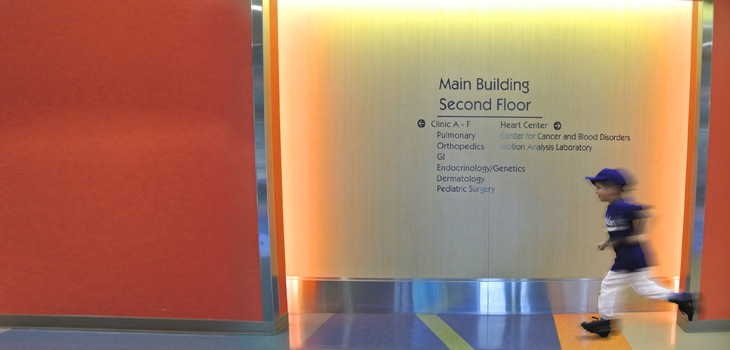
Motion Analysis Lab
Computers, data mining and predictive analytics—these are exciting innovations and are a major reason Phoenix Children’s Hospital’s new motion analysis lab is impressive.
Most people have likely heard about motion analysis in terms of elite sports athletes. At Phoenix Children’s Hospital it’s used to help neurologically impaired patients with, for example, cerebral palsy or spinal cord injuries. Sports injuries, while a big part of Phoenix Children’s generally, amount to about 40% of the lab’s work.
 When we stopped by the motion lab we caught Crystal Conyers in mid-measure for a young ACL (anterior cruciate ligament) patient, Gina Botticelli.
Conyers, who has been at Phoenix Children’s for seven years, is a doctor of physical therapy. She is a graduate of the Arizona School of the Health Sciences and has a primary interest in inpatient neurological rehabilitation.
 When we first saw Conyers, she was collecting a series of range of motion measurements and leg length. We asked, “Why leg length?” “The leg length test is used for our balance test—it’s called the y-balance test—and the data we get is compared to leg length.”
Then Conyers picked up a hand-held device and pushed down as hard as she could against Gina’s raised leg. “In this test, I’m using a hand-held dynameter to measure Gina’s muscle strength.”
 While we were there Gina’s mother stopped by to see how everything was going. As we learned during our visit at Phoenix Children’s parents are an integral part of every child’s care. Gina’s mom and dad were in the waiting room and they came by every once in a while to see what was going on.
After Conyers finished with the flexion, rotation and other measurements, then it was into the motion lab and the high-tech part of the visit.
 Conyers placed a few dozen special, reflecting markers on Gina. The motion lab has special cameras everywhere. As Gina moves, the cameras record her motion and computers analyze the data. Dr. Conyers and Gina’s primary physician will use this amazing information about her ACL recovery and rehab program to really customize Gina’s program.
 One of the difficult parts of the process is making sure the markers don’t roll up or slip sideways as Gina moves.
Of course, Dad popped in to say hello.
Once all the sensors were in place, Conyers took a final photograph to record their placement and it was on to the computer.
H adi Salehi, Ph.D., the motion lab’s engineer, then led Gina through a series of movements—squats, jumps, and balance—and collected all the data.
This was one of the more interesting parts of Phoenix Children’s Hospital and we came away convinced that it is the future of all orthopedics.
Babies
This is Daniel Salcedo Zarota. He is two months old and has club feet.
 “Club Foot” is a term used for several congenital foot conditions. No one knows its cause, but the cure is a simple, tendon lengthening surgery. By lengthening the tendon, doctors return the foot to a normal position. Without surgery, children grow up an impaired ability to walk, run and play.
Little Daniel, sleeping so gently on the table, will not remember today. The next 30 minutes, however, will give him a lifetime of running, jumping and playing—and those memories.
 His surgeon is Dr. Mohan Belthur and the Fellow assisting him today is Dr. Mohammed Waseemuddin.
Dr. Belthur, with more than three decades of experience—both as a surgeon and instructor (in his “spare time” he is an assistant professor at the University of Arizona)—is one of the leading pediatric orthopedic surgeons in the United States.
Belthur, has been staff pediatric orthopedic surgeon at Phoenix Children’s for five years. He came to Phoenix from top hospitals in the United Kingdom and U.S., including Alfred I Dupont Hospital for Children in Wilmington, Sinai Hospital in Baltimore, and Baylor College of Medicine in Houston.
 He and his team perform about 60 club feet procedures every year.
We asked Dr. Belthur why he chose pediatric orthopedics. “I love working with children,” he said. “We in pediatric orthopedics have the opportunity to change a person’s whole life for the better. What we do has to be the right fit from age zero to age eighteen.”
“And all the time our work is with families. I empathize with the families I meet. Many times parents feel as if what is affecting their child could somehow be their fault—which it is not. I understand that. I try to tell them the natural history of the issue with their child and then the treatment.”
“This case, a club foot, has a record of 30-50 year successful follow up. Most children do very well.”
 As surgeons, Dr. Belthur and his Fellow, Dr. Waseemuddin (who plans to go to Harvard’s Mass General Hospital after his stint at Phoenix Children’s) were a real joy to watch. Dr. Belthur conducts his operating room like Leonard Bernstein conducted the New York Philharmonic. At one point in the short surgery, the two doctors were so focused on Daniel that their foreheads were almost touching.
Wrapping up was, literally, wrapping Daniel’s legs in casts. Surgery took about 10 minutes, casting took about 25 minutes. Then it was straight to the Pediatric Acute Care Unit (PACU) and the care of Recovery Nurse Sheila Birlin. Mom and dad came in just minutes later and while they were holding a hungry Daniel, back in the OR, Dr. Belthur was writing up his case notes from the case.
 Daniel is on his way to making sure his young parents hustle to keep up. Go Daniel Go!
Photographs Source: Margaret Young and RRY Publications, LLC
End of Part I
Part II—“Next week, teens, young adults and a five-hour surgery fill the rest of our day in the many lives of Phoenix Children’s Hospital.”
Author
React:
Discussion
This is a fascinating development. In my practice we've seen similar outcomes with the revised protocol. The key differentiator seems to be patient selection criteria. Has anyone else noticed the correlation with BMI thresholds?
Great point. I'd push back slightly on the conclusion, the sample size in the cited study is too small to draw population-level inferences. That said, the directional signal is compelling and worth a larger RCT.
We implemented a similar approach last year. Early results are promising but we're still gathering 12-month follow-up data. Happy to share our protocol if anyone is interested.
Join the conversation
Orthopedic professionals are discussing this. Sign in and upgrade to read every comment and add your voice.