
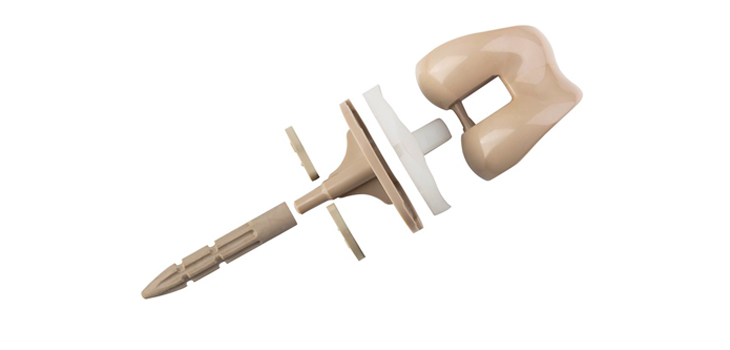
A new study of a PEEK polymer knee implant which was fabricated using injection molding techniques was found to exhibit 50% less wear than metal when used for articulating knee implant components over a 3 million cycle test.
2018 AAOS Notes: Injectable Knee Implant? 50% Less Wear!
2 min read Premium comments
#peekSecondary#knee#solvaypolymrs#okanimedicaltechnology#orgknee#zeniva
The study was sponsored by Okani Medical Technology, a China-based innovator in artificial joint applications. Okani’s ORGknee uses a new formulation of PEEK developed by Belgium-based Solvay Specialty Polymers LLC.
The new formulation, brand named Zeniva ZA-600 CF30 polyetheretherketone (PEEK), is a 30% carbon fiber-reinforced, radiolucent polymer designed specifically for implantable device applications.
Additionally, said Solvay to OTW, Zeniva ZA-600 CF30 PEEK has a modulus of elasticity which is very similar to cortical bone. That means, unlike implantable metals, a Zeniva injection molded implant could maintain normal stress on surrounding bone tissue better than metal implants.
Okani’s engineers designed a fully moldable knee implant which, according to the study released at the 2018 American Academy of Orthopaedic Surgeons (AAOS), exhibited 50% less wear than metal implants at 3 million cycles. Because the implant is moldable, it opens new design possibilities and is significantly less costly to fabricate. According to OTW’s conversations with the company at AAOS, this also could reduce the size and scale of implanted knee components.
Okani’s ORGknee knee implant will enter pre-clinical trials in April 2018 before undergoing standard clinical trials which will be overseen China’s Food and Drug Administration (CFDA) this coming September 2018. Assuming all goes as planned, the first fully PEEK knee implant will hit the market in 2020.
According to Jeff Hrivnak, Solvay’s business manager for Healthcare at Solvay’s Specialty Polymer business unit, “Zeniva ZA-600 PEEK CF30 offers the orthopedic industry an innovative new structural material with the potential to dramatically reduce the manufacturing costs of implantable devices used for sports medicine, trauma and joint reconstruction.”
“It is optimized for injection molding and therefore opens the door to cost-effective, large-scale production of implants, offering OEMs [original equipment manufacturers] the economic advantage they need to compete and succeed in this fast-growing market.’
Also noteworthy is that, as a PEEK implant, Okani’s knee is inherently radiolucent. So, no blocked X-rays, CT scans, MRIs or other medical imaging.
In addition to Okani, ECA Medical Instruments has jumped on the Solvay band wagon and is using a high-performance Ixef polyacrylamide (PARA) resin for medical instruments—specifically for its single-use instrument set for one and two-level cervical spine implant surgeries.
Author
React:
Discussion
This is a fascinating development. In my practice we've seen similar outcomes with the revised protocol. The key differentiator seems to be patient selection criteria. Has anyone else noticed the correlation with BMI thresholds?
Great point. I'd push back slightly on the conclusion, the sample size in the cited study is too small to draw population-level inferences. That said, the directional signal is compelling and worth a larger RCT.
We implemented a similar approach last year. Early results are promising but we're still gathering 12-month follow-up data. Happy to share our protocol if anyone is interested.
Join the conversation
Orthopedic professionals are discussing this. Sign in and upgrade to read every comment and add your voice.