
Disintermediation.
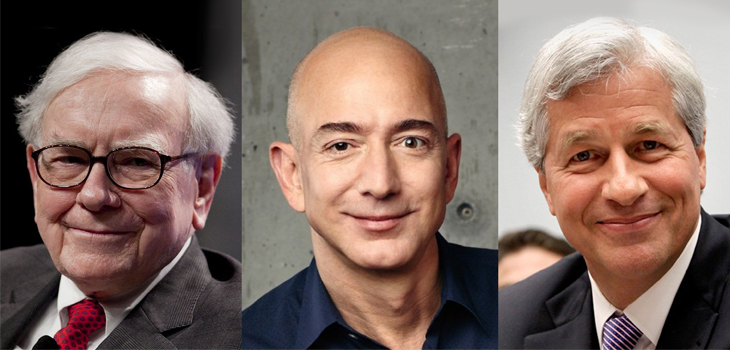
Amazon, Warren Buffett and JP Morgan in Healthcare. Why?
5 min read Premium comments
#spine#knee#shoulder#hip
That’s why.
The U.S. military does it (VA hospitals), so why not?
These three companies employ 1 million people and spend approximately $8.4 billion annually for employee healthcare. Of that number approximately $500 million is the net paid to insurance companies—net of any healthcare spending.
What kind of healthcare system could $500 million (annually) buy?
Apparently, we’re about to find out.
Disintermediation
Disintermediation means eliminating the middle man. In healthcare that pretty much means the health insurance company.
Together, Amazon, Berkshire Hathaway and JP Morgan are charged about 5.9% of their total $8.4 billion in annual employee health care spending by insurance companies for the service of administering healthcare purchases.
That is $500 million annually which could go towards funding an in-house, comprehensive health care service for 1 million employees.
On Tuesday January 30, these three companies announced that they were forming an independent health care company to serve their employees in the United States.
They said that they would initially focus on technology to provide simplified, high-quality health care for their employees and their families, and at a reasonable cost. The initiative is in the early planning stages but would be a long-term effort and would be free from profit-making incentives and constraints.
Well…also $500 million in potential annual savings.
This joint venture may be designed to be no more than a break even enterprise, but each participant could realize significant savings.
Too Much Power at the Health Insurers?
Over the past five years, health insurers have been consolidating at a record pace. The American Medical Association (AMA) has opposed the largest of these prospective mergers since they would, in their view, create virtual monopolies in numerous health care markets.
For example, the proposed merger of Aetna and Humana would have created an 88% market share in Kansas, an 80% market share in West Virginia, 58% in Iowa and 51% in Missouri.
Healthcare providers, who must negotiate with the health insurance providers were horrified. An 88% market share in Kansas essentially eliminates any bargaining power for hospital chains, the state of Kansas and certainly the large, consolidated orthopedic companies like Synthes/DePuy, Zimmer/Biomet, Stryker and so forth.
More recently pharma retailer CVS Health announced a deal to buy health insurer Aetna for about $69 billion.
The largest source of friction between healthcare providers and healthcare insurers is the process of reimbursing legitimate healthcare services. It is expensive, time consuming and often illogical or obtuse. Every surgeon and hospital have stories.
Which brings us to the health insurer’s Achilles heel.
Employer contracts.
Employers like Amazon, Berkshire Hathaway, JP Morgan, Home Depot, Boeing and Wal-Mart.
Employers Cutting Out the Insurance Middleman
Remember the golden rule? He who has the gold, rules.
If Wal-Mart were a country, it would be the 25th largest in the world. In terms of revenues, it is 4 times larger than UnitedHealthcare. It is 36% larger than all five of the largest healthcare insurers combined.
In terms of employees, Wal-Mart is 13 times larger than the largest healthcare insurer—UnitedHealthcare. With 2.2 million employees, Wal-Mart has bargaining power.
A couple years ago Wal-Mart, in collaboration with Home Depot, started to use it.
The two companies put in place a program that offered a hip or knee replacement surgery, plus transportation for the employee and one other person to and from the hospital, plus hotel rooms and food at no charge if they used one of three designated hospitals for their surgery.
No Aetna, Anthem, Humana or United required.
In 2014, Boeing and some of the hospitals in the Seattle/Puget Sound area teamed up to provide healthcare services—also without the benefit of a health insurer in the middle. The mechanism Boeing used to make this happen is the new system of accountable care organizations, or ACOs.
Under the program, Boeing negotiated its own healthcare service contracts with ACOs in the Puget Sound-area. Their employees started using these providers in 2015. The three ACOS were set up by University of Washington Hospitals, Providence Health and Swedish Heath Services.
When interviewed by the Seattle newspaper about this arrangement, Dr. Elliott Fisher, Director of the Dartmouth Institute for Health Policy and Clinical Practice said: “The advantage for Boeing will be that they can take the middle man out of the equation between the patients and the health system. It may be able to reduce cost, in part because of the simplification of not having the insurance mechanism in the middle.”
A Private VA?
With 1,243 healthcare facilities, The Veterans Administration operates the largest hospital system in the United States. The system is a fully integrated healthcare system—meaning that it does not rely on a health insurance middle man. No patient is asked for an insurance card.
Reading between the lines of the press announcement, it sounds as though this partnership of three of this country’s most influential companies could potentially result in a similarly integrated healthcare system serving 1 million employees—also no insurance required.
“It could be big,” Ed Kaplan, who negotiates health coverage on behalf of large employers as the national health practice leader for the Segal Group, said of the announcement.
Mr. Kaplan said larger insurers were frustratingly inefficient when it came to fixing problems like people visiting the emergency room when they did not need to, or requiring a doctor’s visit for routine tasks like refilling a prescription.
“The health care system is complex, and we enter into this challenge open-eyed about the degree of difficulty,” Jeff Bezos, Amazon’s founder and chief executive, said in a statement. “Hard as it might be reducing health care’s burden on the economy while improving outcomes for employees and their families would be worth the effort. Success is going to require talented experts, a beginner’s mind, and a long-term orientation.”
“The ballooning costs of health care act as a hungry tapeworm on the American economy,” Mr. Buffett said in the statement. “Our group does not come to this problem with answers. But we also do not accept it as inevitable. Rather, we share the belief that putting our collective resources behind the country’s best talent can, in time, check the rise in health costs while concurrently enhancing patient satisfaction and outcomes.”
Investors sold health insurer stocks on the day of the Amazon/Buffet and JPM announcement.
What’s in it for Orthopedics?
Orthopedics is the largest healthcare sector in terms of procedures and patients requiring treatment. Eliminating the health insurer middle man could mean fewer pre-authorizations, irrational insurer decisions, and significant paperwork reduction and, perhaps, a greater openness to new technologies.
It is also noteworthy that Amazon, an information and logistics company, could disintermediate healthcare system in much the same way it cut out various middle men between suppliers and consumers in the retail goods sector.
It also worth remembering that both retail and healthcare are, essentially, consumer industries.
Author
React:
Discussion
This is a fascinating development. In my practice we've seen similar outcomes with the revised protocol. The key differentiator seems to be patient selection criteria. Has anyone else noticed the correlation with BMI thresholds?
Great point. I'd push back slightly on the conclusion, the sample size in the cited study is too small to draw population-level inferences. That said, the directional signal is compelling and worth a larger RCT.
We implemented a similar approach last year. Early results are promising but we're still gathering 12-month follow-up data. Happy to share our protocol if anyone is interested.
Join the conversation
Orthopedic professionals are discussing this. Sign in and upgrade to read every comment and add your voice.