
Saline is an Essential Medicine (as defined by the World Health Organization). It costs between $0.60 and $4.20 per liter, wholesale. It’s so ubiquitous in orthopedic surgery that we hardly give it a second thought.
No Saline?!
6 min read Premium comments
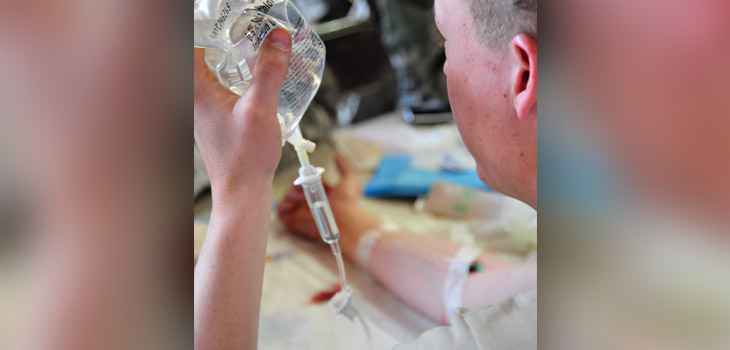
#knee#surgery#hip#ivsaline
Until we can’t get it.
Hospitals across the United States have been reporting shortages of saline and IV fluids since 2014. It got worse in late 2017.
Saline—which is essentially salt and/or dextrose in sterile water—how does that become a shortage?
Baxter and Pfizer Control 90% of the Saline Sold in the U.S.
Baxter International Inc. and Pfizer Inc. subsidiary Hospira Inc. control about 90% of the $1.2 billion a year saline solution market in the United States according to a lawsuit which was filed against the two firms by hospitals in New York and Pennsylvania in 2017.
In April 2017, the federal government subpoenaed a Baxter International employee as part of a criminal investigation related to the nationwide shortage of saline (source: SEC filings by Baxter) asking for documents about pricing, sale, manufacture and shortage of IV solutions.
The issue, in fact, was a shortage of large saline bags—most of which are manufactured by Baxter in Puerto Rico.
Five months after that subpoena, Hurricane Irma hit Puerto Rico. Six weeks after that, Hurricane Maria blasted through.
Puerto Rico is still devastated. As of the December 28, half the island did not have stable power.
And saline bag production is way down.
Getting Saline From the Vet
On the allnurses.com website, nurses are raising hell. Here’s a sampling of their anonymous posts. (Note the comment about going to the local vet for saline!)
| “I’m in a hospital setting but we’ve moved to using 250mL bags for anything we’d normally use 50mL or 100mL bags for. Our 250mL bags are from mainland US but our 50 & 100mL bags come from a facility in Puerto Rico which is not running at capacity since the hurricane hit.” |
| “Can’t get Sterile Water, Lactated Ringers, or Normal Saline IV bags! Have been able to get some through local vet. You may also try getting empty bags and individual “bottles” of normal saline then fill the bags. I am adjusting IV solutions for osmolarity in my clinic it seems nearly once a week as I am having to use whatever I can get my hands on. D5W seems to be the only fluid left, but it really messes up your osmolarity levels as well as can cause precipitation! What a mess.” |
| “In our larger hospital we are doing a TON of IV push meds that used to be in bags. They are also using larger bags of fluids, pulling out the extra fluid and mixing appropriately (using a 1,000ml bag, pulling out the extra 500ml). Supposedly there is another country where the NS bags can be made, but it’ll be 6+ weeks before we can start importing them.” |
| “Oh jeez. There’s a NS shortage now too? I guess it hasn’t hit us yet. However, the LR, Plasmalyte, Hydralazine, Bicarb, Protonix, Epi, Labetalol, Kphos, etc. etc. etc. shortages sure have. There is something wrong with this country when we are running out of essential meds regularly while the pharmaceutical industry sits raking in billions. But alas, I preach to the choir, I know.” |
| “Having same problem at our hospital too. Many of our ATB are coming in syringes now that we push over 5 minutes or more.” |
| “We’ve been given guidelines for “judicious use” of fluids and medications. Anything that can be given PO, SQ or IM is. Many IVPBs are being given as IV pushes. I think we’re putting things that can’t easily be given IVP via syringe pump. We’re DC’ing IV fluids as soon as possible and/or switching to the lowest rate possible if not able to go to PO.” |
| “I’m not on the floor but in the OR. I don’t have a good “feel” for what our fluid situation is like. Anesthesia is using less wherever possible, but some situations do not allow for that. We’re finding many medications are difficult to obtain—local anesthetics and many other meds are almost near impossible to obtain. Much of the production of local anesthetics occurs in Puerto Rico. We’re using local that is different from our “go to” choices. In reality, while local is “nice” it’s not required when a procedure is performed under general anesthesia. We do very few cases under local anesthesia only, so that’s not a huge concern. We were already so short on bicarb earlier this year that we were not allowed to open any outside of a code or other resuscitation situation.” |
The FDA Takes Action
On January 16, FDA Commissioner Scott Gottlieb stated that his agency is working with IV fluid manufacturers in Puerto Rico to get them back to full capacity. In the meantime, the FDA is allowing Baxter and B. Braun to import product into the U.S. from foreign facilities including Baxter’s Brazilian facility.
The agency also fast-tracked approvals for IV saline products from Fresenius Kabi and Laboratorios Grifols.
The FDA also asked companies to submit data to extend expiration dates for these products. If expiration dates can be safety extended, it would allow some near-expiry product that remains at the hospital level to be used.
Even so, Commissioner Gottlieb is asking for patience. “Despite these steps, it may still take more time for new product supply to diffuse across the marketplace and have a noticeable impact on product availability. Because of the generally tight product supply, even when certain volumes of IV saline are not technically in shortage, there could be individual institutions that have a hard time obtaining adequate stock.”
Black-Market of Saline Bags?
A market for saline bags has sprung up as a result of these shortages. Empty containers are regulated by the FDA as class II medical devices.
With the shortage of filled bags, numerous hospitals and other health care providers are turning to the repackaging or compounding of IV saline fluids and utilizing empty IV containers.
And that, in turn, is creating yet another shortage. This time, empty containers.
Exacerbating the situation is this year’s severe flu season—which increases demand for saline.
In a final note to healthcare providers, the FDA said: “Individual providers may find that they’re not able to order excess supply, above the volumes they’ve purchased in the past, until there is more product in the supply chain. We’ll continue to pursue efforts to increase supplies of IV saline while product availability concerns remain, as well as monitor the impact of mitigation strategies on the supply chain.”
Baxter’s Response
Shortly after Hurricane Maria hit, Baxter issued a reassuring press release which said, in part:
“Baxter remains focused on helping ensure patients have continued access to the products and therapies they need. In Puerto Rico, Baxter manufactures products used across the hospital setting, from premixed injectables to products used in the delivery of medications. The medications made in Puerto Rico are small volume parenterals, such as 50mL and 100mL presentations (brand names Mini-Bag and Mini-Bag +). These products are used primarily in the pharmacy to compound or admix a medication or to aid in the delivery of medication. Baxter is working closely with customers and has taken proactive steps to responsibly manage inventory distribution as its Puerto Rico operations continue to ramp up production.”
“Baxter has activated a global response to support recovery from the devastating impact of the natural disasters in Puerto Rico. In advance of the hurricanes, Baxter implemented a hurricane preparedness plan to help mitigate potential impact, including proactively moving some finished product off the island and into secure storage. Baxter is also delivering products to customers on the island to help address patient need. Additionally, Baxter has been working with the U.S. Food and Drug Administration (FDA) and has recently been granted regulatory discretion for temporary special importation of certain products from Baxter facilities in Ireland and Australia to help support product supply for the U.S. market. While these actions will help mitigate some of the projected shortfall in supply, they will not be adequate to fully bridge the gap in the near term. Baxter will continue to do everything it can to ramp up production in Puerto Rico in the weeks ahead and, with the support of special importation granting from FDA, continue to utilize its other facilities to help address product demand in the United States.”
Two Easy Ways to Make Saline
In the meantime, if anyone needs to make saline, here is a handy website which shows how to make your own saline.
Author
React:
Discussion
This is a fascinating development. In my practice we've seen similar outcomes with the revised protocol. The key differentiator seems to be patient selection criteria. Has anyone else noticed the correlation with BMI thresholds?
Great point. I'd push back slightly on the conclusion, the sample size in the cited study is too small to draw population-level inferences. That said, the directional signal is compelling and worth a larger RCT.
We implemented a similar approach last year. Early results are promising but we're still gathering 12-month follow-up data. Happy to share our protocol if anyone is interested.
Join the conversation
Orthopedic professionals are discussing this. Sign in and upgrade to read every comment and add your voice.