
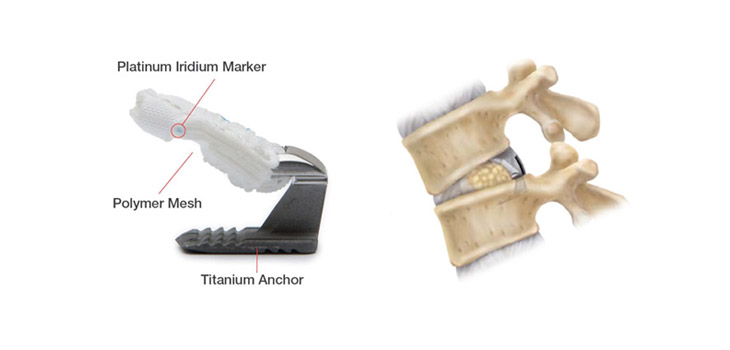
Even before the committee voted, it was not looking good for Intrinsic and its annular closure device for discectomy patients, Barricaid.
Did FDA Panel Make a Mistake on Barricaid Vote?
4 min read Premium comments
#barricaid#reherniation#discetomy#annulardefect#fdapanel#intrinsic
Then the committee voted, and by a margin of 9 to 5, the committee said that there was insufficient evidence of Intrinsic’s annular closure device’s safety when implanted to prevent disc re-herniation.
It did vote 12-1 that Barricaid was effective at preventing reherniations following discectomy.
When asked, however, whether the benefits outweighed its risks, the committee said “no” by a vote of 8 to 5.
The vote by the FDA’s Orthopaedic and Rehabilitation Devices Panel of the Medical Devices Advisory Committee occurred on December 12, 2017.
Did the Panel Miss the Forest for the Trees?
There is one big problem with the Panel’s decision. The efficacy measure in this study included, in fact, safety observations such as reductions in adverse events and re-operations.
The full data from the study showed that using Barricaid cut recurrent disc herniations 56%, reduced re-operations 49% and, finally, lowered serious adverse events 33%.
So, what were the safety concerns that caused the panel to vote “no”?
Barricaid’s RCT Study
Barricaid’s study, which was a prospective, randomized investigation, recruited 554 discectomy patients of which 276 were randomized to Barricaid after a discectomy while the remaining 278 received discectomy alone. This is the largest ever conducted for an annular closure device with 24-month endpoints that included re-herniation and a composite of safety and effectiveness.
This type of composite score is the acid test for any device and all previous premarket approval (PMA) spine studies have included five or six composite components. In this trial, the bar was elevated to eight components, all of which had to be successful to demonstrate statistical superiority. Barricaid did that. Superiority.
Patients were followed for a minimum of twp years post-op with a significant number going out as far as five years—again, a record follow up for review by a PMA spine device Panel.
The FDA noted in their instructions to the panel, that CT imaging showed bone changes to the vertebral endplates for some of the Barricaid patients.
Endplate Changes
Endplate changes are a well-known observation following discectomy, and are not generally associated with clinical symptoms.
Eighty-eight percent of the patients receiving Barricaid had endplate changes versus 40% of control patients. The control patient’s changes were smaller on average and appeared to stabilize sooner than the Barricaid patient’s. The Barricaid endplate changes were larger and had a distinctive radiographic feature—according to the FDA’s radiologist. What those distinct features were, however, remain unclear.
Intrinsic carefully analyzed these endplate changes and found no correlation to measured study outcomes, pain or function.
Difference Without a Distinction
The panel seems to have missed the point that the efficacy endpoints were, in fact, measures of adverse events, readmissions and risks associated with secondary or tertiary surgery.
Barricaid’s data showed a dramatic drop in symptomatic adverse events and expensive repeat surgeries. But the panel determined that a non-symptomatic potential adverse event was more important.
So, a clinician could be able to reduce the risk of reherniation by more than 50% on average and serious adverse events by 33% but won’t have that choice because an FDA panel is worried about non-symptomatic endplate changes that are visible only by CT scan and occur half as often in the control group.
Bad Timing
This FDA panel vote comes just seven months after Intrinsic raised $49 million in a debt/equity deal to fund the commercialization of Barricaid.
That particular round consisted of a $28 million equity financing led by New Enterprise Assoc. and Delos Capital, plus a $21 million debt facility with CRG. Other backers included Greenspring Associates, Quadrille Capital and a “corporate strategic.”
Back in December, when Intrinsic revealed an $18 million raise in a regulatory filing, the company had filed its premarket approval application with the FDA for the Barricaid device.
Back to the FDA
Intrinsic intends to provide additional safety information to the FDA and will reiterate some of the data it didn’t have the opportunity to clarify with the 14-member Panel.
Among the data not presented to panel is the health economics analysis—which looked squarely at the issues of re-herniation and a higher rate of adverse events when NO annular closure device is used.
An independent economist conducted the analysis using two-year follow up data from the Barricaid RCT study. Here is a summary of the findings.
- Barricaid’s QALY (quality-adjusted life year) score was $6,826 versus $76,023 for conventional lumbar discectomy
- After performing 1,000 simulations as part of a sensitivity analysis, 93.3% of the simulation results were below the $100k Willingness-to-Pay threshold with
According to an Intrinsic write-up:
“Most of the cost savings—approximately 85%—came from the reduction of reoperations due to the reduction in reherniations. The majority of the remaining 15% of the cost savings came from lower rates rehospitalizations (due to fewer SAE’s). Lower rates of reoperation mean fewer diagnostic tests, less physical therapy, and reduced medication.”[1]
In health economic terms, this kind of data represents dominance over conventional lumbar discectomy—where, as the economist described it to OTW, “dominance” is defined as when a procedure is both more efficacious and cheaper than the alternative—“you get more for less.”
Stay tuned, for sure.
[1] Thomas Michal, Vice President of Market Access, Health Economics & Reimbursement Intrinsic Therapeutics, Inc. 30 Commerce Way, Woburn, MA 01801 USA
Author
React:
Discussion
This is a fascinating development. In my practice we've seen similar outcomes with the revised protocol. The key differentiator seems to be patient selection criteria. Has anyone else noticed the correlation with BMI thresholds?
Great point. I'd push back slightly on the conclusion, the sample size in the cited study is too small to draw population-level inferences. That said, the directional signal is compelling and worth a larger RCT.
We implemented a similar approach last year. Early results are promising but we're still gathering 12-month follow-up data. Happy to share our protocol if anyone is interested.
Join the conversation
Orthopedic professionals are discussing this. Sign in and upgrade to read every comment and add your voice.