
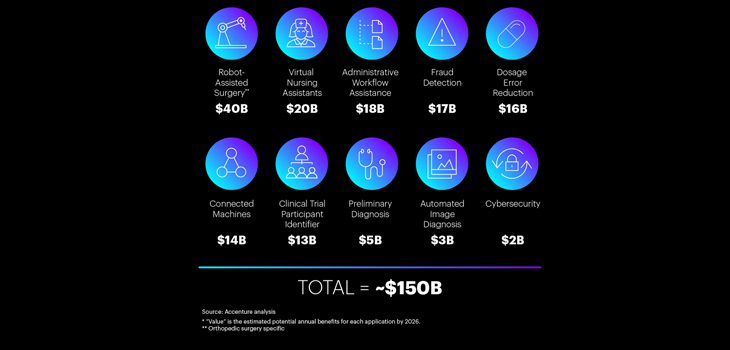
Global management consulting firm, Accenture issued a new report, Artificial Intelligence: Healthcare’s New Nervous System, which declares that Artificial Intelligence (AI) will become the new operating system for healthcare.
Artificial Intelligence’s Profound Effect on Orthopedics
1 min read Premium comments
Secondary
And we thought evidence-based medicine was the operating system.
Or, absent that, then the cost accounting package that your CEO just paid a million dollars for.
Silly us.
Follow the Money, if You Dare
One recent blog said that competition for experienced AI software engineers is so intense that starting salaries are $1 million a year.
In 2014 buyers paid $600 million for AI start-ups. By 2021, say the market analysts at Accenture, that number will rise to $6.6 billion. For start-ups!
AI’s Near Term Impact
Johnson & Johnson, Medtronic, Stryker and other integrated orthopedic suppliers have concluded that AI can be an effective tool to reduce cost, improve quality and expand access—in other words, nail the “Triple Aim.”
The goal is to free up orthopedic doctors, nurses, techs and even the hospital admins to work at their highest and best use. Let AI, in other words, shoulder the routine administrative and clinical tasks.
AI is driving robot-assisted surgery today. Tomorrow look for virtual nursing assistants, administrative workflow support, fraud detection, medication error reduction and, finally, post-operative care management.
Bandwagon Effect
Newsweek declared in June that AI is the “cure for America’s sick-care system.”
The authors cited the usual buzzwords—algorithms, big data, cognitive computing—to support their thesis.
But, as we’ve written repeatedly on the electronic pages of OTW, healthcare is complicated. Indeed, we predict that the early version of AI will likely hit a wall in healthcare.
Unless, as its supporters tout, AI has the ability to learn.
In which case, we’re probably all expendable.
C’est la vie!
Author
React:
Discussion
This is a fascinating development. In my practice we've seen similar outcomes with the revised protocol. The key differentiator seems to be patient selection criteria. Has anyone else noticed the correlation with BMI thresholds?
Great point. I'd push back slightly on the conclusion, the sample size in the cited study is too small to draw population-level inferences. That said, the directional signal is compelling and worth a larger RCT.
We implemented a similar approach last year. Early results are promising but we're still gathering 12-month follow-up data. Happy to share our protocol if anyone is interested.
Join the conversation
Orthopedic professionals are discussing this. Sign in and upgrade to read every comment and add your voice.