
This past October, on the eve of the 2016 Annual Meeting of the North American Spine Society (NASS), the society issued evidence-based coverage recommendations for Electrical Stimulation for Bone Healing for spine.
NASS Issues Major Spine Stim Coverage Recommendations
6 min read Premium comments
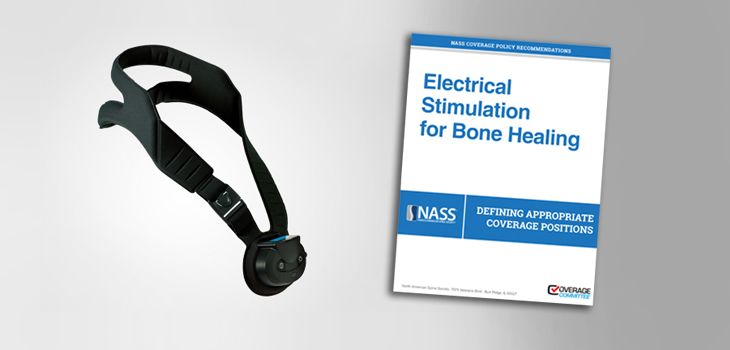
NASS, which is the largest association of spine professionals in North America, concluded that electrical stimulation can augment spinal fusion in any and all regions of the spine but it may not work for all patients and certain types of stimulators work better than others.
Failure to Fuse
Roughly one-third of all spine fusions either fail or are slow to fuse. Biologically, the patient’s fibrocartilaginous tissue, which would normally grow to fill the boney gap, doesn’t grow or grows too slowly. In those cases new bone cells don’t proliferate within the callus and the fibrocartilage fails to calcify.
This is particularly pronounced in high risk patients such as those with diabetes, vascular restriction, a tobacco habit or dependency on alcohol or drugs.
One bone growth solution that has been known for literally hundreds of years is electricity.
A Short History of Electrical Stimulation for Spine Care
In 1791 Luigi Galvani, an Italian surgeon, observed and recorded the effect of electrical current on soft tissue in his famous 1791 paper, “The Effects of Artificial Electricity on Muscular Motion.”
Fifty years later Edward Hartshorne describes the use of electrical stimulation by John Birch, a London surgeon, to treat a tibial non-union. In 1849, W. Lente described electricity’s effect on fracture non-unions and pseudoarthrosis.
By the late 1920s, however, electrical stimulation had become the playground of hucksters and the medical establishment decided to crack down on quack purveyors by disavowing electricity’s medical efficacy.
But, in 1957, Japan’s Fukada and Yasuda demonstrate that bone has piezoelectric properties and generated electric potentials in response to mechanical stresses.
Then in 1962, Andrew Bassett and Robert Becker expanded on the Japanese research and confirmed that bone is negatively charged in areas of compression and positively charged in areas of tension.
In 1970, Alan Dwyer of Australia used an implanted bone growth stimulator to successfully treat failed posterior lumbrosacral fusions and a longstanding tibial non-union. In 1974 Dwyer described the first use of implanted direct current stimulation (DCS) for human spine fusion.
In 1979, the FDA approved the first PEMF (pulsed electromagnetic field) stimulation device for treatment of non-unions. The semi-portable device used AC current from a standard household receptacle for its source of electricity.
In 2001 Brighton demonstrated how an electric field stimulated an influx of Calcium ions through voltage-gated channels in bone cells resulted in increases to cytosolic Calcium ions, prostaglandin E2 and Calmodulin.
In 2004 Aaron et al. found that pulsed electromagnetic fields regulate the expression of genes in connective tissue cells for structural extracellular matrix proteins, resulting in increased cartilage and bone production.
Finally, in 2006 Wang et al. demonstrated an upregulation of BMP (bone morphogenetic protein) 2, 4, 5, 6 and 7 with capacitive coupled electrical stimulation (CCS).
Today, electrical stimulation is one of the most commonly used approaches to augment bone growth and has been used in hundreds of thousands of high risk patients.
PEMFS or DCS or CCS or What?
Forty percent of electrical stimulator devices are used for spinal fusion and about 60% for long bone fracture non unions.
To make the problem even more challenging, patient size and compliance rates probably affect outcomes more than the type of device.
For spine fusion, there is one implantable device, direct current stimulators (DCS), and three types of non-invasive electrical stimulators: capacitive coupled (CCS), combined magnetic field (CMF) and pulsed electromagnetic field (PEMF) stimulation devices.
The NASS Coverage Committee tackled this subject and concluded that of the four electrical stimulators with FDA approval, only three had enough evidence to support their use in spine fusion. The outlier was CMF. Here is the NASS committee’s summary statement:
“In the lumbar spine, the following forms of electrical stimulation are indicated in high-risk patients with the specific techniques outlined. In all other regions of the spine, coverage for the same indications is recommended although there is less supporting evidence.
- DCS and CCS for posterolateral fusion using autograft and extender
- PEMFS for lumbar interbody fusion”
Current Coverage Policies for Spine Stimulation
All bone growth stimulators are Class III devices and are required to undergo FDA investigational device exemption (IDE) clinical trials and the PMA process.
The first bone growth stimulator to emerge from the FDA gauntlet for spine fusion was the implantable DC electrode-based SpF® from Electro-Biology (aka: EBI, later a division of Biomet, now Zimmer) in Parsippany, New Jersey. The approval language was for use as an adjunct to primary lumbar spinal fusion for one or two levels.
The first noninvasive bone growth stimulator for spine fusion, SpinalStim® from Orthofix, a PEMF technology, received FDA approval and came to market in 1990. It was approved for use as an adjunct to primary lumbar spinal fusion or as a treatment for failed lumbar spine fusion.
The second was SpinalPak® (a CCES device) from Electro-Biology received FDA approval and came to market in 1999. It was approved for use as an adjunct to primary lumbar spinal fusion for one or two levels.
The third was SpinaLogic™ from OrthoLogic, (now DJO), a CMF technology, received FDA approval and came to market in 1999. It was approved for use as an adjunct to primary lumbar spinal fusion for one or two levels.
The most recent device was CervicalStim® from Orthofix, a PEMF technology. That device, which remains the only FDA approved bone stimulator for cervical use, received FDA approval in 2004 as an adjunct to primary cervical fusion in patients at high risk for nonfusion.
All the major insurance companies list bone growth stimulators as being medically necessary for patients who might otherwise have a difficult time with bone healing and growth.
But, given the range of products on the market and the need for more post market review and analysis, NASS stepped in to help bring consistency and clarity to physicians and insurance companies who pay the bills.
NASS’ Role
Ever noticed the gap between FDA approved clinical study outcomes and post-market outcomes?
Us too.
Here’s where NASS and all other spine societies can shine.
Organizing an objective, blue ribbon committees of physicians and scientists to critically review post market experience is one of the most essential roles for any spine society.
Here is how former NASS president and one of the architects of NASS’ coverage initiative program, Christopher Bono M.D. (Chief of Orthopaedic Spine Service at Brigham and Women’s Hospital, Department of Orthopaedic Surgery and Assistant Professor, Orthopaedic Surgery at Harvard Medical School and Co-Director, Harvard MGH-BWH Combined Orthopaedic Spine Fellowship) described it:
“The NASS Coverage Committee, by nature of its mission to use the best available evidence in order to develop reasonable coverage recommendations, reviews all available post market studies as well as any IDE study data that led to FDA approval. While in years past FDA-approval was synonymous with insurance coverage, those days are long gone. Payers are now the “final gatekeepers”, so to speak, determining real usage of procedure. Another difference between past and current days is the manner in which procedures are covered. In the past, blanket coverage without any clinical criteria was the norm—so-called “light switch” coverage that was either on or off. Today, insurance companies require various clinical criteria to be met prior to coverage. This difference actually gets to the heart of another issue. IDE and, less so, post-market studies, are usually performed with strict selection criteria. Thus, the results are more likely to demonstrate clinical differences. When technologies are then released upon the population at large, widespread usage can become less strict, influencing actual clinical outcomes. Striking the balance between the very controlled conditions of a rigorous scientific study and real world application is where we see one of the roles for a society such as NASS.”
The Recommendations
According to Dr. Bono, “the committee recommends for direct current stimulation (DCS) and capacitance coupling stimulation (CCS) in high-risk patients undergoing posterolateral fusion and pulsed electromagnetic field stimulation (PEMFS) in high-risk patients undergoing lumbar interbody fusion.”
“What we tried to avoid is making a blanket statement that electrical stimulation of spinal fusion was effective and should be used simply at the discretion of the treatment physician. This, regrettably, would likely lead to overuse. As per outcomes measurement and general nomenclature, the coverage document acknowledges the methodological flaws in many of the studies.”
Furthermore, said Dr. Bono, “The committee found reasonable supporting literature for some types of electrical stimulation in varying situations. For example, there are conflicting data regarding PEMFS in the setting of posterolateral fusion, which influenced the committee’s recommendations regarding this form of stimulation. Other forms have interesting data for long bone healing, but not in spinal fusion.”
Finally, “I think the main take away message from the coverage recommendations is that they should not be considered for routine use in every patient undergoing a spinal fusion. Instead, it is best reserved for those patients with bone healing challenges and high risk of pseudoarthrosis.”
To obtain the actual NASS coverage document please navigate to the following address: http://www.spine.org/coverage
Author
React:
Discussion
This is a fascinating development. In my practice we've seen similar outcomes with the revised protocol. The key differentiator seems to be patient selection criteria. Has anyone else noticed the correlation with BMI thresholds?
Great point. I'd push back slightly on the conclusion, the sample size in the cited study is too small to draw population-level inferences. That said, the directional signal is compelling and worth a larger RCT.
We implemented a similar approach last year. Early results are promising but we're still gathering 12-month follow-up data. Happy to share our protocol if anyone is interested.
Join the conversation
Orthopedic professionals are discussing this. Sign in and upgrade to read every comment and add your voice.