
ProPublica, an independent, non-profit newsroom that produces investigative journalism in the public interest, created a searchable web app which allows anyone to search the Medicare database for specific hospitals or doctors and then to see their complication rates per CMS (Centers for Medicare and Medicaid Services).
Hip Replacements: Safest Hospitals, Safest Doctors, Ranked
4 min read Premium comments
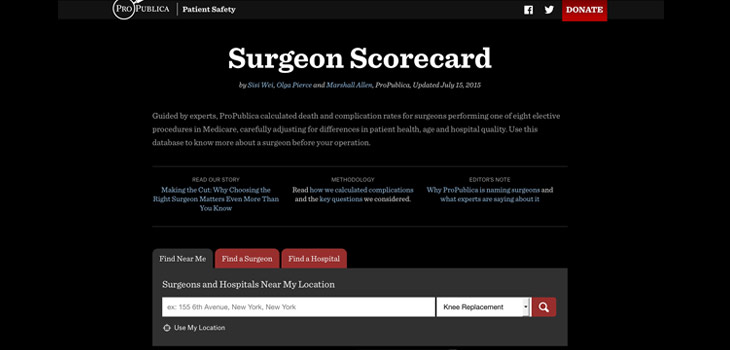
Additionally, the app ranks both the hospitals and physicians against their peers.
This data is okay, not great. There are many confounding reasons for any particular complication rate. There are patient specific issues. This data does not account for co-morbidities like obesity, diabetes, prior surgeries, heart disease and other diagnosis which are associated in the literature with higher rates of complications. Some physicians will not perform revision surgeries, so their complication rates will be lower.
This data should be treated as more interesting and entertaining than useful for actually selecting a care provider.
We know from our sister company PearlDiver Technologies, Inc. that the data coming from CMS has a lot of noise in it.
Here is how ProPublica described their methodology:
Our analysis is based on billing data hospitals submitted to Medicare from 2009-2013. We analyzed 2.3 million procedures: hip and knee replacements, three types of spinal fusion, gallbladder removals, prostate removals and prostate resections. ProPublica’s analysis accounted for factors such as patients’ health and age. We focused only on elective cases because they typically involve healthier patients with the best odds of a smooth recovery.
Sources: Centers for Medicare and Medicaid Services; ProPublica Analysis
Authors and researchers: Marshall Allen, Olga Pierce, Mike Tigas, Al Shaw, Lena Groeger, Annie Waldman, Ryann Grochowski Jones, Jonathan Stray, Cecilia Reyes, Tobin Asher, Mariana Barbosa.
If you spot an error, please let us know at scorecard@propublica.org.
The ProPublica researchers found that the overall complication rates in the United States are low, ranging from 2% to 4%, depending on the type of surgery.
Furthermore, ProPublica found 756 surgeons in the data who each performed at least 50 operations and who did not record a single complication in the five years covered by the analysis. Another 1, 423 surgeons had only one.
If there is an obvious conclusion from this data, it is that U.S. surgeons are excellent and have very low complication rates.
So, for the ten largest metropolitan areas in the United States; here are the best of the best. We listed the five hospitals (as measured by the ProPublica data) in each metropolitan area and one surgeon at each hospital with the lowest complication rates.
| Metro Area | Hospitals With the Lowest Complication Rates and the Physician Associated With Each Hospital With the Lowest Complication Rate |
| 1. Washington Hospital, Fremont (John Dearborn) 2. O’Connor Hospital, San Jose (Jeffrey Anderson) 3. Stanford Hospital, Stanford (William Maloney) 4. Dominican Hospital, Santa Cruz (James Spiegel*) 5. Sutter Maternity & Surgery Center of Santa Cruz (Howard Schwartz) |
| 1. Texas Health Presbyterian, Dallas (Michael Champine) 2. Baylor University Medical Center, Dallas (Richard Shubert*) 3. North Central Surgical Center, Dallas (Paul Peters) 4. Texas Health Presbyterian, Plano (John Barrington) 5. Baylor Medical Center Uptown, Dallas (Charles Rutherford) |
| 1. University of California San Diego Medical Center, San Diego (Scott Ball) 2. Scripps Memorial Hospital, Encinitas (James Helgager) 3. Grossmont Hospital, La Mesa (Peter Hanson) 4. Scripps Green Hospital, La Jolla (Steven Copp) 5. Sharp Memorial Hospital, San Diego (Mark Mcbride) |
| 1. Christus Santa Rosa Hospital, San Antonio (David Templin*) 2. South Texas Spine and Surgical Hospital, San Antonio (Adam Harris) 3. Methodist Hospital, San Antonio (Richard Steffen*) 4. Methodist Stone Oak Hospital, San Antonio (Bryan Kaiser) 5. Baptist Medical Center, San Antonio (David Fox*) |
| 1. Scottsdale Healthcare – Thompson Peak Hospital, Scottsdale (Theodore Firestone) 2. Scottsdale Healthcare – Shea Medical Center, Scottsdale (Brian Miller*) 3. St. Lukes Medical Center, Phoenix (James Chow) 4. Banner Boswell Medical Center, Sun City (James Kort*) 5. Arrowhead Hospital, Glendale (Joseph Janzer) |
| 1. Crozier Chester Medical Center, Upland (Stuart Gordon) 2. Cooper University Hospital, Camden (Dino Nicol Dejusus*) 3. Kennedy University Hospital – Stratford Div, Stratford (Alvin Ong) 4. Riddle Memorial Hospital, Media (Peter Sharkey*) 5. Main Line Hospital Bryn Mawr Campus, Bryn Mawr (Joseph Vernance) |
| 1. Methodist Hospital, Houston (Leland Winston) 2. Texas Orthopedic Hospital, Houston (Gregory Stocks) 3. Memorial Hermann Hospital (Kelly Blevins) 4. Christus St. John Hospital, Nassau Bay (Michael Monmouth) 5. Houston Physician’s Hospital, Webster (Terry Siller) |
| 1. Evanston Hospital, Evanston (James Kudrna) 2. Franciscan St. Margaret Health – Hammond, Hammond (Upendra Patel*) 3. Elmhurst Memorial Hospital, Elmhurst (Lawrence Lieber) 4. Advocate Good Samaritan Hospital, Downers Grove (Kevin Walsh*) 5. Community Hospital, Munster (Gregory Mccomis) |
| 1. Saint John’s Health Center, Santa Monica (Andrew Yun) 2. Good Samaritan Hospital, Los Angeles (William Long) 3. Santa Monica – UCLA Medical Ctr & Orthopaedic Hospital, Santa Monica (Brad Penenberg) 4. Cedars Sinai Medical Center, Los Angeles (Jason Snibbe*) 5. Huntington Memorial Hospital, Pasadena (Paul Gilbert) |
| 1. Riverview Medical Center, Red Bank (Anthony Costa) 2. Hospital for Special Surgery, New York (Chitranjan Ranawat) 3. NYU Hospitals Center, New York (Roy Davidovitch) 4. Beth Israel Medical Center, New York (David Drucker) 5. Staten Island University Hospital, Staten Island (John Reilly*) |
*Occasionally, the same physician is listed at different hospitals but with the same CMS data. When that occurs, we selected the physician with the next lowest complication rate and designated this person with an asterisk.
Coming in future articles are the rankings for knee replacements, lumbar spine fusion posterior approach, lumbar spine fusion anterior approach and cervical spine fusion.
The ProPublica app may be accessed here.
Author
React:
Discussion
This is a fascinating development. In my practice we've seen similar outcomes with the revised protocol. The key differentiator seems to be patient selection criteria. Has anyone else noticed the correlation with BMI thresholds?
Great point. I'd push back slightly on the conclusion, the sample size in the cited study is too small to draw population-level inferences. That said, the directional signal is compelling and worth a larger RCT.
We implemented a similar approach last year. Early results are promising but we're still gathering 12-month follow-up data. Happy to share our protocol if anyone is interested.
Join the conversation
Orthopedic professionals are discussing this. Sign in and upgrade to read every comment and add your voice.