
Born in 1941, Stryker Corporation celebrated its 72nd birthday this year and coincidentally entered into a strategically interesting new marriage with much younger MAKO Corporation.
Is MAKO Stryker’s Trophy Wife?
7 min read Premium comments
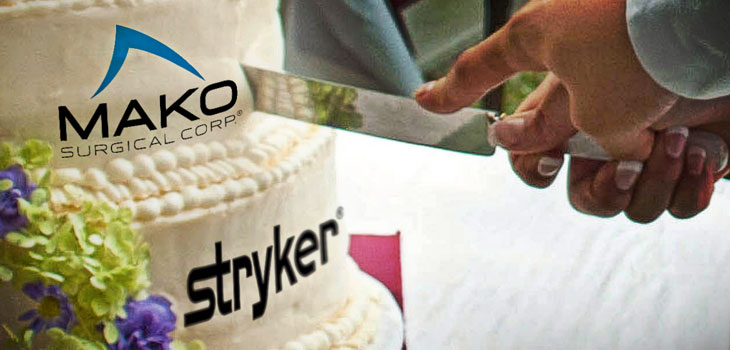
MAKO is, of course, the pioneer of robotics in orthopedic surgery while Stryker is one of the five companies that supplies 90% of all orthopedic implants and instruments in the world.
Together they are…an intriguing combination.
A December / May Romance
He likes Mantovani, she likes Kanye West. Now they must find areas of common interest and start building a life together.
As a general proposition, big company purchases of young, entrepreneurial companies turn out better for the shareholders of the young, entrepreneurial company than the big company. DePuy’s purchase of Synthes is going through a depressingly typical period of integration snafus. Medtronic’s purchase of Kyphon has been a hard slog.
Why do big companies struggle so hard with trophy acquisitions?
There are, according to the academics who study such things, five basic mistakes that large acquirers make:
- Stray too Far From Core Competencies:A company whose traditional strength is selling products to businesses would not likely do well buying a consumer-oriented business. In Stryker’s case, one of its core competencies is selling hospital equipment and surgical navigation systems, endoscopic and communications systems, patient handling and emergency medical equipment. These are large fixed asset sales—similar to MAKO’s robots.
- Putting Cost Savings Ahead of Sales: About ten years ago the business consulting firm McKinsey published an insightful analysis of M&A failures and concluded that the most common cause of failure was putting cost savings ahead of sales. The acquiring company’s management is under pressure to make an acquisition pay for itself with earnings. So most acquirers cut costs in the acquired company. Big mistake. Here’s why. Small changes in sales easily trump major cost savings. According to that McKinsey study, a 1% shortfall in revenue growth required a 25% improvement in cost savings to stay on-track. Oops. But…if the acquired company exceeds its revenue-growth target by only 2% to 3%, then it can offset a 50% failure on cost reduction. Lesson learned: the worst thing you can have is a sales drop-off immediately after the acquisition. Feed the sales beast!
- Getting the Earn-Outs Wrong: When buyers and sellers can’t get to pricing agreement, they use milestones and associated earn-outs to get to “yes.” Too many earn-out structures, however, back fire when the key people responsible for achieving the earn-out milestones either are not aware of them or have not been incentivized to support them. Stryker and MAKO sidestepped that issue by getting to agreement on price—no matter how tortuously—up front with no earn-out milestone provisions.
- Cultures That Don’t Mesh: Just because MAKO is in the same business as Stryker doesn’t mean they have the same culture. MAKO makes its living by selling expensive capital equipment where service and implants are add-ons to the main event. Implants, in other words, are in the service of the capital equipment—the million dollar robot. Stryker, too, sells capital equipment. In fact, Stryker’s capital equipment sales are a bigger percent of Stryker sales than such other diversified orthopedic companies as Zimmer, DePuy or Biomet. Unlike MAKO however, Stryker’s capital equipment sales are in the service of implants. Stryker will cut deals on capital equipment sales in order to build up implant orders. The one key aspect, however, of Stryker’s culture which should play well at MAKO is its decentralized operating model. To a great extent, MAKO will be more autonomous at Stryker than it would have been, for example, at JNJ or Medtronic.
- Integration for Its Own Sake: Stryker has the established brand, for sure. But RIO and MAKO have built a brand synonymous with successful robot sales and improved rates of implant accuracy and surgical consistency. Stryker will have to impose its standard operating procedures onto MAKO. That’s just how it goes at a big company. MAKO is now a Stryker business unit. But this aspect of integration risks demoralizing the small MAKO sales team that has account authority. Stryker’s reputation for autonomous operating units will help but…here is where the hardest post-deal work could be.
Six Percent of Stryker
The final price tag for MAKO was $1.65 billion or $30 per share. At that price MAKO represents about 6% of Stryker’s overall market value. MAKO’s sales are but a rounding error for Stryker and MAKO’s operating losses should not prove to be material.

Stryker’s return on equity is 10.41%. Stryker’s shareholders probably hope MAKO will generate around $170 to $200 million in incremental earnings eventually. Not all of those sales need to come specifically from MAKO, however. They can come from pull-through sales of Stryker implants and other capital equipment due to MAKO’s RIO systems. Clearly, MAKO’s value to Stryker is strategic.
$1.65 Billion
$1.65 billion is a lot of money for a 9-year-old firm. But surgical robotics companies operate in a different universe than implant suppliers. Intuitive Surgical, the supplier of the da Vinci surgical robot and related instruments and accessories is 18-years-old yet has a $14.8 billion market value—about 50% less than Stryker. Intuitive’s sales are $2.2 billion, which is 75% less than Stryker’s. So, one fourth the sales but just half the valuation. Wall Street puts a much higher value on surgical robotics than on implant suppliers.
How did MAKO’s CEO Maurice Ferré, M.D., and Stryker’s CEO Kevin Lobo agree on $1.65 billion ($30 per share)?
It all started with a phone call from Lobo to Dr. Ferré in early August 2013. Lobo opened the bidding at $21 per share in cash.
Dr. Ferré told Lobo that $21 wasn’t going to get much board support. Dr. Ferré reviewed it with his board chairman, Charles W. Federico, and it was a non-starter.
Lobo responded quickly and increased the offer to $24 – $26 per share, in cash. This time, he put the offer in writing and said that it could go even higher if there were some new opportunities or product capabilities disclosed by MAKO.
Between August 16 and August 19, 2013, the whole MAKO team along with their advisors reviewed Stryker’s letter and decided to take Lobo up on his offer to show off their new opportunities or products.
A week or so later, on August 26, 2013, the respective corporate teams met in person for several hours to review any heretofore unknown opportunities and future product capabilities. After the meetings ended, Dr. Ferré told Stryker that MAKO’s board would be meeting the following week to make a go/no go decision regarding Stryker. Dr. Ferré told Stryker that if they were going to increase their bid, they’d better do it before the MAKO board meeting.
Just three days later, August 29, 2013, Lobo called Dr. Ferré and moved his bid up to $30 per share, in cash.
On September 4, 2013, the MAKO board met in person and reviewed Stryker’s new offer with their advisors. Their conclusion? Stryker’s price would be more favorable to MAKO’s stockholders than staying independent. After the board meeting ended Dr. Ferré contacted Lobo to find out if a higher price was possible. Lobo said that the $30 per share was pretty much it. But he’d check with his guys further.
Sure enough, on the next day Lobo moved the price to $31 per share—but that price was subject to due diligence. Lobo also told Dr. Ferré that no further increases would be forthcoming.
For the next three weeks Stryker’s team poured over MAKO’s books and records.
Then, on September 19, Lobo called Dr. Ferré and asked for a face-to-face meeting. The next day Lobo was in MAKO’s Florida office. After looking at everything, Lobo said, Stryker had decided to LOWER its price from $31/share to $29/share. According to Lobo, his team had found several business- and performance-related issues. In addition, MAKO had been planning to acquire Pipeline Business and that if MAKO went ahead with that purchase, the additional costs were on Stryker’s books.
Dr. Ferré told Lobo that $29 per share was not going to pass MAKO’s board.
Lobo told Dr. Ferré that he did not have authority from Stryker’s board to raise the offer.
MAKO and its board together with their advisors went back and reviewed everything again. Was there any way to accept the $29 offer? After long hours of debate, discussion and analysis, the MAKO board could not pull together enough votes to approve the $29 offer. So MAKO’s board told Dr. Ferré to call Lobo before Stryker’s September 24 board meeting and to try again to move the purchase price up to $30 per share, or more.
After Stryker’s board meeting, Lobo had some good news for MAKO. Stryker’s board was willing to pay $30/share but asked that the size of the termination fee that would be payable by MAKO to Stryker in certain situations (generally involving the existence of a superior proposal to acquire MAKO from a third party) would be 3.7% of the transaction value, up from the 3.0% – 3.25% .
With that, the deal was sealed at the board levels.
Thirty dollars per share was 84% higher than MAKO’s stock price just before the deal was announced. It was also about 113% higher than the three-month average MAKO closing price.
PostScript
Stryker’s purchase of MAKO will likely close in mid-December.
One recurring question from surgeons—who are all dealing with the realities of an increasingly cost conscious healthcare system—is why would Stryker acquire a company which sells million dollar robots in this period of healthcare cost reduction?
Stryker’s answer is that MAKO will simplify joint reconstruction procedures, reduce variability and enhance the surgeon and patient experience.
In dollar terms, Stryker’s implants comprise about 18% of the total cost of a large joint replacement. The rest of the cost of surgery is everything else including the surgery itself, rehab and any problems that come up. Small gains in the non-implant portion of surgery—like fewer errors, more consistent outcomes—can have a huge effect on overall costs.
At a time when insurance companies are asking hospitals, surgeons and implant suppliers to virtually guarantee outcomes and eliminate variability…Stryker’s purchase of MAKO is a $1.65 billion bet that robots are the answer.
Author
React:
Discussion
This is a fascinating development. In my practice we've seen similar outcomes with the revised protocol. The key differentiator seems to be patient selection criteria. Has anyone else noticed the correlation with BMI thresholds?
Great point. I'd push back slightly on the conclusion, the sample size in the cited study is too small to draw population-level inferences. That said, the directional signal is compelling and worth a larger RCT.
We implemented a similar approach last year. Early results are promising but we're still gathering 12-month follow-up data. Happy to share our protocol if anyone is interested.
Join the conversation
Orthopedic professionals are discussing this. Sign in and upgrade to read every comment and add your voice.