
Stryker Corporation, which owns about 905 patents, used to share virtually the entire market for orthopedic pulsed lavage devices with Zimmer Holdings, Inc. No longer. A jury ruled in late July that Zimmer willfully infringed Stryker’s three pulsed lavage patents and, therefore, must pay for all of Stryker’s lost profits—about $73 million—and then treble that number. Add in Stryker’s $11 million legal fees, the check to rival Stryker is for $228 million big ones.
Zimmer Zonked for Treble Damages
6 min read Premium comments
Now that Zimmer rolled out the re-designed version of Pulsava Plus, it’s no longer Stryker’s legal monopoly.
An Orthopedic Spray Gun
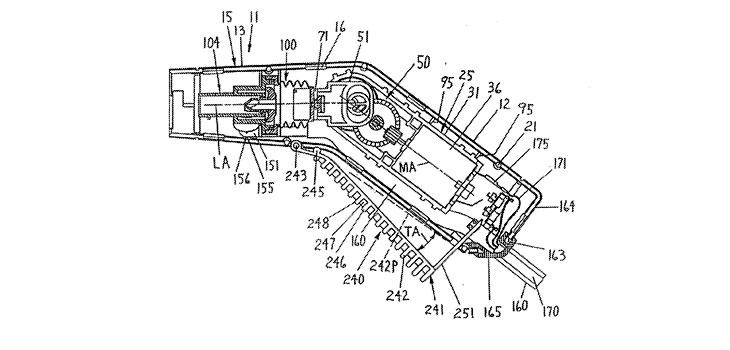
A modern, orthopedic pulsed lavage device is a combination spray-gun and suction tube. It’s used by surgeons to clean wounds and remove necrotic tissue from wound sites.
Early-model pulsed lavage devices were bulky and required a centralized power source. They had to be wheeled around a hospital, from one room to another. Stryker’s innovation was to shrink the size of these boxes to a portable, disposable, battery-powered lavage device that looked like a spray gun on steroids.
It was a disruptive innovation. Zimmer, the only other major supplier of orthopedic pulsed lavage devices, had no answer. Its market share started to melt away and Zimmer’s future in the pulsed lavage marketplace became an open question.
So Big Blue fought back. Zimmer’s managers hired an independent contractor, with no experience in pulsed lavage devices and asked him, as the jury found in this case, to copy Stryker’s product.
Sadly, Zimmer forgot to check with their patent counsel about the risk of infringement and went to work successfully luring customers away from Stryker.
Stryker Sues, Zimmer gets Zonked
In 2010, Stryker sued Zimmer saying that Zimmer’s Pulsavac Plus was a blatant knock-off of Stryker’s patented (No. 6, 022, 329, No. 7, 144, 383 and No. 6, 179, 807) pulse lavage device.
The suit went to a jury in a trial that lasted just two weeks. The verdict came quickly and unequivocally in Stryker’s favor. The jury found that Zimmer willfully infringed Stryker’s patents.
In reading the case, it is clear that Zimmer’s lawyers really had no chance. They fought hard but lost, literally, every argument on claim construction, on disputed claims and finally on all claims at trial. Post-verdict, they were even skunked on every one of their ten post-verdict motions.
Amazingly, even after losing all of those arguments and getting the clear jury verdict, Zimmer kept infringing. Any hospital that wanted to buy a Pulsavac Plus which had just been ruled to be an infringing product, could do so.
Did Zimmer’s managers not get the legal memo saying “we lost”?
On May 21, 2013, about four months after the end of the trial and weeks after the parties had wrapped up their third and final round of briefing on post-verdict motions, Zimmer unveiled a redesign of its otherwise infringing Pulsavac Plus.
And asked the court to allow it to sell the new Pulsavac Plus.
U.S. District Court Judge Robert Zonker sidestepped the issue of whether the re-designed Pulsavac Plus was ok to sell or not, but that didn’t stop him from rejecting Zimmer’s motion.
Zonker zonked Zimmer’s motion.
Willful Infringement
At trial, the jury heard testimony that Zimmer all-but instructed its design team to copy Stryker’s products. Zimmer’s lead engineer, Bill Donizetti, testified that Zimmer had instructed his design team to model the Pulsavac Plus after features of Stryker’s products. He went further saying that Stryker’s inventions were “pioneering, ” suggesting they were novel and non-obvious.
Zimmer also admitted at trial that it did not take any actions to stop selling the accused products, even after the court found that Zimmer was infringing several claims of the patents-in-suit.
Permanent Injunction
Stryker asked the court to permanently stop Zimmer from manufacturing and distributing the infringing design of he Pulsavac Plus (but not the current re-designed version). The court ageed.
In Judge Zonker’s view, Zimmer’s infringement harmed—and continued to harm—Stryker by depriving it of market share and diminishing Stryker’s right to exclude others from practicing its patents, all to the direct harm to Stryker.
Lost Market Share
According to court records, Zimmer’s sales of the Pulsavac Plus took 15-18% of the market away from Stryker. The judge called it “a textbook example of irreparable harm” and cited lost market share, revenues and brand recognition as a result of Zimmer’s infringement.
Furthermore, experts at the trial testified that the orthopedic pulsed lavage market consists, for all practical purposes, of just Stryker and Zimmer.
One of those experts was a Zimmer brand manager who testified that Stryker and Zimmer are the two major competitors in the orthopedic pulsed lavage device market. So, in effect, any Zimmer gain was by definition a Stryker loss.
Zonker ruled: “In this case, there is no doubt that Zimmer’s infringement not only cost Stryker market share and deprived it of the exclusive use of proprietary technology, but that it directly benefitted Stryker’s only rival in the orthopedic pulsed lavage industry. That is more than enough to establish irreparable injury.”
In its defense, Zimmer argued that Stryker delayed seeking injunctive relief—by, for example, not seeking a preliminary injunction at the outset of the lawsuit—which demonstrated that Stryker has not suffered irreparable harm.
Zonker, again, rejected Zimmer’s arguments. “To the contrary, an infringer’s past successful infringement should not become a sort of de facto license to continue infringing. Infringement does not cease to be a problem just because the patent holder has not pursued a particular remedy.”
Going for Game, Set and Match
The jury calculated that Stryker lost about $70 million in profits during the period that Zimmer was selling its Pulsavac Plus. But that only reflected lost profits through November 30, 2012. From December 1, 2012 to February 28, 2013, Zimmer was still selling Pulsavac Plus. So Stryker’s damages expert asked the court to increase damages by $2, 351, 257.66.
Zonker agreed.
And then Stryker asked the judge to TRIPLE the damages.
In order to qualify for treble damages, the facts of a case have to be particularly egregious. And there are some clear guidelines for this. They are called the nine Read factors, or questions. Judge Zonker had to ask the following questions and, depending on the answers, could potentially grant Stryker treble damages. Those questions were:
- Did Zimmer deliberately copy Stryker’s ideas or design?
- Did Zimmer investigate the scope of Stryker’s patents and form a good faith belief that they were invalid or not infringed?
- What was Zimmer’s conduct during litigation?
- What’s Zimmer’s size and financial condition? Could Zimmer handle treble damages?
- How close was this case?
- How long did Zimmer’s infringing conduct last?
- Did Zimmer take any remedial actions?
- What was Zimmer’s motivation for infringing?
- Did Zimmer try to hide its misconduct?
For example, one of Zimmer’s engineers noted that use of gear drives, like the ones ultimately incorporated in the Pulsavac Plus devices, “would be probably copying.” Zimmer never checked to see if they were infringing. Zimmer also, according to Judge Zonker, needlessly delayed in producing requested information concerning its application for a patent for the Pulsavac Plus.
This was not a close case. Every major decision—from claim construction through post-verdict motions—went against Zimmer.
Zimmer’s infringement lasted more than a decade, from 2000 all the way through part of 2013—a considerable amount of time. The judge noted in his opinion that at no point during those 12-plus years of infringement did Zimmer take any remedial action to stop infringement or mitigate damages.
Motivated by a Desire to Harm
Finally, since Stryker and Zimmer were the only major competitors in the orthopedic pulsed lavage device market, the court ruled that Zimmer’s infringement of Stryker’s patents could only have been motivated by a desire to harm Stryker.
In his final ruling, Judge Zonker wrote: “Given the one-sidedness of the case and the flagrancy and scope of Zimmer’s infringement, the Court concludes that treble damages are appropriate here.”
And the judge went on to say, “At bottom, there is simply no good reason not to treble the award of supplemental damages here when the Court has determined that treble damages are appropriate for pre-November-30th lost profits.”
Zimmer Plans to Appeal
Stryker’s attorney, Greg Vogler, of McAndrews Held & Malloy, applauded the ruling saying to Law360: “It’s a just decision. Stryker came up with a pioneering invention, and Zimmer simply copied it. This is what happens when a company recklessly ignores patent law.”
Zimmer is vowing to appeal. Zimmer, with its re-designed version of the Pulsavac Plus, is planning to appeal Judge Zonker’s rulings. In a statement the company said: “Zimmer is disappointed with the judge’s recent rulings denying our post-trial motions and increasing the damages awarded by the jury earlier this year.
Stryker was represented by Gregory J. Vogler, Sharon A. Hwang, Deborah A. Laughton, Laura M. Personick and Justin J. Paul of McAndrews Held & Malloy Ltd. and by David J. Gass and D. Andrew Portinga of Miller Johnson.
Zimmer was represented by David K. Callahan, Bryan S. Hales, Eric D. Hayes and Michael I. Cohen of Kirkland & Ellis LLP and by Kevin Abraham Rynbrandt of Rynbrandt & Associates.
The case was Stryker Corp. et al. v. Zimmer Inc. et al., case number 1:10-cv-01223, in the U.S. District Court for the Western District of Michigan.
Author
React:
Discussion
This is a fascinating development. In my practice we've seen similar outcomes with the revised protocol. The key differentiator seems to be patient selection criteria. Has anyone else noticed the correlation with BMI thresholds?
Great point. I'd push back slightly on the conclusion, the sample size in the cited study is too small to draw population-level inferences. That said, the directional signal is compelling and worth a larger RCT.
We implemented a similar approach last year. Early results are promising but we're still gathering 12-month follow-up data. Happy to share our protocol if anyone is interested.
Join the conversation
Orthopedic professionals are discussing this. Sign in and upgrade to read every comment and add your voice.