
Thirty-six years ago the United States was fighting its way through a particularly severe recession. Unemployment was spiking, the stock market was tanking. In the midst of the doom and gloom Warren Buffet told a reporter “I feel like an oversexed guy in a whorehouse. Now is the time to invest and get rich.” and he started buying.
#1 Private Equity Firm Bets on Spine
6 min read Premium comments
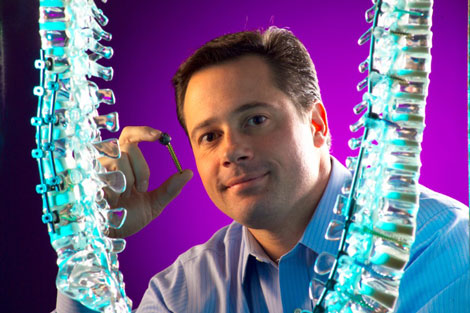
Kind of reminds us of the spinal implant industry today. Hospitals are demanding lower prices, Medicare (CMS) is cranky, the FDA is flailing around, several small spine technology firms have left the pitch and one of the most important new technology initiatives—motion preservation implants—was mugged in the alley.
 Then, like Buffett in 1974, the $20 billion private equity firm of Welsh, Carson, Anderson & Stowe (WCAS)—the largest and most successful private equity firm focused on information/business services and healthcare—lays a big bet on one of the fastest growing young spine technology companies in the industry—K2M, Inc.
Who are these guys at WCAS? What do they see, that orthopedic-specific private equity firms and the boards at the Big Five are missing?
So we did a little investigating.
WCAS is about 31 years old. Their modus operandi is to pick one company in an industry sector, put a bet down, keep management intact and tell them to build, build, build. With the fat checkbook managements are offered an opportunity to build out product lines and distribution whether through organic growth or via acquisition. But, and this may be the key, WCAS bets on strong jockeys to ride a thoroughbred company to the finish line.
Case in point: AGA Medical. This Minnesota-based cardiovascular implant company was generating about $100 million in revenues and growing fairly rapidly (although, not as fast as K2M) when WCAS made their investment in 2005. In the intervening five years, AGA invested in distribution and product line expansion. Last year AGA went public. Today it has a market value of $650 million and an enterprise value of $825 million. Its sales have more than doubled to $220 million (consensus estimate by analysts this year). While WCAS didn’t disclose its 2005 purchase price, we can reasonably estimate that WCAS’ investment in AGA has appreciated roughly 400%.
 WCAS’ investment in K2M is expected to close later this month. Investors who are NOT selling include K2M’s management, employees and its other major investor, Ferrer Freeman, who has two seats on K2M’s board. One of Ferrer Freeman’s principals is former Wright Medical CEO Tom Patton. Patton has built a remarkable track record since pulling Wright Medical out of its downward spiral some ten years ago. In addition to selling Wright to another private equity firm, Warburg Pincus, he went on to run and sell three other companies.
But why K2M? “When Welsh Carson looked at us, they saw a company with the potential to be a platform investment in spine.” recalls K2M CEO and Co-Founder, Eric Major. “They saw in us, I think, a mature management team, the kind of processes and structure that can scale to the next level and beyond that a strong regulatory and compliance organization.”
We also suspect that WCAS saw a management team that tackled tough projects—like products for complex surgery and then successfully navigated the pathway to market, wining design awards in the process. One surgeon who has used K2M’s products wrote this on an anonymous blog this past February:
“The system is incredible. I am a deformity surgeon and I “gave it a go” to see what all the talk was about. I thought I would use it once and that it would be a joke. How wrong was I. It is incredibly powerful and fast. I can do monster reductions very quickly, far easier that the previous system that I used. I had to do a revision using my old system last week—what a nightmare. It reminded me what a frame-shift this pedicle screw is.”
Last year K2M won a “Best Spine Technology Award” from this publication and then earlier this year won the 2010 Medical Design Excellence Award (MDEA) for the SERENGETI Minimally Invasive Retractor System. The SERENGETI features a unique flexible polymer retractor which is captured under the head of a cannulated screw and placed with the screw for secure, spine-based retraction. The retractor provides simplified access to the hard-to-reach L5 – S1 levels, as well as rod introduction for multi-level complex posterior instrumentation procedures.
K2M was founded in 2004 by John Kostuik, Eric Major, Lew Parker, Andrew Rock, and Richard Woods of the management team and others. Dr. John Kostuik, who serves as K2M’s Chairman and Chief Medical Officer, was previously Chief of Spine Surgery at The Johns Hopkins University School of Medicine and he was once President of the Scoliosis Research Society and the North American Spine Society. In fact, Dr. Kostuik was one of NASS’ original members and organizers.
This is the second company Eric Major has started. We first got to know the then 29-year-old Eric Major as CEO of American Osteomedix (AOM). This was around 2000 when Kyphon was just emerging as a treatment for vertebral compression fractures. Eric had an alternate, less expensive approach and it created significant buzz at the small NASS meeting in Chicago that year. Eighteen months later, Interpore Cross bought Eric’s company for US$8 million in cash and about 2.4 million shares of Interpore Cross common stock. AOM became a wholly owned subsidiary of Interpore Cross. The company’s revenues before selling to Interpore were about $1.2 million. Eric worked about two years at Interpore. And then disappeared.
In 2004, along with Dr. Kostuik, Major quietly started K2M. K2M did not hit most spine surgeons’ radars until 2005 when the company started selling its first products and hit the bricks looking for capital. The company snared $21.5 million from a number of investors including some surgeons and the private equity firm, Ferrer Freeman & Company that same year. Sales in 2006 were, we estimate, about $22 million and it was that same year that the FDA granted K2M clearance for its Denali Deformity Spinal System.
Over the next four years, sales at K2M rose at an average annual rate of about 50% and this year, we estimate, K2M will report more than $100 million in sales.
What’s Next for K2M?
K2M’s global headquarters will remain in Leesburg, Virginia, and it will continue to operate under its existing management team. But, the scope of the company’s growth and vision will likely change. One clue as to where K2M may be looking came last October when the firm announced that it had opened a direct sales and distribution office in the United Kingdom. K2M’s expansion into the UK had actually started in 2008 when it received the CE Mark clearance and successfully introduced its RANGE Spinal System, MESA Spinal System, DENALI Spinal System, PYRENEES Cervical Plate System, and ALEUTIAN Interbody Systems.
“Setting up a European base is a clear statement that we are committed to expanding the availability of our innovative technology globally and supporting surgeons treating the most difficult spinal deformities, ” stated Lane Major, K2M’s Senior Vice President. of Global Marketing “Our mission is to be the worldwide leader in providing solutions for complex spinal pathologies and this is a huge step in the right direction.”
With WCAS and Ferrer Freeman backing the firm, K2M’s future is so bright, management may have to wear sunglasses.
Here is the PearlDiver forecast for the entire spinal implant and related biologics products, including K2M.
Spine Implant and Related Biologics Industry Revenue Forecast 2006-2011
|
Revenue |
2006 |
2007 |
2008 |
2009 |
2010E |
2011E |
|
Medtronic |
2, 355 |
2, 755 |
3, 389 |
3, 500 |
3, 528 |
3, 722 |
|
Depuy |
818 |
870 |
913 |
1, 002 |
1, 046 |
1, 121 |
|
Synthes |
630 |
724 |
867 |
955 |
1, 020 |
1, 119 |
|
Stryker |
340 |
424 |
507 |
558 |
616 |
687 |
|
Kyphon |
408 |
424 |
– |
– |
– |
– |
|
Zimmer |
177 |
198 |
230 |
254 |
257 |
281 |
|
Orthofix / Blackstone |
145 |
243 |
252 |
279 |
311 |
348 |
|
Biomet |
215 |
210 |
210 |
234 |
241 |
258 |
|
Abbott |
101 |
111 |
86 |
– |
– |
– |
|
NuVasive |
98 |
154 |
250 |
370 |
497 |
626 |
|
Globus |
82 |
123 |
178 |
256 |
348 |
460 |
|
Alphatec |
74 |
80 |
101 |
132 |
222 |
259 |
|
Pioneer Surgical |
53 |
73 |
92 |
112 |
134 |
158 |
|
K2M |
21 |
35 |
60 |
83 |
112 |
129 |
|
Osteotech |
54 |
57 |
52 |
47 |
48 |
51 |
|
Orthovita |
47 |
58 |
77 |
93 |
104 |
122 |
|
Arthrocare |
21 |
22 |
23 |
20 |
19 |
28 |
|
Scient’X |
38 |
45 |
47 |
50 |
– |
– |
|
SeaSpine |
20 |
30 |
45 |
60 |
75 |
89 |
|
RTI Biologics |
35 |
41 |
42 |
41 |
37 |
42 |
|
U.S. Spine |
5 |
17 |
29 |
39 |
50 |
58 |
|
Integra Spine |
19 |
41 |
46 |
52 | ||
|
Trans1 |
6 |
17 |
25 |
30 |
27 |
29 |
|
LDR |
15 |
21 |
35 |
53 |
73 | |
|
Spinal Elements |
6 |
12 |
18 |
25 |
33 |
41 |
|
MEDICREA |
19 |
23 |
30 | |||
|
Exactech (Altiva) |
7 |
7 |
7 |
8 | ||
|
Other |
300 |
393 |
495 |
550 |
629 |
714 |
|
Total Revenues |
$6, 048 |
$7, 130 |
$8, 036 |
$8, 792 |
$9, 480 |
$10, 504 |
|
Total Growth |
17.6% |
17.9% |
12.7% |
9.4% |
7.8% |
10.8% |
Author
React:
Discussion
This is a fascinating development. In my practice we've seen similar outcomes with the revised protocol. The key differentiator seems to be patient selection criteria. Has anyone else noticed the correlation with BMI thresholds?
Great point. I'd push back slightly on the conclusion, the sample size in the cited study is too small to draw population-level inferences. That said, the directional signal is compelling and worth a larger RCT.
We implemented a similar approach last year. Early results are promising but we're still gathering 12-month follow-up data. Happy to share our protocol if anyone is interested.
Join the conversation
Orthopedic professionals are discussing this. Sign in and upgrade to read every comment and add your voice.