
Today's spine surgeon can place pedicle screws with submillimeter precision using robotic guidance, navigate complex anatomy with three-dimensional imaging, and perform procedures through incisions that would have seemed impossible a generation ago.
The 30 Minutes That Can Make – or Break – a Spine Practice
7 min read Premium comments
Spine Surgeryanterior cervical discectomy and fusionturnover timeoperating room efficiencyperioperative workflowquality improvementadult degenerative spine surgeryworkflow coordination software
Artificial intelligence is beginning to influence preoperative planning. Augmented visualization continues to evolve. New implants arrive at scientific meetings with remarkable regularity.
Yet for all of this innovation, there remains one part of the surgical day that often feels strangely stuck in the past.
The operation ends. The dressing is applied. The patient leaves the operating room.
Then everyone waits.
Not because people are standing around doing nothing. Quite the opposite. Environmental services is cleaning the room. The scrub technician is preparing the next instrument trays. Anesthesia is coordinating the incoming patient. Radiology is repositioning equipment. Implants are arriving. Nurses are juggling multiple responsibilities simultaneously.
Everyone is working. Yet the room itself sits idle.
Every surgeon has experienced those seemingly endless turnover periods. Individually, they appear insignificant. Collectively, they can consume hours every week. By the end of the day, those lost minutes may mean one fewer operation performed, another late evening for hospital staff, increased surgeon frustration, and patients waiting weeks — or months — longer for surgery.
A fascinating new study published in the Journal of Spine Surgery argues that one of the greatest opportunities to improve surgical efficiency may lie not in making surgeons faster, but in helping surgical teams work together more effectively during the intervals between cases.
The Hidden Cost of Standing Still
Turnover time is simply the interval between one patient leaving the operating room and the next patient entering. It sounds mundane, but its consequences are anything but.
Previous research has estimated that turnover accounts for nearly 40% of all non-operative time between surgical cases, while operating room costs have been estimated at anywhere from $36 to $150 per minute. Every unnecessary delay represents lost operating room capacity, increased institutional expense, and reduced patient access to care. Surgeons themselves consistently identify operating room inefficiency as one of the greatest sources of daily frustration and professional burnout.
Hospitals have spent decades attempting to solve the problem.
Lean management initiatives. Value-stream mapping. Staff education. Performance improvement committees. Financial incentives.
Some programs have succeeded, but many require major organizational restructuring, policy changes, or continuous oversight to maintain momentum. The challenge is that turnover is fundamentally different from surgery itself.
A lumbar fusion may depend largely on surgical skill. Turnover depends on choreography.
An Operating Room Is Really a Team Sport
Unlike the operation itself, turnover requires dozens of parallel activities to occur in precisely the right sequence.
Environmental services cannot begin until the patient leaves. The next patient cannot enter until the room is ready.
Instrumentation must arrive at the appropriate moment. Radiology equipment must be repositioned. Anesthesia must complete its preparation.
Nursing coordinates nearly every step.
Each individual task may take only a few minutes. The problem is rarely the task itself. It is the communication between tasks.
One small delay ripples through the system. The room waits. Then everyone else waits.
The authors of this study believed that many of these delays were not failures of effort but failures of coordination. Their hypothesis was: if every member of the perioperative team could see exactly where everyone else was in the workflow, many of those idle minutes might simply disappear.
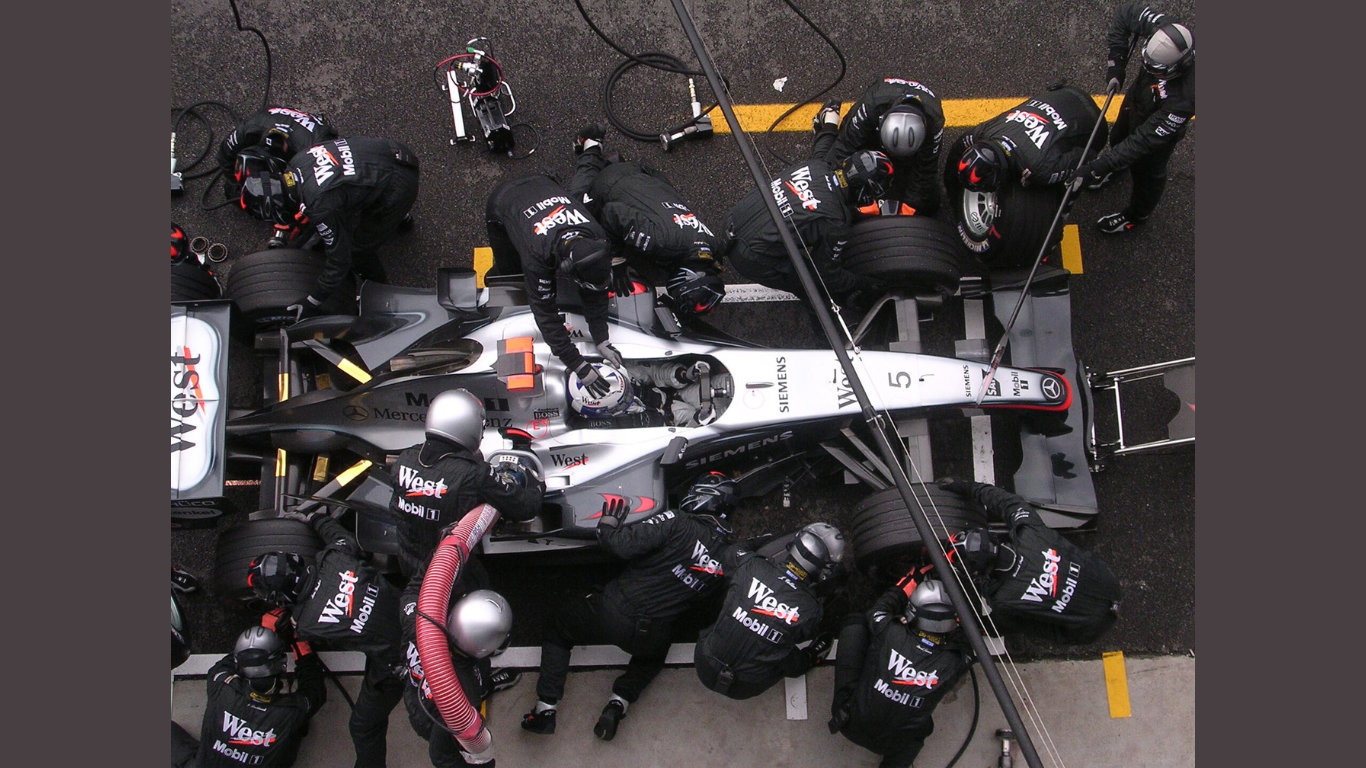
Borrowing an Idea From Formula One
To test that concept, investigators evaluated a real-time workflow coordination platform known as the S1 Pit Crew™ system during 51 consecutive elective degenerative spine procedures performed by three fellowship-trained spine surgeons at a single hospital.
The name is appropriate.
Formula One pit crews are famous not because individual mechanics work unusually fast, but because every movement is synchronized. Each person knows exactly what to do, precisely when to do it, and how that action fits into the larger sequence.
The software attempts to bring that same philosophy into the operating room.
Rather than changing staffing levels, altering surgical technique, or introducing additional personnel, the platform provides live, role-specific task prompts and continuously updated workflow displays across connected devices. Every member of the perioperative team shares the same situational awareness. As one task is completed, the next responsible team immediately knows it is time to begin.
Perhaps equally important, the system records detailed workflow data throughout each turnover, documenting 24 separate operational events spanning the period from wound closure of one case to incision of the next. Instead of simply knowing that turnover took 30 minutes, the team can identify exactly where delays occurred and why.
What happened when everyone could see the same picture?
The results were striking.
Following implementation of the platform, average turnover time measured 26.5 minutes compared with the institution's historical average of 38 minutes — a descriptive reduction of approximately 30%.
The investigators are careful not to overstate the finding. Because the comparison involved a historical institutional baseline rather than a concurrent control group, the reduction is appropriately described as descriptive rather than statistically proven.
However, another finding did achieve statistical significance.
The operating room teams became progressively more efficient as they gained experience using the system.
During the first 26 cases, average turnover measured 28.9 minutes.
During the subsequent 25 cases, average turnover fell to 23.9 minutes — a statistically significant improvement (P=0.02). Rather than producing a temporary novelty effect, the workflow appeared to improve as the teams became increasingly comfortable with the new coordination process.
That observation may be the most encouraging finding in the study.
Technology often promises immediate transformation. Real organizational improvement, however, usually depends on people adapting their behavior over time.
This study suggests exactly that.
Perhaps More Important Was What Didn't Change
One might worry that faster turnover simply means people rushing. The data suggest otherwise.
The perioperative intervals immediately before and after turnover remained essentially unchanged throughout the study. Different procedure types — from decompressions to anterior cervical discectomy and fusion to anterior lumbar procedures — showed remarkably similar workflow intervals. Different surgeons performed similarly. Different operating rooms produced comparable results.
In other words, surgeons were not operating faster.
Anesthesia was not shortening safety-critical processes. Clinical care was not being compressed.
Instead, the improvements appeared isolated to the period most dependent upon communication and coordination.
Efficiency should never come at the expense of safety. Instead, this study suggests that much of the wasted time between cases may simply reflect uncertainty about who should be doing what — and when.
Data Can Reveal Problems Nobody Sees
Another intriguing aspect of the platform is its ability to identify recurring operational bottlenecks.
Among the delays documented during the study were patient restroom visits, translator requirements, sterile processing issues, anesthesia-related delays, surgeon availability, and post-anesthesia care unit holds.
None of these problems can be solved simply by displaying a timer. But they can be measured.
And once they are measured consistently, they become opportunities for systematic quality improvement.
Hospitals frequently spend months debating the causes of operating room inefficiency based largely on anecdotal experience. Objective workflow data can transform those conversations from opinion into evidence.
Instead of asking, "Why are we always running late?" administrators can begin asking, "Why are translator delays occurring in 6% of cases, and how can we solve that?"
Could this extend beyond spine surgery?
Although the study focused exclusively on adult degenerative spine surgery, the underlying concept is almost certainly broader.
Every orthopedic specialty experiences turnover. Every surgical specialty depends on coordination among multiple professional teams.
Every hospital struggles with balancing increasing patient demand against finite operating room capacity.
Because the intervention targets workflow rather than procedure-specific technique, there is every reason to believe the concept deserves investigation in arthroplasty, trauma, sports medicine, hand surgery, and beyond.
Whether similar benefits will be observed across different hospitals and healthcare systems remains an open question. The authors appropriately acknowledge that larger multicenter studies will be necessary before broad conclusions can be drawn.
The Real Innovation May Be Cultural
Perhaps the most interesting aspect of this paper is that it challenges the way orthopedic surgeons traditionally think about innovation.
For decades, progress has largely meant better hardware. Better imaging. Better navigation. Better robotics.
Those advances have unquestionably improved patient care.
Yet this study reminds us that enormous gains may still exist outside the operative field itself. A perfectly executed lumbar fusion still occupies only part of the surgical day.
Everything surrounding that procedure — preparation, communication, coordination, and turnover — determines how many additional patients can ultimately benefit from that surgeon's expertise.
In many ways, operating room efficiency is becoming a strategic issue rather than merely an operational one.
Hospitals face growing workforce shortages. Demand for spine surgery continues to increase. Financial pressures are mounting. Patients expect faster access to care. Finding additional operating rooms is expensive. Building new hospitals is even more so.
Finding 30 extra minutes each day inside existing operating rooms may prove to be one of the most valuable investments an institution can make.
What if the next major advance is simply better work flow coordination?
This study was performed at a single institution using a relatively small cohort, and its comparison with historical turnover times remains descriptive rather than statistically validated.
Nevertheless, it asks an important — and surprisingly overlooked — question. What if the next major advance in spine surgery isn't another instrument, implant, navigation platform, or robot?
What if it is simply helping highly skilled people coordinate their work more effectively?
Orthopedic surgery has always celebrated technical excellence inside the wound.
This study reminds us that excellence outside the wound may be just as important.
Because in today's operating room, the most valuable innovation may not help surgeons operate faster.
It may simply help the entire team move together.
Authors: Brumm ZG; Aepala MR; Gottlieb JK; Kim PD; Nigh E; Barrus A; Bowler R; Britton J; Bergen SR; Haua SL; Makabenta MF; Pusch S; Stephens S; Fishell J; Iligan H; Airada I; Tegura VJ; Ortega V; Iniguez K; Reyes J; Iribe N; Duda B; Delos Santos ME; Raiszadeh R
Author
Why This Matters
Two Perspectives
MBA Lens: Economic and industry impact
Optimizing operating room turnover time presents a significant opportunity for hospitals to enhance efficiency, reduce costs, and increase surgical capacity. The S1 Pit Crew™ system, a real-time workflow coordination platform, demonstrated a descriptive 30% reduction in turnover, improving staff satisfaction and potentially increasing case volume without additional staffing or compromising safety.
- Workflow coordination software offers a market solution to improve OR utilization and financial performance.
- Reduced turnover can lead to substantial cost savings, increased revenue from more procedures, and mitigated surgeon burnout.
PhD Lens: Clinical and outcomes impact
A study evaluated the S1 Pit Crew™ system, a real-time workflow coordination platform, in 51 elective degenerative spine procedures. It showed a descriptive 30% reduction in average turnover time (from 38 to 26.5 minutes) by improving team communication and coordination, not by accelerating surgical steps or compromising safety. Efficiency significantly improved with team experience.
- The study used a historical institutional baseline for comparison, not a concurrent control group, making the initial 30% reduction descriptive.
- A statistically significant improvement (P=0.02) was observed as teams gained experience, reducing turnover from 28.9 to 23.9 minutes.
React:
Discussion
This is a fascinating development. In my practice we've seen similar outcomes with the revised protocol. The key differentiator seems to be patient selection criteria. Has anyone else noticed the correlation with BMI thresholds?
Great point. I'd push back slightly on the conclusion, the sample size in the cited study is too small to draw population-level inferences. That said, the directional signal is compelling and worth a larger RCT.
We implemented a similar approach last year. Early results are promising but we're still gathering 12-month follow-up data. Happy to share our protocol if anyone is interested.
Join the conversation
Orthopedic professionals are discussing this. Sign in and upgrade to read every comment and add your voice.