
LONDON--(BUSINESS WIRE)--OSSTEC, an orthopedic company developing 3D-printed cementless joint replacement implants, today announced it has closed $8 million to fund the first-in-human U.S. surgical cases of ASCENT, its cementless, fixed-bearing partial knee system. The round was led by EMBRYO Ventures, with participation from Neovate Capital, New Wave Ventures, Oxford Technology Innovation Finance and Empirical Ventures.
OSSTEC Closes $8 Million to Fund First-in-Human & U.S. Launch of ASCENT® Cementless Partial Knee and Advance Pipeline
2 min read Premium comments
OSSTEC#fundingASCENTEMBRYO VenturesNeovate CapitalNew Wave VenturesOxford Technology Innovation FinanceEmpirical Ventures
Around half of knee replacement patients are suitable for a partial knee, a bone-preserving procedure with faster recovery, yet only about 10% receive one. Cement adds time and complexity in the operating room, while cementless fixation reduces loosening, a leading cause of revision, opening up the treatment opportunity to more active patients.
The capital will take ASCENT and its CLARITY instrumentation through FDA clearance to first-in-human procedures in the U.S., planned for the first half of 2027. It enables training and support of OSSTEC's surgeon faculty at leading partial knee centers, following the establishment of U.S. operations earlier this year.
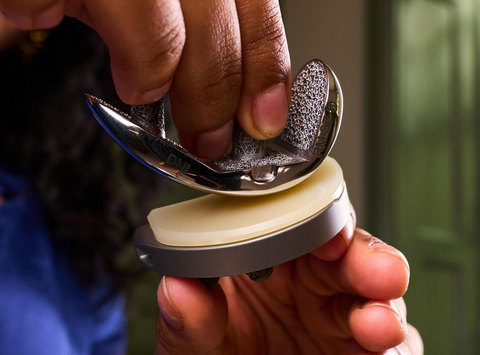
This financing also advances ASCENT's underlying platform technology: a 3D-printed biomimetic fixation platform built on more than a decade of research into implant fixation and osseointegration, designed to enable biological fixation without cement. OSSTEC is expanding a pipeline of cementless applications beyond partial knee replacement and evaluating integration with robotic surgery platforms.
"This financing moves our focus from preparation to patients," said Max Munford, PhD, Founder and CEO of OSSTEC. "Surgeons tell us they would offer a partial knee to more patients if they could use next-generation cementless technology. ASCENT is designed to give them that, integrated with a familiar, streamlined surgical workflow, and the platform behind it is built to go further, with a pipeline of cementless applications beyond the knee."
"We are excited to lead this financing round in OSSTEC, representing an exceptional opportunity to advance partial knee replacement. With its next-generation implant technology approaching first clinical use, we look forward to supporting the company in its ambition to improve patient outcomes and drive greater operational efficiency", said Dr Arash Moavenian, Chief Executive, EMBRYO Ventures.
OSSTEC will attend the 2026 AAHKS Annual Meeting, November 5–8, in Grapevine, Texas.
ASCENT and CLARITY are not cleared by the FDA and are not available for sale in the United States.
About OSSTEC
OSSTEC is an orthopedic company developing cementless joint replacement implants using patented 3D-printing technology. Founded in 2021 as a startup from Imperial College London, the company combines surgeon-led design and additive manufacturing to improve implant fixation, durability and surgical efficiency. OSSTEC is headquartered in the UK, with U.S. operations through OSSTEC Inc. Learn more at www.osstec.com.
About EMBRYO Ventures
EMBRYO Ventures is a London-based venture capital firm invested in exceptional founders advancing the frontiers of human health and experience. Learn more at www.embryoventures.com.
Socials
Author
TH
TJ Halvorson
The De Angelis Group | Orthopedics This Week | MSK Innovations
Why This Matters
Two Perspectives
MBA Lens: Economic and industry impact
OSSTEC secured $8 million to fund the U.S. launch of its ASCENT cementless partial knee system, targeting a significant market opportunity where only 10% of suitable patients receive partial knees. This capital will facilitate FDA clearance, first-in-human procedures by H1 2027, and surgeon training, aiming to increase adoption by offering next-generation cementless technology that reduces OR time and revision rates for active patients.
- The company aims to expand the partial knee market by addressing surgeon preferences for cementless technology, potentially improving surgical efficiency and patient outcomes.
- Strategic financing supports U.S. market entry, surgeon education, and pipeline development, positioning OSSTEC for growth in the joint replacement sector.
PhD Lens: Clinical and outcomes impact
OSSTEC's $8 million funding will advance its 3D-printed cementless ASCENT partial knee system, built on a biomimetic fixation platform developed from over a decade of research into osseointegration. This technology aims to enable biological fixation without cement, reducing loosening—a primary cause of revision—and improving durability for joint replacement patients. First-in-human U.S. procedures are planned for H1 2027.
- The core technology involves a 3D-printed biomimetic fixation platform designed to promote biological fixation and osseointegration, eliminating the need for cement.
- Clinical development includes FDA clearance and planned first-in-human U.S. surgical cases by early 2027, with a focus on reducing revision rates due to implant loosening.
React:
Discussion
This is a fascinating development. In my practice we've seen similar outcomes with the revised protocol. The key differentiator seems to be patient selection criteria. Has anyone else noticed the correlation with BMI thresholds?
Great point. I'd push back slightly on the conclusion, the sample size in the cited study is too small to draw population-level inferences. That said, the directional signal is compelling and worth a larger RCT.
We implemented a similar approach last year. Early results are promising but we're still gathering 12-month follow-up data. Happy to share our protocol if anyone is interested.
Join the conversation
Orthopedic professionals are discussing this. Sign in and upgrade to read every comment and add your voice.