
The Broström repair is a time tested, dependable answer to a difficult problem: an ankle that never quite recovered from its first bad sprain. When rehabilitation, bracing, and time fail to stop recurrent giving-way, surgeons tighten and reattach the attenuated lateral ligaments, restoring anatomy as well as stability.
Is the Internal Brace Ready to Stand Alone?
6 min read Premium comments
internal bracechronic lateral ankle instabilitysuture tapeBrostrom repairaugmentation
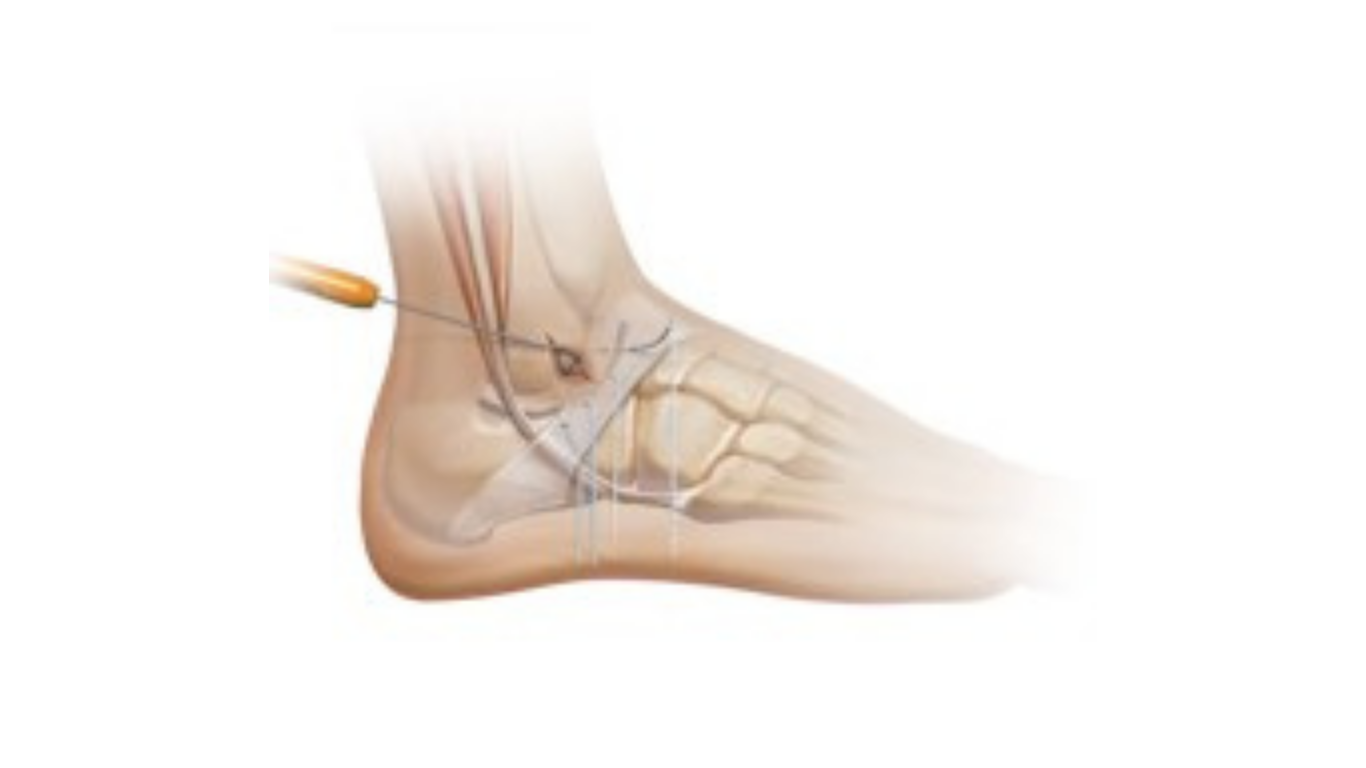
Then came the internal brace — a strip of high-strength suture tape anchored along the path of the damaged ligaments. Initially conceived as a checkrein protecting a Broström repair while biology did its work, the construct offered impressive time-zero strength and the promise of earlier motion, weightbearing, and return to sport.
But if the brace is strong enough to protect a repair, is it strong enough to replace one?
A new retrospective study from Albany Medical Center takes on that provocative question by comparing internal brace augmentation alone with a modified Broström repair reinforced by an internal brace.
Its answer is intriguing but deliberately incomplete: outcomes at roughly one year were not statistically different, yet the brace-only cohort showed numerical signals — especially in revision surgery — that prevent any declaration of equivalence.
Two Routes to a Stable Ankle
The investigators reviewed lateral ankle stabilization procedures performed at a single academic center from January 2017 through December 2020. They identified 80 adults, ages 18 to 72, with chronic lateral ankle instability that persisted despite at least six months of nonsurgical care.
These were not simply patients with a sore ankle.
Diagnosis rested on recurrent sprains, clinical laxity demonstrated by anterior drawer or talar tilt testing, and, when available, imaging evidence such as attenuation of the anterior talofibular ligament.
Patients with prior lateral ligament reconstruction, revision Broström surgery, or substantial concomitant procedures were excluded. Diagnostic arthroscopy and limited debridement were permitted.
Fifty-eight patients received internal brace augmentation alone. In this technique, suture tape was anchored along the anatomic course of the lateral ligament complex, typically from the distal fibula to the talar insertion of the anterior talofibular ligament.
When calcaneofibular ligament augmentation was required, an additional strand could extend from the fibula to the calcaneus. Crucially, the surgeon did not imbricate or repair the native ligament remnants and did not advance the extensor retinaculum.
The remaining 22 patients underwent the familiar biologic repair plus mechanical reinforcement.
Their attenuated anterior talofibular ligament was imbricated and repaired to the fibula; the calcaneofibular ligament was repaired when stress examination showed laxity. Where documented, the inferior extensor retinaculum supplied the Gould reinforcement. Only then was the suture-tape brace placed across the repair.
The conceptual difference is substantial. One operation asks the implant to provide stability. The other combines immediate implant support with repaired tissue that may heal and assume load over time.
Postoperative care was similar.
Patients spent approximately two weeks non-weightbearing in a splint or cast, followed by a controlled ankle motion boot and progressive weightbearing over two to four weeks. Physical therapy began with weightbearing and emphasized motion and peroneal strengthening. Most patients could return to unrestricted activity or sport at about three months, depending on progress.
Similar Satisfaction, Unsettling Numbers
At baseline, the groups looked broadly alike. Mean age was 32.4 years in the brace-only cohort and 29.5 years in the combined cohort. Both had a mean body mass index near 29.4, similar sex distribution, laterality, comorbidity profiles, and rates of concurrent arthroscopy or debridement.
All 80 patients had at least 12 months of follow-up; mean follow-up was about 14 months.
Satisfaction was high regardless of technique. Among respondents, 87.5% of brace-only patients were satisfied, compared with 90.9% of those receiving Broström repair plus the brace. That difference was not statistically significant.
Nor were differences in the other measured outcomes. Persistent pain affected 32.7% of brace-only patients and 22.7% of combined-procedure patients. Recurrent instability occurred in 6.9% and 4.5%, respectively.
Revision surgery produced the most eye-catching comparison. Seven of 58 patients in the brace-only group — 12.1% — underwent another operation for persistent instability, generally conversion to a formal Broström repair or tendon reconstruction.
One of 22 patients in the combined group, or 4.5%, required revision.
Statistically, none of these comparisons cleared the conventional threshold for significance.
For revision, the odds ratio was 2.88, but its 95% confidence interval stretched from 0.33 to 24.90. That enormous range encompasses everything from a possible reduction in risk to a very large increase. It is a portrait of uncertainty, not reassurance.
Three minor perioperative complications — superficial wound irritation or neuropraxia — occurred in the brace-only group and resolved without surgery. Neither cohort experienced a major complication.
Absence of Evidence Is Not Equivalence
The paper’s most important contribution may be its statistical restraint. A superficial reading could conclude that the operations “performed the same.” The investigators explicitly warn against that interpretation.
This was a Level III retrospective comparison, not a randomized trial and not a study designed to demonstrate noninferiority or equivalence. No sample-size calculation preceded the analysis. Post hoc, the study had less than 30% power to detect small differences.
With only 80 patients, an uneven 58-to-22 split, and relatively few adverse events, even clinically meaningful differences could fail to produce a significant P value.
Treatment allocation also followed surgeon preference. One surgeon exclusively performed the standalone internal brace procedure, whereas other foot and ankle surgeons performed the combined operation. Differences in patient selection, technique, operative philosophy, and thresholds for reoperation could therefore travel with the surgeon rather than the procedure.
The outcomes themselves were blunt instruments. Formal validated patient-reported measures were not collected routinely, so investigators relied on charted yes-or-no assessments of satisfaction, pain, instability, and revision. The study could not describe the magnitude of improvement, subtle functional differences, athletic performance, or return-to-sport timing. It also could not meaningfully analyze high-risk subgroups such as patients with generalized laxity or poor ligament tissue.
And one year is early when the key biological question is durability. A combined procedure offers both an implant checkrein and repaired ligament tissue. Standalone bracing leaves long-term stability more dependent on the tape-and-anchor construct. Differences might emerge only after years of loading, remodeling, athletic exposure, or implant-related change.
A Construct With Promise – and a Burden of Proof
This study offers a credible signal that the brace-only approach can work for selected patients. Nearly nine in 10 respondents were satisfied, and reported recurrent instability was uncommon at short-term follow-up. Those are not trivial findings for a technique that omits the traditional repair.
Yet the numerical pattern consistently favored the combined operation: less persistent pain, less recurrent instability, and fewer revisions.
The study cannot establish that those differences are real, but neither can it make them disappear. The 12.1% revision rate after standalone bracing deserves particular attention because all seven revisions represented patients for whom mechanical stabilization alone did not provide a durable solution.
There is tension hiding inside those numbers.
A construct can be exceptionally strong on the day of surgery and still face questions that a load-to-failure experiment cannot answer. Anchors can remain secure while symptoms persist; mechanical restraint can limit giving-way without recreating normal proprioception; and excessive tension could theoretically trade instability for stiffness or pain.
The present review did not measure range of motion, stress radiographs, strength, or ankle-specific quality of life, so it cannot explain why nearly one-third of brace-only patients reported persistent pain. Nor can it determine whether pain arose from the stabilization, associated intra-articular disease, rehabilitation, or unrelated pathology. That ambiguity matters when counseling a patient who wants a stable ankle.
For now, the practical message is measured. Internal brace augmentation alone may be a useful option in carefully selected cases, including situations in which native ligament quality makes conventional repair unattractive.
But the evidence does not justify treating the brace-only technique as equivalent to a Broström repair reinforced with suture tape.
What would settle the issue? A prospective, adequately powered, preferably randomized trial with standardized indications and rehabilitation; validated pain and function scores; objective laxity measurements; return-to-sport data; and follow-up extending well beyond one year. A noninferiority design would be especially valuable because the real clinical question is not whether standalone bracing can produce good outcomes — it plainly can — but whether surgeons can safely surrender biologic repair without accepting more failures later.
Until those data arrive, the internal brace is best viewed as an intriguing candidate for a larger role, not a proven replacement for the operation it was designed to protect. The new study opens that door. Its revision numbers remind surgeons not to walk through too quickly.
Authors: Maschhoff C; Bui V; Gauta S; Rosenbaum A
Author
Why This Matters
Two Perspectives
MBA Lens: Economic and industry impact
A retrospective study comparing internal brace augmentation alone versus combined with Broström repair for chronic lateral ankle instability presents intriguing, though incomplete, market signals. While patient satisfaction was high for both, the brace-only cohort showed a numerically higher revision rate (12.1% vs. 4.5%). This suggests potential market differentiation and adoption challenges for standalone brace procedures, impacting product strategy and competitive positioning in the orthopedic device market.
- The study's findings, though not statistically significant, highlight a potential trade-off between procedural simplicity (brace-only) and long-term durability, influencing surgeon adoption.
- The higher revision rate for standalone bracing may necessitate further evidence to drive broader market acceptance and impact reimbursement strategies for device manufacturers.
PhD Lens: Clinical and outcomes impact
A retrospective study compared internal brace augmentation alone (suture tape) with a modified Broström repair augmented by an internal brace for chronic lateral ankle instability. While outcomes at one year were not statistically different, the brace-only group exhibited numerically higher rates of persistent pain (32.7% vs. 22.7%), recurrent instability (6.9% vs. 4.5%), and revision surgery (12.1% vs. 4.5%).
- The study's Level III retrospective design, uneven cohort split (58 vs. 22), and lack of formal validated patient-reported outcomes limit definitive conclusions on equivalence.
- Long-term durability and the biological contribution of repaired tissue versus sole reliance on the implant construct remain critical unanswered questions requiring further investigation.
React:
Discussion
This is a fascinating development. In my practice we've seen similar outcomes with the revised protocol. The key differentiator seems to be patient selection criteria. Has anyone else noticed the correlation with BMI thresholds?
Great point. I'd push back slightly on the conclusion, the sample size in the cited study is too small to draw population-level inferences. That said, the directional signal is compelling and worth a larger RCT.
We implemented a similar approach last year. Early results are promising but we're still gathering 12-month follow-up data. Happy to share our protocol if anyone is interested.
Join the conversation
Orthopedic professionals are discussing this. Sign in and upgrade to read every comment and add your voice.