
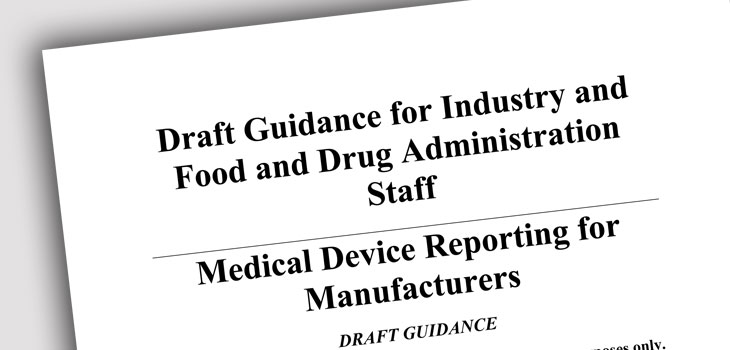
The FDA recently issued a 54-page draft guidance to help device manufacturers figure out if an event is adverse and reportable. The draft addresses specific questions about reporting and record-keeping requirements for device-related adverse events.
Adverse Event Guidance Changes From FDA
2 min read Premium comments
Secondary
You’ve got until October 7, 2013 to respond.
Adverse Event
According to the FDA, reportable events for manufacturers “are events that manufacturers become aware of that reasonably suggest that one of their marketed devices may have caused or contributed to a death or serious injury, or has malfunctioned and the malfunction of the device or a similar device that they market would be likely to cause or contribute to a death or serious injury if the malfunction were to recur.”
Recommendations
The FDA hasn’t updated its device reporting guidance in 16 years. The draft significantly expands on an earlier 1997 guidance for manufacturers and attempts to respond to concerns of industry. For example, it includes recommendations concerning:
- Evaluating differences of medical opinion
- Conducting follow-up investigations
- Determining the expected life of the device
- Reporting events for devices marketed only in foreign countries
- Reporting events for devices that are no longer being manufactured
- Allocating responsibility for reporting after a 510(k) has been transferred to another firm
- Dealing with patient confidentiality rules in healthcare settings
The draft contains some suggestions on the topic of reportability, including events involving:
- A delay in surgery
- The failure of a diagnostic device
- Incorrect treatment with a radiation therapy device
The draft makes additional recommendations concerning the information that should be submitted in the different blocks on the MedWatch Form 3500A. Finally, the draft makes clear that certain changes to medical device reporting proposed by Congress in the Food and Drug Administration Amendments Act 2007 have not been implemented by the FDA. The result is that malfunction reporting requirements for Class I and those Class II devices that are not permanently implantable, life supporting or life sustaining, continue to be subject to the medical device reporting requirements of 21 CFR Part 803.
Link to Draft Guidance
The draft guidance is available: “Medical Device Reporting for Manufacturers“.
For questions regarding this document, contact the MDR (medical device reporting) Policy Branch, 301-796-6670, MDRPolicy@fda.hhs.gov.
Author
React:
Discussion
This is a fascinating development. In my practice we've seen similar outcomes with the revised protocol. The key differentiator seems to be patient selection criteria. Has anyone else noticed the correlation with BMI thresholds?
Great point. I'd push back slightly on the conclusion, the sample size in the cited study is too small to draw population-level inferences. That said, the directional signal is compelling and worth a larger RCT.
We implemented a similar approach last year. Early results are promising but we're still gathering 12-month follow-up data. Happy to share our protocol if anyone is interested.
Join the conversation
Orthopedic professionals are discussing this. Sign in and upgrade to read every comment and add your voice.