
Most companies with an intradiscal therapy are still waiting on trial data. Vivex Biologics is in the opposite position. VIA Disc NP has been on the market since 2021, Medicare contractors reimburse the procedure, and the company has treated well over 25,000 discs. That created a dataset most of its competitors do not have.
What Happens When You Put Something Between Conservative Care and Surgery
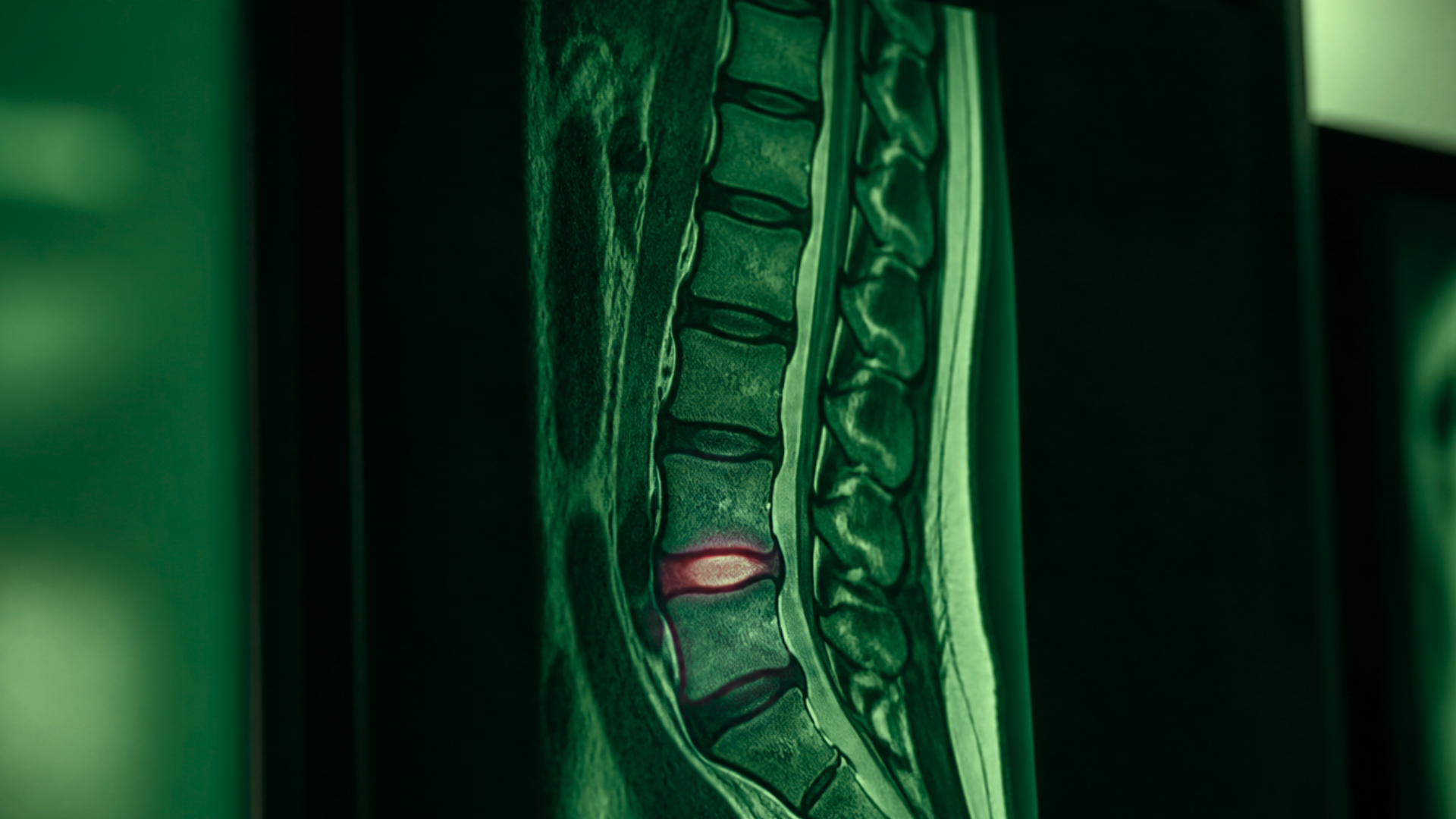
In June, Vivex published a retrospective analysis of that dataset in the Journal of Pain Research. The paper, "Comparing Medicare Claims in Patients with Lumbar Discogenic Pain Managed Conservatively or with Intradiscal Nucleus Pulposus Allograft," was authored by George Girardi, MD, Derron Wilson, MD, Raj Patel, MD, and Shiraz Yazdani, MD. I sat down with Dr. Block, Vivex's Chief Clinical Officer, to go through what the study found and how it was built.
How the study was built
The analysis used the full Medicare fee-for-service claims database. "It's the 100% Medicare database," Dr. Block said. "It's not a 5% random sample. It's the whole dataset." Inovalon, an independent data firm, handled access, processing, and analysis. To be included, a patient needed 12 months of continuous Medicare enrollment before the VIA Disc NP procedure and 12 months after. That requirement limited the study to patients treated between August 2021 and the end of 2024, the earliest stretch of the product's commercial life.
Dr. Block sees that as a conservative cut of the data. The cohort includes physicians who did one case and never did another, and physicians who started with a handful of cases before doing hundreds in the years that followed. Patients treated in 2025 and 2026 do not yet have enough claims history to qualify.
From roughly 3.3 million Medicare beneficiaries with a degenerative disc disease diagnosis in that window, the researchers matched 1,804 VIA Disc NP patients one-to-one with 1,804 patients managed with conservative care, defined as epidural steroid injections, platelet-rich plasma injections, and/or physical therapy. Patients were matched on eight variables: age, sex, baseline Charlson Comorbidity Index, disc degeneration, radiculopathy, disc herniation, spondylosis or facet arthropathy, and baseline chronic opioid therapy.
Two groups at different points in the care continuum
The matching made the groups statistically comparable. It did not make them clinically identical, and Dr. Block was direct about that.
Conservative care patients were typically earlier in their disease course. The VIA Disc NP patients had already moved on. Seventy-two percent of them were managed by a pain medicine specialist, compared with 25% of the conservative care group. At baseline, the VIA Disc NP group also had 18% more opioid prescriptions and 11% more imaging utilization than the conservative care group. By Dr. Block's read, three times as many VIA Disc NP patients had already reached a pain physician, which tells you they were further down the line.
What changed after the procedure
Comparing the 12 months before VIA Disc NP with the 12 months after, the treated group showed:
About a 20% reduction in opioid prescriptions (P=0.001). The mean number of scripts per patient fell from 3.3 to 2.6.
About a 30% reduction in total days' supply of opioids (P=0.001), from a mean of 129 days to 90.
About a 40% reduction in imaging utilization (P=0.0001). The share of patients with any lumbar imaging claim dropped from 81% before the procedure to 46% after.
A 60% reduction in MRI use. MRI utilization fell from 63% of patients to 25%.
The conservative care group also saw opioid and imaging use decline over its own 12-month window, though from a lower starting point, and the two groups ended up at similar levels on those measures by the end of follow-up.
The imaging numbers were the finding Dr. Block kept coming back to, MRI in particular, since it is the big ticket item. "Having that imaging utilization go down after VIA Disc means the patient is now satisfied," he said. "They don't need to go chasing for a diagnosis anymore."
Against conservative care
Compared with the matched conservative care group over the same period, VIA Disc NP patients used fewer downstream conservative treatments:
Epidural steroid injections: 31% of VIA Disc NP patients versus 55% of conservative care patients, a 44% reduction (P=0.0001).
Physical therapy claims: 40% versus 76%, a 47% reduction (P=0.0001).
The fusion number
At one year, 6% of patients in each group had gone on to spinal fusion (P=0.53). Dr. Block does not read that as a wash. Because the VIA Disc NP group was further along in the continuum, he would have expected its fusion rate to come in higher. Without the procedure that number could have been 8%, 10%, or 12%, and nobody knows the natural history of that more burdened group.
His overall take is that this is a textbook example of what happens when a new treatment is inserted into a care pathway that previously had nothing between conservative management and surgery. Those patients would have stayed in conservative care until the day they needed a decompression, a fusion, or an arthroplasty. Something was put in the middle, and it moved the numbers.
The authors note the usual limits of claims data. Medicare restricts the population to patients 65 and older, and the claims are collected for billing rather than clinical outcomes, so the paper describes its findings as inferential on clinical effectiveness.
What comes next
One year is not long enough to answer the question Vivex most wants answered. Dr. Block said the company plans to return to the Medicare database and extend follow-up to 24 months and beyond, with three things in mind: whether VIA Disc NP reduces the rate of fusion or arthroplasty, how much time it adds before surgery for patients who do eventually have one, and overall prevalence.
The claims study sits alongside two randomized controlled trials Vivex is running at the same time: the RESTORE trial in the United States, a 20-site study with Timothy Deer, MD, as principal investigator, and the ASCEND trial in Australia. The ASCEND data was recently published in the Journal of Clinical Medicine, titled “Intradiscal Nucleus Pulposus Allograft versus Sham Procedure in Patients with Lumbar Discogenic Pain: A Randomized Clinical Trial”.
VIA Disc NP is a minimally manipulated, micronized nucleus pulposus allograft processed from donor intervertebral disc tissue. It is delivered minimally invasively under fluoroscopic guidance in an outpatient procedure under light sedation.
Source: Girardi GE, Wilson DK, Patel RG, Yazdani S. Comparing Medicare Claims in Patients with Lumbar Discogenic Pain Managed Conservatively or with Intradiscal Nucleus Pulposus Allograft. J Pain Res. 2026;19:596149. doi:10.2147/JPR.S596149. Published June 6, 2026. Full text
Author
TH
TJ Halvorson
The De Angelis Group | Orthopedics This Week | MSK Innovations
Why This Matters
Two Perspectives
MBA Lens: Economic and industry impact
Vivex Biologics' VIA Disc NP, on the market since 2021 with Medicare reimbursement, demonstrates significant market penetration and cost-saving potential. A large-scale Medicare claims analysis showed reduced opioid use, imaging, and downstream conservative treatments post-procedure, even for patients further along the care continuum. This positions Vivex favorably against competitors awaiting trial data.
- The procedure is reimbursed by Medicare and has treated over 25,000 discs, establishing strong market adoption.
- Reduced healthcare resource utilization (opioids, imaging, ESI, PT) suggests potential cost efficiencies and market differentiation.
PhD Lens: Clinical and outcomes impact
A retrospective Medicare claims analysis of VIA Disc NP, a minimally manipulated nucleus pulposus allograft, revealed significant reductions in opioid prescriptions, imaging utilization, and subsequent conservative treatments for patients with lumbar discogenic pain. Despite the VIA Disc NP group being clinically more advanced at baseline, fusion rates were comparable to conservative care at one year.
- The study utilized a large, 100% Medicare fee-for-service claims database, matching 1,804 VIA Disc NP patients to conservative care controls.
- Limitations include the retrospective claims data nature, inferential clinical effectiveness, and focus on patients aged 65 and older.
React:
Discussion
This is a fascinating development. In my practice we've seen similar outcomes with the revised protocol. The key differentiator seems to be patient selection criteria. Has anyone else noticed the correlation with BMI thresholds?
Great point. I'd push back slightly on the conclusion, the sample size in the cited study is too small to draw population-level inferences. That said, the directional signal is compelling and worth a larger RCT.
We implemented a similar approach last year. Early results are promising but we're still gathering 12-month follow-up data. Happy to share our protocol if anyone is interested.
Join the conversation
Orthopedic professionals are discussing this. Sign in and upgrade to read every comment and add your voice.