
BOUNTIFUL, Utah--(BUSINESS WIRE)--Vy Spine, a spine innovation leader using differentiated materials and designs, announced today that it has received U.S. Food and Drug Administration (FDA) clearance for its VySion-P SI Fusion and VyStop SI Screw Systems.
Vy Spine Announces FDA Clearance of 3D Printed VySion-P SI Fusion and VyStop SI Screw Systems
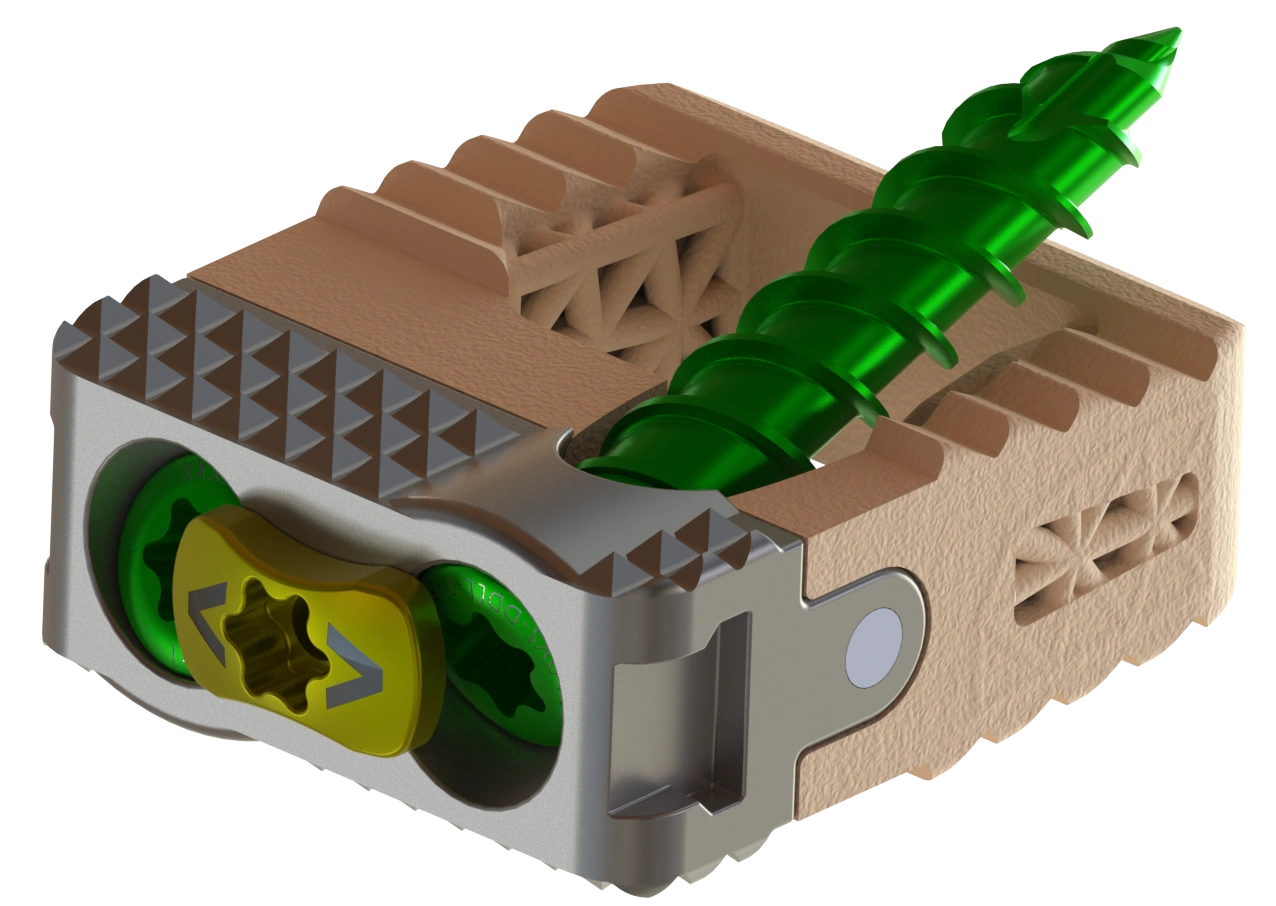
The VySion-P SI System is intended for sacroiliac joint fusion for conditions including degenerative sacroiliitis and sacroiliac joint disruptions, to augment immobilization and stabilization of the sacroiliac joint in skeletally mature patients undergoing sacropelvic fixation as part of a lumbar or thoracolumbar fusion. This includes those whose symptoms began during pregnancy or in the peripartum period and have persisted postpartum for more than six months. When the VySion-P SI System device (i.e., an “in-line” or “intra-articular” device) is implanted, it must be used with a VyStop SI Screw System device (i.e., a “transfixing” device) implanted across the same sacroiliac joint to create a hybrid SI joint fusion construct.
The VyStop SI Screw System is indicated for sacroiliac fusion for the following conditions:
• Sacroiliac joint dysfunction that is a direct result of sacroiliac joint disruption and degenerative sacroiliitis. This includes conditions whose symptoms began during pregnancy or in the peripartum period and have persisted postpartum for more than six months;
• To augment immobilization and stabilization of the sacroiliac joint in skeletally mature patients undergoing sacropelvic fixation as part of a lumbar or thoracolumbar fusion; and
• Acute, non-acute, and non-traumatic fractures involving the sacroiliac joint.
The VySion-P device is offered in PEEK Optima LT1, HA-Enhanced PEEK Optima, NanoVy Ti coated PEEK Optima, and OsteoVy PEKK. It is the first polymeric device of its kind to be cleared for SI fusion, and the first SI fusion device using the proven 3D printed OsteoVy PEKK material. Additionally, the VySion-P has self-drilling screws to aid in anchoring the device directly to the bone.
OXPEKK has demonstrated bone ingrowth, no radiographic interference, no fibrotic tissue membrane formation, a significant increase in bony apposition over time, and significantly higher push-out strength compared to standard PEEK. In addition to these product benefits, OXPEKK is bacterostatic and an ideal option for patients with metal hypersensitivity. Vy Spine’s proprietary OsteoVy lattice structure aids in bony integration as well as wicking, PEKK being a hydrophilic material, to provide even greater benefit as an interbody implant.
“The VySion-P SI Fusion clearance is an exciting development for Vy Spine, and another product in a long line of Vy Spine implants which will utilize the unique qualities of our proprietary OsteoVy PEKK designs,” said Bret Berry, President of Product Development for Vy Spine. “As we researched OXPEKK and its unique characteristics, we found that this composition accomplishes what PEEK cannot. We are excited about the OXPEKK material and our continued partnership with Oxford Performance Materials.”
About Vy Spine, LLC
VySpine was created through active internal development and the licensing of various proven technologies using innovative materials and designs. The company strives to outpace the competition by collaborating with key spine innovators while providing a flexible, cost-effective approach to spine care. Learn more at www.vyspine.com.
Founded in 2000, Oxford Performance Materials (OPM) is a pioneer in the development and commercialization of advanced materials and additive manufacturing technologies. OPM's proprietary OsteoFab technology leverages the high-performance PEKK (poly-ether-ketone-ketone) polymer and state-of-the-art 3D printing experience to produce devices that address critical challenges in today’s orthopedic industry. OPM provides the world’s only implantable medical devices that are personalized, metal-free, osseointegrative, anti-bacterial, radiolucent, and fully modifiable in the operating room. OPM is in commercial production of numerous orthopedic implant applications, including lower & upper extremity, oncology, trauma, cranial, facial, spinal, and sports medicine devices. OPM has also developed patented PEKK nanocoating technologies to improve performance of metal implants.
“Vy Spine,” “VySion,” “VyStop,” and “OsteoVy,” are registered trademarks of Vy Spine.
“OsteoFab,” “OXFAB” and “OXPEKK” are registered trademarks of Oxford Performance Materials.
Contacts
Media Contact: Paul Williams, 310-569-0023, paul@medialinecommunications.com
Author
Why This Matters
Two Perspectives
MBA Lens: Economic and industry impact
Vy Spine secured FDA clearance for its VySion-P SI Fusion and VyStop SI Screw Systems, strategically entering or expanding in the sacroiliac joint fusion market. This move leverages proprietary 3D printed OsteoVy PEKK material, offering differentiation through enhanced bone integration and unique properties like bacteriostasis. The required hybrid construct approach could influence adoption and competitive dynamics, positioning Vy Spine with a novel material advantage.
- Vy Spine differentiates its SI fusion offering with proprietary 3D printed OsteoVy PEKK, a polymeric material with unique benefits.
- The company's strategy involves a required hybrid construct (VySion-P with VyStop SI Screw) for SI joint fusion, impacting market adoption.
PhD Lens: Clinical and outcomes impact
Vy Spine received FDA clearance for its VySion-P SI Fusion and VyStop SI Screw Systems, indicated for sacroiliac joint fusion in conditions like degenerative sacroiliitis and postpartum symptoms. The VySion-P device utilizes advanced materials, notably 3D printed OsteoVy PEKK, and is the first polymeric device of its kind cleared for SI fusion. A hybrid construct, combining both systems, is required for implantation.
- The VySion-P device incorporates OsteoVy PEKK, demonstrating bone ingrowth, no radiographic interference, and significantly higher push-out strength than standard PEEK.
- Indications include sacroiliac joint dysfunction, degenerative sacroiliitis, and augmentation for sacropelvic fixation, with a mandatory hybrid construct using both systems.
React:
Discussion
This is a fascinating development. In my practice we've seen similar outcomes with the revised protocol. The key differentiator seems to be patient selection criteria. Has anyone else noticed the correlation with BMI thresholds?
Great point. I'd push back slightly on the conclusion, the sample size in the cited study is too small to draw population-level inferences. That said, the directional signal is compelling and worth a larger RCT.
We implemented a similar approach last year. Early results are promising but we're still gathering 12-month follow-up data. Happy to share our protocol if anyone is interested.
Join the conversation
Orthopedic professionals are discussing this. Sign in and upgrade to read every comment and add your voice.