
MONTEREY, Calif.--(BUSINESS WIRE)--Elevation Spine today announced the first surgical case with Saber-XA™, its expandable anterior lumbar interbody fusion (ALIF) system. Andrew Fox, MD, performed the two-level procedure at Mission Community Hospital in Panorama City, Calif.
Elevation Spine Announces First Surgical Case with Saber-XA™, Its Expandable ALIF System with Integrated Plate Fixation
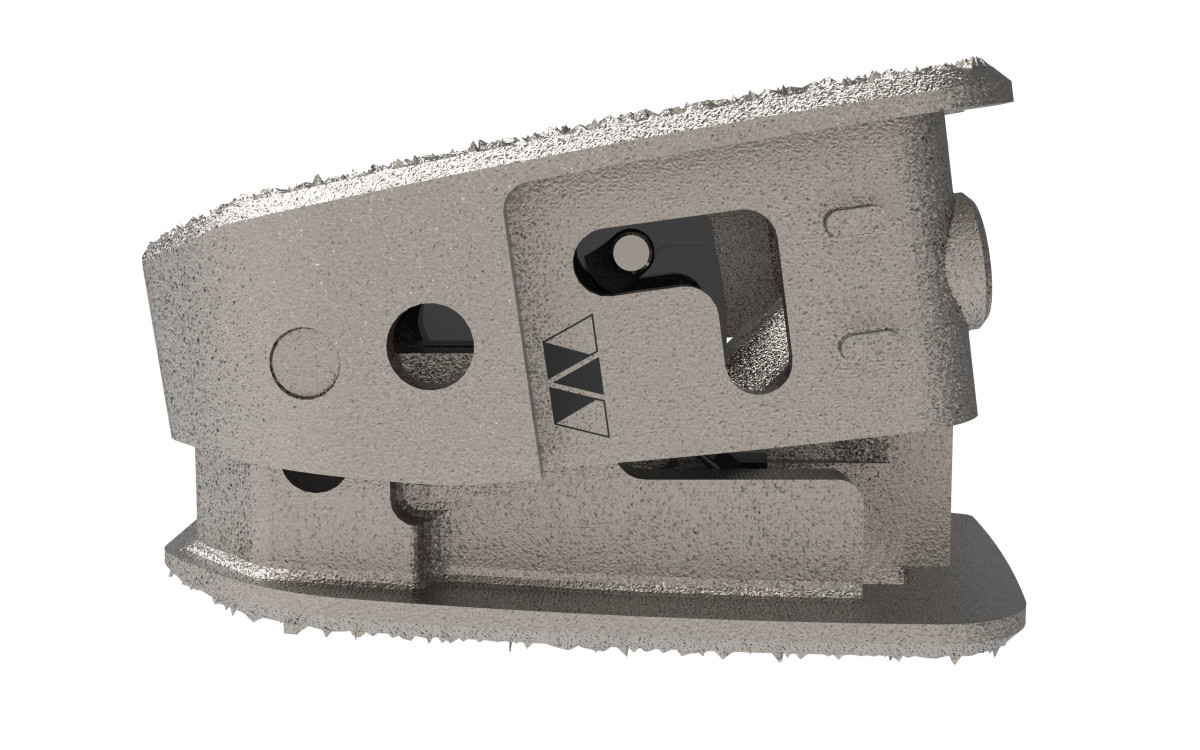
Saber-XA received FDA 510(k) clearance in August 2026 and combines an expandable cage with a zero-profile, FDA-cleared anterior lumbar plate. The system allows surgeons to independently adjust implant height and lordotic angle after the implant is in the disc space, based on individual patient anatomy.
Saber-XA is manufactured with 3D-printed titanium endplates and is available in three footprints with three sizes per footprint. Across nine implant sizes, the system provides height and lordosis configurations that include hyperlordotic options, whereas static ALIF systems can require upward of 70 implant sizing options to cover a comparable range. Fewer implants mean a leaner tray and simpler inventory for facilities.
“Being able to dial in height and lordosis after the cage is seated changes how I approach sizing in an anterior lumbar case. I was able to match the implant to the patient's anatomy in the moment, and the plate gave me fixation without adding profile,” said Dr. Fox.
“A first case is where a design becomes a product,” said Charlie Gilbride, CEO of Elevation Spine. “Saber-XA was built around what surgeons told us they wanted from an anterior lumbar system: true intraoperative control of height and lordosis, and integrated plate fixation. Seeing that come together in the OR with Dr. Fox is a proud moment for our team, and it marks the Saber platform's first clinical use in the lumbar spine.”
Saber-XA is indicated for intervertebral fusion in skeletally mature patients with degenerative disc disease at one or two contiguous levels from L1 to S1, including patients with up to Grade 1 spondylolisthesis or retrolisthesis at the involved levels, and is designed for anterior and oblique lateral approaches. The system is currently in a limited market release, with full commercial launch anticipated in 2027.
About Elevation Spine
Elevation Spine, headquartered in Monterey, California, is a spinal medical device company focused on integrated fixation technologies. The Saber Technology platform combines zero-profile anterior fixation with interbody support for both cervical and lumbar spine procedures. Saber systems are designed to simplify surgical workflows through a streamlined, integrated approach to fixation.
Contacts
Media Contact
Martin Klazmer
martinklazmer@elevationspine.com
(844) 415-0226
Author
Why This Matters
Two Perspectives
MBA Lens: Economic and industry impact
Elevation Spine's Saber-XA™, an expandable ALIF system with integrated plate fixation, completed its first surgical case. This product offers a strategic market advantage by allowing intraoperative height and lordosis adjustment, simplifying inventory and surgical workflows. It significantly reduces the number of required implant sizes compared to static systems, potentially lowering facility costs. Currently in limited release, its full commercial launch in 2027 positions Elevation Spine for growth.
- The system's intraoperative adjustability and integrated fixation differentiate it, simplifying inventory and surgical workflows.
- Anticipated full commercial launch in 2027 aims to capture market share through a streamlined, cost-effective solution.
PhD Lens: Clinical and outcomes impact
Elevation Spine's Saber-XA™ is an expandable ALIF system, featuring 3D-printed titanium endplates and integrated zero-profile plate fixation. Its core mechanism allows independent, intraoperative adjustment of implant height and lordotic angle post-insertion, tailoring to individual patient anatomy. Indicated for intervertebral fusion in skeletally mature patients with degenerative disc disease at L1-S1, including Grade 1 spondylolisthesis, it supports anterior and oblique lateral approaches.
- The system utilizes 3D-printed titanium endplates and allows independent, intraoperative adjustment of height and lordosis.
- Indicated for degenerative disc disease and Grade 1 spondylolisthesis at L1-S1, it combines an expandable cage with integrated plate fixation.
React:
Discussion
This is a fascinating development. In my practice we've seen similar outcomes with the revised protocol. The key differentiator seems to be patient selection criteria. Has anyone else noticed the correlation with BMI thresholds?
Great point. I'd push back slightly on the conclusion, the sample size in the cited study is too small to draw population-level inferences. That said, the directional signal is compelling and worth a larger RCT.
We implemented a similar approach last year. Early results are promising but we're still gathering 12-month follow-up data. Happy to share our protocol if anyone is interested.
Join the conversation
Orthopedic professionals are discussing this. Sign in and upgrade to read every comment and add your voice.