
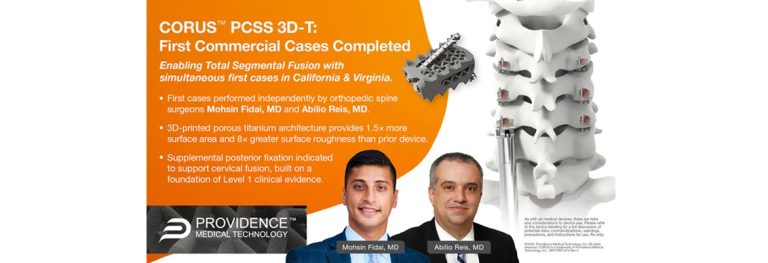
PLEASANTON, Calif., Oct. 29, 2026 /PRNewswire/ — Providence Medical Technology, Inc., the leader in Total Segmental Fusion, stabilizing all three joints of the spinal segment with technology backed by Level 1 clinical evidence, today announced the successful completion of the first commercial surgical cases using its FDA-cleared CORUS™ Posterior Cervical Stabilization System 3D-T (CORUS™ PCSS 3D-T). Following its debut at the North American Spine Society (NASS) 2026 Annual Meeting, these procedures mark the commercial launch of Providence’s posterior cervical fusion implant featuring a proprietary 3D-printed porous titanium lattice.
Providence Medical Technology Announces First Commercial Cases Using Next-Generation, 3D-Printed CORUS™ Posterior Cervical Stabilization System (PCSS 3D-T)
3 min read Premium comments
milestoneProvidence Medical TechnologyTotal Segmental FusionCORUS™ Posterior Cervical Stabilization System 3D-Tcervicalposterior3D-printed porous titanium lattice
The first cases were performed by Dr. Mohsin Fidai at Adventist Health White Memorial in Los Angeles, California, and Dr. Abilio Reis at Bon Secours Memorial Regional Medical Center in Mechanicsville, Virginia. Both are fellowship-trained orthopedic spine surgeons specializing in minimally invasive spinal surgery.
Spine surgeons are increasingly choosing 3D-printed implants, which allow precisely engineered porous surfaces and structures that support bone healing after fusion surgery. The porous lattice of CORUS PCSS 3D-T is engineered to provide pathways for vascularization and bone ingrowth, with isotropic load distribution that resists forces from every direction.
“My priority is to offer patients a stable cervical fusion while minimizing the impact of surgery on the surrounding muscles and soft tissues,” said Dr. Mohsin Fidai. “CORUS PCSS 3D-T gives me a way to use a less invasive posterior approach while incorporating an advanced porous titanium surface intended to support bone healing around the implant. That combination is an encouraging step forward in how we approach posterior cervical fusion.”
“In cervical spine surgery, achieving immediate segmental stabilization while minimizing disruption to surrounding musculature is critical for patient recovery,” said Dr. Abilio Reis. “The tactile feel and intuitive instrumentation of the CORUS PCSS 3D-T system allow for precise, tissue-sparing fusion bed preparation and implant placement without adding procedural complexity. Adding CORUS to an anterior fusion gives patients the additional stability many need to heal properly and gives surgeons confidence that we are setting our patients up for durable fusion outcomes.”
CORUS PCSS 3D-T builds on the clinically proven foundation of the original CORUS PCSS system, supported by Level 1 randomized clinical trial evidence showing higher fusion rates and significantly lower 2-year revision rates when combined with multilevel anterior fusion (Spine, May 2025). Placed bilaterally through a posterior approach, CORUS PCSS 3D-T features a proprietary porous lattice offering 50% more surface area and eight times the surface roughness of the original machined implants, providing uniform load distribution, structural support, and dedicated space for bone graft material inside the device.
“Surgeons on both coasts put CORUS PCSS 3D-T to work as soon as it was available, and that says a lot about the unmet need we’ve been seeing and can now meet with this next-generation technology,” said Lane Major, President and Chief Executive Officer of Providence Medical Technology. “Dr. Fidai’s and Dr. Reis’s successful cases show our commitment to Total Segmental Fusion in action. We’re building on our Level 1 clinical evidence, and the 3D-printed CORUS, featuring our proprietary porous titanium lattice, will help surgeons deliver predictable, lasting fusion outcomes for patients and elevate the standard of care.”
Like its predecessor, CORUS PCSS 3D-T is provided in a sterile-packaged, single-use set indicated for posterior cervical fusion, supporting patient safety and perioperative efficiency.
About Providence Medical Technology, Inc.
Providence Medical Technology, Inc. is a medical device company focused on improving clinical outcomes for patients undergoing spinal surgery. By combining its proprietary supplemental posterior technology with anterior fusion approaches, Providence enables spine surgeons to achieve Total Segmental Fusion (TSF), supporting clinically demonstrated higher fusion rates and substantially fewer patient reoperations and revision surgeries than anterior fusion alone (ACDF). Learn more at https://providencemt.com/corus-pcss-3d
SOURCE Providence Medical Technology, Inc.
Author
TH
TJ Halvorson
The De Angelis Group | Orthopedics This Week | MSK Innovations
Why This Matters
Two Perspectives
MBA Lens: Economic and industry impact
Providence Medical Technology launched its CORUS PCSS 3D-T, a next-generation 3D-printed posterior cervical stabilization system, marking its commercial debut with initial cases on both coasts. This strategic move leverages the company's Level 1 clinical evidence for its Total Segmental Fusion approach, aiming to capture market share in the growing 3D-printed implant segment. The sterile, single-use system also enhances perioperative efficiency.
- The commercial launch expands Providence's portfolio with a 3D-printed porous titanium implant, building on established Level 1 evidence.
- The system's sterile, single-use packaging supports patient safety and operational efficiency in surgical settings.
PhD Lens: Clinical and outcomes impact
The CORUS PCSS 3D-T system features a proprietary 3D-printed porous titanium lattice, engineered to facilitate vascularization and bone ingrowth with isotropic load distribution. This next-generation implant builds upon the original CORUS PCSS system's Level 1 evidence, which demonstrated superior fusion rates and reduced revision rates when combined with anterior fusion. Its enhanced surface characteristics aim to improve bone healing.
- The 3D-printed lattice offers 50% more surface area and eight times the surface roughness compared to previous machined implants.
- It provides structural support and dedicated space for bone graft material, promoting bone healing and durable fusion outcomes.
React:
Discussion
This is a fascinating development. In my practice we've seen similar outcomes with the revised protocol. The key differentiator seems to be patient selection criteria. Has anyone else noticed the correlation with BMI thresholds?
Great point. I'd push back slightly on the conclusion, the sample size in the cited study is too small to draw population-level inferences. That said, the directional signal is compelling and worth a larger RCT.
We implemented a similar approach last year. Early results are promising but we're still gathering 12-month follow-up data. Happy to share our protocol if anyone is interested.
Join the conversation
Orthopedic professionals are discussing this. Sign in and upgrade to read every comment and add your voice.