
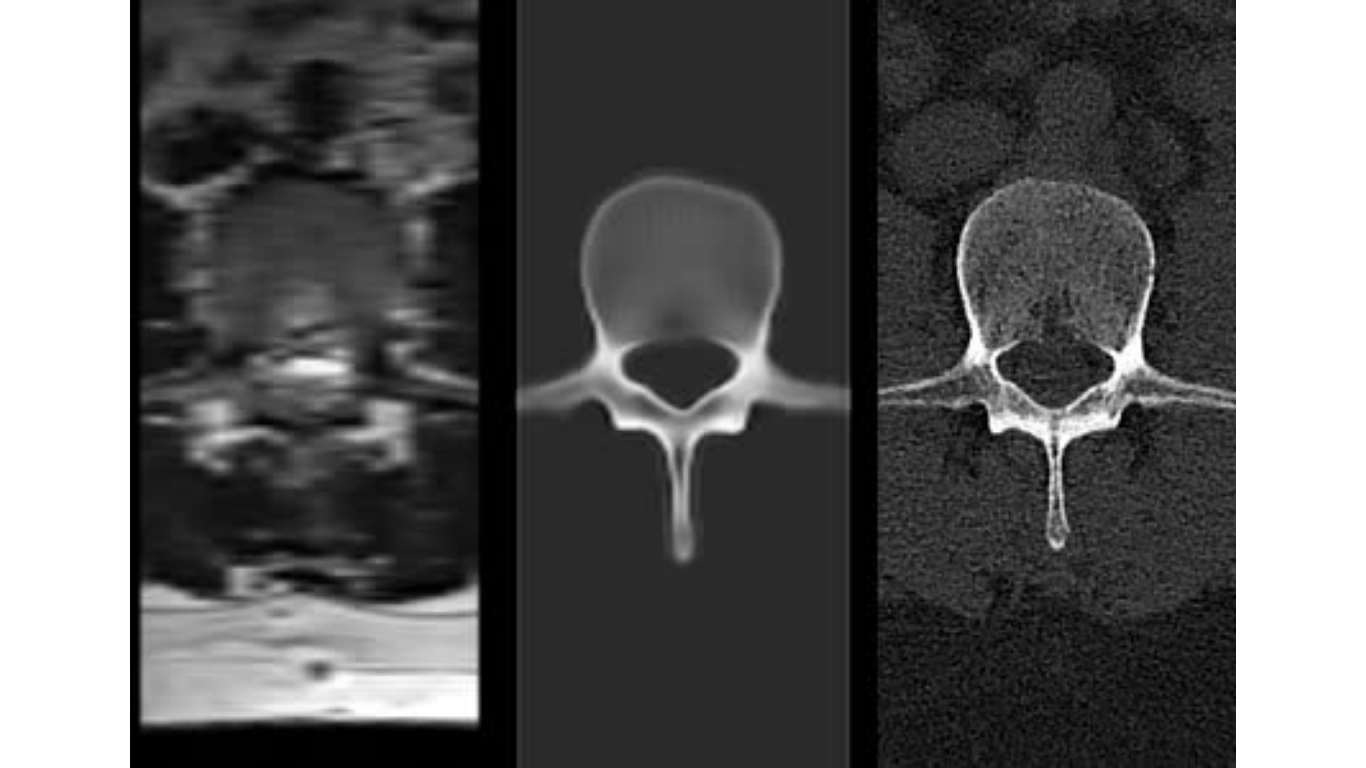
CLAYMONT, Del.--(BUSINESS WIRE)--MRI2CT Inc. today announced FDA 510(k) clearance for NextMR, its AI powered imaging platform, for generating accurate 3D bone visualization of the lumbar spine and sacrum directly from a patient’s standard diagnostic MRI.
MRI2CT Receives FDA 510(k) Clearance for NextMR, Enabling 3D Bone Visualization from Standard Spine MRI
2 min read Premium comments
spine care510(k) clearanceMRI2CT IncNextMRAI powered imaging platform3D bone morphology
“NextMR gives us the ability to take the routine MRI a patient already has and transition directly to highly accurate 3D bone morphology that can support the surgical workflow. That’s a huge advantage,” said Dr. Frank Phillips, Midwest Orthopaedics at Rush
The clearance marks an important step toward MRI2CT’s vision of MRI-only workflows in spine care. Using the MRI already acquired as part of the patient’s diagnostic path, NextMR provides detailed 3D bone morphology without exposing the patient to additional radiation, creating a more streamlined pathway from initial imaging through surgical planning and execution.
“Patients commonly begin their spine journey with an MRI, while detailed 3D visualization of bone may require another imaging step,” said Shmulik Shpiro, CEO of MRI2CT. “NextMR changes that paradigm. Our vision is an MRI-only workflow that simplifies the patient journey and connects the standard diagnostic MRI more seamlessly with planning and surgical enabling technologies.”
NextMR works with routine conventional MRI sequences acquired on 1.5T and 3T scanners and automatically generates its 3D bone output in under 60 seconds. Clinicians can view the output in sagittal, coronal and axial planes and as a three dimensional reconstruction through the MRI2CT web interface or compatible DICOM environments. The secure, cloud based application requires no local software installation.
“NextMR gives us the ability to take the routine MRI a patient already has and transition directly to highly accurate 3D bone morphology that can support the surgical workflow. That’s a huge advantage,” said Dr. Frank Phillips, Professor, Director, Section of Minimally Invasive Spine Surgery at Midwest Orthopaedics at Rush in Chicago. “For patients, that can mean avoiding additional imaging, radiation and appointments while helping streamline their path to surgery.”
NextMR was validated on an independent retrospective dataset of 145 adults with paired MRI and CT imaging from sites in the United States and Israel, demonstrating submillimeter cortical delineation accuracy across multiple patient subgroups.
About MRI2CT
MRI2CT is a medical technology company pioneering MRI-only workflows for orthopedic care. Its AI powered NextMR platform transforms standard diagnostic MRI into detailed 3D bone visualization, with a vision of connecting a single imaging exam to an increasingly streamlined pathway from imaging through planning and surgical enabling technologies. MRI2CT is headquartered in Claymont, Delaware. For more information, visit mri2ct.ai.
NOTE: NextMR Spine images are not intended to replace CT images in general. For use in subsequent workflows with third party devices, consult the documentation of the respective device(s) for compatibility. Clinical decisions regarding specific surgical procedures remain the responsibility of the qualified healthcare professional.
Contacts
Media Contact
Joe Duraes
Pazanga Health Communications
jduraes@pazangahealth.com
917-687-6419
Author
TH
TJ Halvorson
The De Angelis Group | Orthopedics This Week | MSK Innovations
Why This Matters
Two Perspectives
MBA Lens: Economic and industry impact
MRI2CT Inc. received FDA 510(k) clearance for NextMR, an AI-powered platform generating 3D bone visualization from standard spine MRI. This clearance advances MRI-only spine workflows, offering a strategic advantage by streamlining the patient journey and surgical planning without additional radiation. This innovation could reduce costs, enhance patient experience, and reshape market dynamics by integrating diagnostic imaging more seamlessly with surgical technologies.
- NextMR enables an MRI-only workflow, potentially reducing the need for additional CT scans in spine care.
- This technology aims to simplify the patient pathway and connect standard MRI with surgical planning, impacting market efficiency.
PhD Lens: Clinical and outcomes impact
MRI2CT Inc.'s NextMR, an AI-powered platform, received FDA 510(k) clearance to generate 3D bone visualization of the lumbar spine and sacrum from standard 1.5T and 3T diagnostic MRIs. This technology provides detailed 3D bone morphology, viewable in multiple planes and as a reconstruction, without additional radiation. Validation on 145 adults demonstrated submillimeter cortical delineation accuracy, supporting its clinical utility.
- The platform transforms routine MRI sequences into 3D bone output, automatically in under 60 seconds.
- Clinical validation showed submillimeter cortical delineation accuracy on a retrospective dataset of 145 paired MRI/CT scans.
React:
Discussion
This is a fascinating development. In my practice we've seen similar outcomes with the revised protocol. The key differentiator seems to be patient selection criteria. Has anyone else noticed the correlation with BMI thresholds?
Great point. I'd push back slightly on the conclusion, the sample size in the cited study is too small to draw population-level inferences. That said, the directional signal is compelling and worth a larger RCT.
We implemented a similar approach last year. Early results are promising but we're still gathering 12-month follow-up data. Happy to share our protocol if anyone is interested.
Join the conversation
Orthopedic professionals are discussing this. Sign in and upgrade to read every comment and add your voice.