
Centinel Spine® offers an extensive portfolio of cervical total disc replacement (TDR) devices that allows matching the disc to the needs of the patient and surgeon.
With this approval, prodisc® C Nova joins prodisc C Vivo and prodisc C SK as three distinct prodisc cervical TDR devices FDA approved for both one- and two-level use, further expanding the Company's Match-the-Disc™ cervical portfolio.
Centinel Spine's prodisc technology remains the only TDR platform in the U.S. approved for one- and two-level use in both the cervical and lumbar spine.
Centinel Spine® Receives FDA Approval for Two-Level Use of prodisc® C Nova, Further Expanding the Match-The-Disc™ Cervical Portfolio
3 min read Premium comments
FDA approvalCentinel Spineprodisc C SKprodisc C Vivoprodisc C Novacervical total disc replacementtwo-level
WEST CHESTER, Pa., Oct. 14, 2026 /PRNewswire/ -- Centinel Spine®, LLC ("the Company"), a commercial-stage medical technology company focused exclusively on total disc replacement (TDR) and advancing motion-preserving solutions for the cervical and lumbar spine, today announced that it has received U.S. Food and Drug Administration (FDA) approval for two-level use of the prodisc® C Nova cervical total disc replacement device.
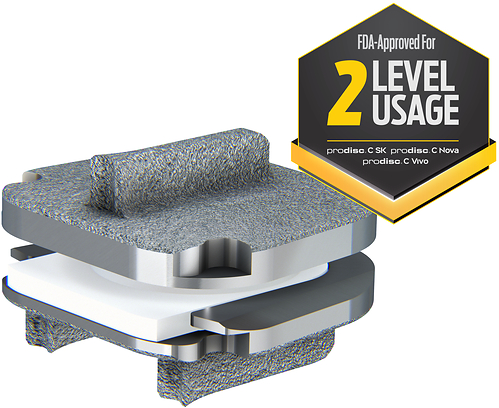
prodisc C Nova
With this approval, Centinel Spine now offers three distinct prodisc cervical devices—prodisc C Vivo, prodisc C SK, and prodisc C Nova—that are FDA approved for both one- and two-level use. This achievement further advances the Company's Match-the-Disc™ philosophy, providing surgeons with multiple implant options and combinations to address individual patient anatomy and select the appropriate implant for each treated level.
The prodisc C Vivo and prodisc C SK devices received FDA approval for two-level use in October 2025.
"This is welcome news for spine surgeons and patients," said Christopher Summa, MD, Orthopedic Spine Surgeon with Sutter Health in Santa Cruz, CA. "Two-level approval expands the clinical application of the prodisc C Nova technology and provides me with another excellent prodisc option. I can now select among three distinct prodisc cervical devices, all with one-and two-level FDA approval. This optionality benefits my patients by allowing me to optimize implant fit and fixation based on anatomical variation."
Currently, the prodisc C Nova is available on a limited-release basis in the U.S. The device has been in clinical use outside of the U.S. since 2009 and features flat endplates with low-profile keels designed to match particular vertebral anatomy. This device also incorporates prodisc CORE technology, the kinematic foundation of the prodisc platform.
"This approval represents another important advancement for our Match-the-Disc portfolio," notes Steve Murray, CEO of Centinel Spine. "With three distinct prodisc cervical devices now approved for both one- and two-level use, we continue to expand our cervical portfolio and advance our strategy of providing multiple implant designs to address differences in patient anatomy and disease advancement. The two-level approval of prodisc C Nova represents another important milestone in the continued evolution of our Match-the-Disc approach."
Centinel Spine's prodisc portfolio includes multiple motion-preserving anatomic solutions, allowing surgeons to Match-the-Disc to each patient's anatomy for both cervical and lumbar total disc replacement.
The Company will highlight its prodisc cervical and lumbar total disc replacement technologies, including its expanded Match-the-Disc cervical portfolio, at the upcoming 2026 North American Spine Society (NASS) 41st Annual meeting in San Antonio, Texas, October 14-17, 2026.
About Centinel Spine, LLC
Centinel Spine®, LLC is a commercial-stage medical technology company with a singular mission to transform spine surgery by advancing motion-preserving solutions for the cervical and lumbar spine. The Company is exclusively focused on total disc replacement (TDR), which the Company believes represents a fundamentally different and increasingly important approach to spine surgery compared to traditional fusion techniques that permanently eliminate motion. Centinel Spine's prodisc platform is designed to improve the long-term quality of life for patients suffering from chronic neck and back pain while preserving the spine's natural movement. The Company believes that its depth of technology, exclusive focus, and long history of clinical success uniquely position it to lead the continued evolution of spine surgery toward motion-preserving solutions.
For more information, please visit the Company's website, www.centinelspine.com or contact:
Varun Gandhi
Chief Financial Officer
900 Airport Road, Suite 3B
West Chester, PA 19380
Phone: 484-887-8871
Email: v.gandhi@centinelspine.com
SOURCE Centinel Spine, LLC
Author
TH
TJ Halvorson
The De Angelis Group | Orthopedics This Week | MSK Innovations
Why This Matters
Two Perspectives
MBA Lens: Economic and industry impact
Centinel Spine's FDA approval for two-level use of prodisc C Nova significantly expands its cervical total disc replacement portfolio, reinforcing its "Match-the-Disc" strategy. This approval provides surgeons with three distinct prodisc cervical devices approved for both one- and two-level use, enhancing market penetration and competitive positioning. The company aims to optimize implant fit for diverse patient anatomies, driving adoption and market share in motion-preserving spine solutions.
- Centinel Spine is the only TDR platform in the U.S. approved for one- and two-level use in both cervical and lumbar spine.
- The expanded portfolio offers surgeons greater optionality, supporting a patient-specific approach to disc replacement and market differentiation.
PhD Lens: Clinical and outcomes impact
The FDA approval for two-level use of prodisc C Nova expands its clinical application for cervical total disc replacement. This device, available clinically outside the U.S. since 2009, features flat endplates with low-profile keels, designed to match specific vertebral anatomy. It incorporates the prodisc CORE technology, providing a consistent kinematic foundation. This approval allows for broader use in patients requiring multi-level cervical intervention.
- prodisc C Nova features flat endplates with low-profile keels, designed for specific vertebral anatomy, and utilizes prodisc CORE technology.
- The device has been in clinical use outside the U.S. since 2009, with this approval expanding its application to two-level cervical use in the U.S.
React:
Discussion
This is a fascinating development. In my practice we've seen similar outcomes with the revised protocol. The key differentiator seems to be patient selection criteria. Has anyone else noticed the correlation with BMI thresholds?
Great point. I'd push back slightly on the conclusion, the sample size in the cited study is too small to draw population-level inferences. That said, the directional signal is compelling and worth a larger RCT.
We implemented a similar approach last year. Early results are promising but we're still gathering 12-month follow-up data. Happy to share our protocol if anyone is interested.
Join the conversation
Orthopedic professionals are discussing this. Sign in and upgrade to read every comment and add your voice.