
What is the most consequential new tool in spine surgery for 2026?
Best New Spine Surgery Technologies for 2026
4 min read Premium comments
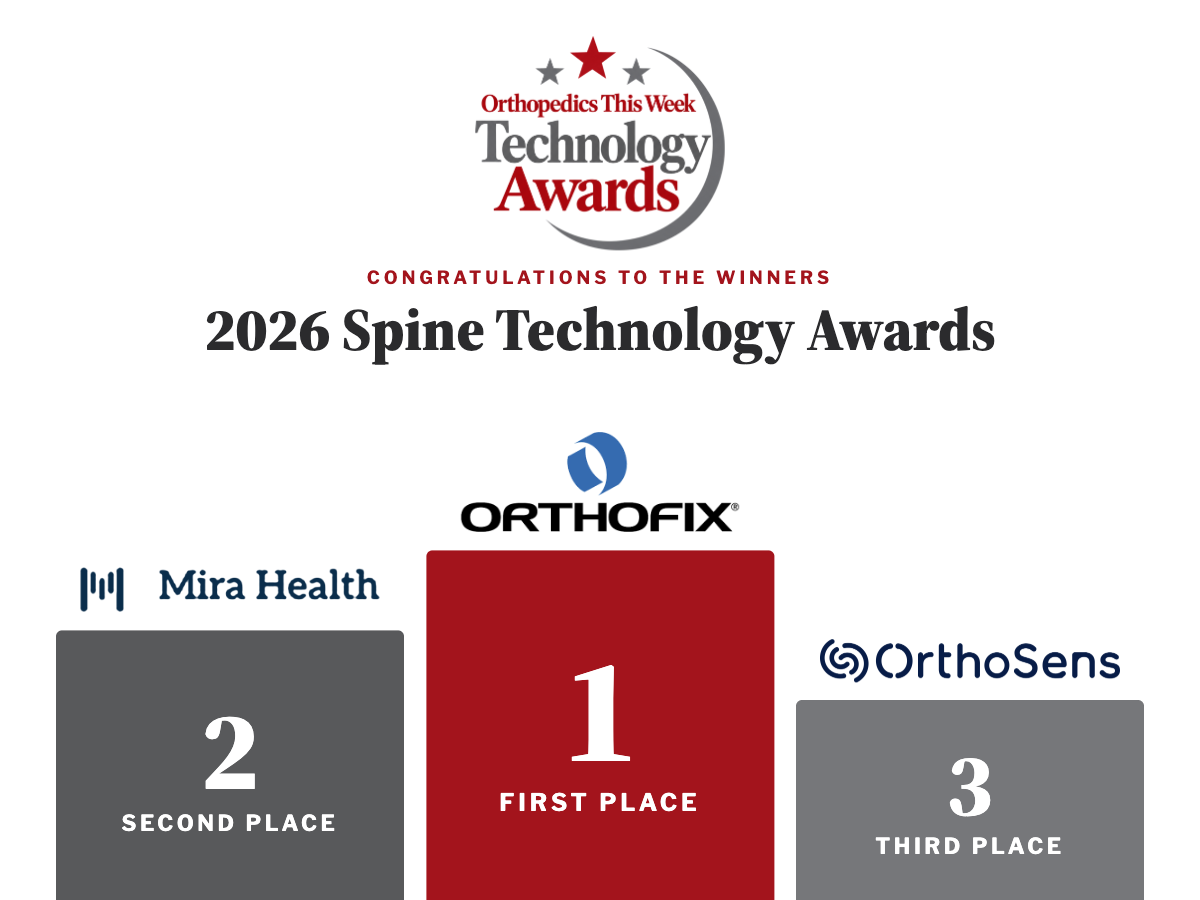
Orthofixspine navigation7D MRVisionMira HealthOrthoSensSens+
This year’s judges found three very different answers: a fusion implant that may one day report on healing, software that tackles the work surrounding an operation, and a navigation workflow that can dispense with radiation used for navigation imaging.
Each year, Orthopedics This Week invites brands to submit their best technologies for review by a panel of orthopedic spine surgeons and neurosurgeons. The judges look for creativity, staying power, a solution to a current clinical problem, an improvement in care, cost effectiveness and one final test: Would they consider using it themselves?
The 2026 awards program drew many submissions but only three could be crowned.
Third Place: OrthoSens Sens+

A patient leaves the operating room with an interbody cage. Months later, the surgeon wants to know how the fusion is progressing. Imaging and clinical examination provide important answers, but they offer snapshots. What if the cage could contribute information between visits?
That is the proposition behind Sens+, developed by Swiss company OrthoSens.
A thin, battery-free sensor embedded in an implant is designed to detect changes in mechanical load. An external wearable powers the sensor and relays information to SensApp, the company’s monitoring platform.
OrthoSens aims to give care teams a view of how the implant’s mechanical environment changes during recovery.
Founder Gwenael Hannema, a mechanical engineer trained at École Polytechnique Fédérale de Lausanne, developed the concept after seeing how little information can be available during a family member’s postoperative recovery. OrthoSens has integrated its first-generation sensors into three proof-of-concept implants. It is also pursuing an ultrasound-readable sensor design.
The clinical question is whether changes in an implant’s signal will reliably tell surgeons something useful about fusion, impending failure or the need to alter rehabilitation. Sens+ is still a developing technology; it has yet to establish that clinical value in patients. That distinction is important. An interesting mechanical signal becomes a useful surgical tool only when a surgeon knows what decision to make from it.
The judges nevertheless saw considerable promise in the idea. Spine implants have traditionally supported and stabilized anatomy. OrthoSens asks whether they can also help surgeons understand what happens after implantation.
Inventor and founder: Gwenael Hannema
Company: OrthoSens
Second Place: Mira Health

Spine surgeons can navigate a difficult anatomy, complete a technically demanding operation and still return to a practice where the note needs finishing, the claim needs checking and the next patient is waiting on the phone.
Mira Health is aimed at that second workplace.
Founded by brothers Pavan Pinnamaneni and Sri Pinnamaneni, M.D., Mira is an artificial intelligence platform for orthopedic practices.
It combines functions that commonly sit in separate systems: patient intake, calls and scheduling, clinical documentation, coding, claims, and revenue cycle work.
The company says its computer-vision software can carry out tasks within an existing electronic medical record by interacting with its on-screen controls, without requiring an application programming interface for those workflows.
Pavan Pinnamaneni previously worked on machine-learning products at Amazon. Sri Pinnamaneni is an orthopedic surgeon and partner at The Orthopedic Center of St. Louis.
The company’s clinical advisors include spine surgeon Joseph Schwab, M.D., director of the Center for Surgical Innovation and Engineering at Cedars-Sinai.
Mira’s ambition is broad, and that creates a practical test for prospective users: Can the platform perform reliably across the many exceptions in a real practice’s scheduling, documentation, and billing workflows?
Surgeons and administrators will want to examine its results in their own systems. The judges, however, recognized the size of the problem it is trying to solve and could see a place for such a tool in their practices.
Second place going to software is interesting. The quality of spine care depends on what happens in the operating room, but a surgeon’s working day extends well beyond it. Technology that gives clinical teams time back has a place in this awards program.
Founders: Pavan Pinnamaneni and Sri Pinnamaneni, M.D.
Company: Mira Health
First Place: Orthofix 7D MRVision

Navigation can help a spine surgeon plan and execute an operation, but preparing images for navigation has often involved a preoperative computed tomography (CT) scan or intraoperative radiation.
7D MRVision changes that particular equation.
The system uses MRIguidance’s BoneMRI software to create a synthetic CT-like dataset from a preoperative magnetic resonance imaging scan.
That dataset can then be used for planning and navigation with Orthofix’s 7D FLASH Navigation System. In the operating room, FLASH uses cameras and visible light to register the exposed anatomy to the images. Orthofix says registration can take as little as 30 seconds.
Put together, the technologies offer a navigation workflow designed to avoid a preoperative CT for navigation and intraoperative radiation for registration. That qualification is essential: MRVision does not mean a patient will never need a CT scan or another radiographic study for a separate clinical reason.
There is a longer development story behind this year’s winner.
The FLASH platform joined Orthofix through its combination with SeaSpine in 2023.
In January 2024, Orthofix announced its U.S. distribution agreement for BoneMRI and reported the first eight cases combining the software with FLASH.
The panel placed 7D MRVision first for its potential to improve the navigation workflow and for a persuasive measure of relevance: the surgeons could envision using it themselves. It preserves the planning and image guidance they value while addressing an imaging burden that has long accompanied navigation.
Technology: 7D MRVision
Company: Orthofix
Thank You to Every Participant
Together, these outstanding submissions addressed a wide range of clinical problems with creativity, practical innovation and an obsession to improve spine care. Thank you to each and every participant in this program.
Author
Why This Matters
Two Perspectives
MBA Lens: Economic and industry impact
Orthofix's 7D MRVision, leveraging MRI-derived synthetic CT for radiation-free navigation, offers a significant competitive advantage by addressing a key imaging burden, potentially expanding market adoption for navigation systems. Mira Health's AI platform targets administrative inefficiencies, a large untapped market for practice optimization. OrthoSens' Sens+ introduces a novel post-operative monitoring concept, potentially creating new service lines and improving long-term patient management.
- Orthofix's 7D MRVision enhances market competitiveness by offering a radiation-free navigation workflow, potentially increasing surgeon adoption and patient preference.
- Mira Health's AI platform and OrthoSens' sensor technology represent strategic plays into practice efficiency and post-operative monitoring, respectively, opening new market segments.
PhD Lens: Clinical and outcomes impact
Orthofix's 7D MRVision utilizes BoneMRI software to generate a synthetic CT-like dataset from preoperative MRI, enabling radiation-free navigation with the 7D FLASH system. OrthoSens' Sens+ features a battery-free implantable sensor designed to detect mechanical load changes, aiming to provide insights into fusion progression. Mira Health employs computer-vision AI to automate administrative tasks within existing EMRs.
- 7D MRVision's core mechanism is the conversion of MRI data into a CT-like dataset, allowing for image-guided surgery without additional radiation exposure.
- OrthoSens' Sens+ relies on a mechanical load sensor within an implant, with clinical utility for fusion monitoring still requiring validation.
React:
Discussion
This is a fascinating development. In my practice we've seen similar outcomes with the revised protocol. The key differentiator seems to be patient selection criteria. Has anyone else noticed the correlation with BMI thresholds?
Great point. I'd push back slightly on the conclusion, the sample size in the cited study is too small to draw population-level inferences. That said, the directional signal is compelling and worth a larger RCT.
We implemented a similar approach last year. Early results are promising but we're still gathering 12-month follow-up data. Happy to share our protocol if anyone is interested.
Join the conversation
Orthopedic professionals are discussing this. Sign in and upgrade to read every comment and add your voice.