
Some of the hardest pain problems in orthopedics emerge after an otherwise successful operation. The implant is well positioned, the imaging looks right, and pain persists.
Best New Pain Management Technologies for 2026
3 min read Premium comments
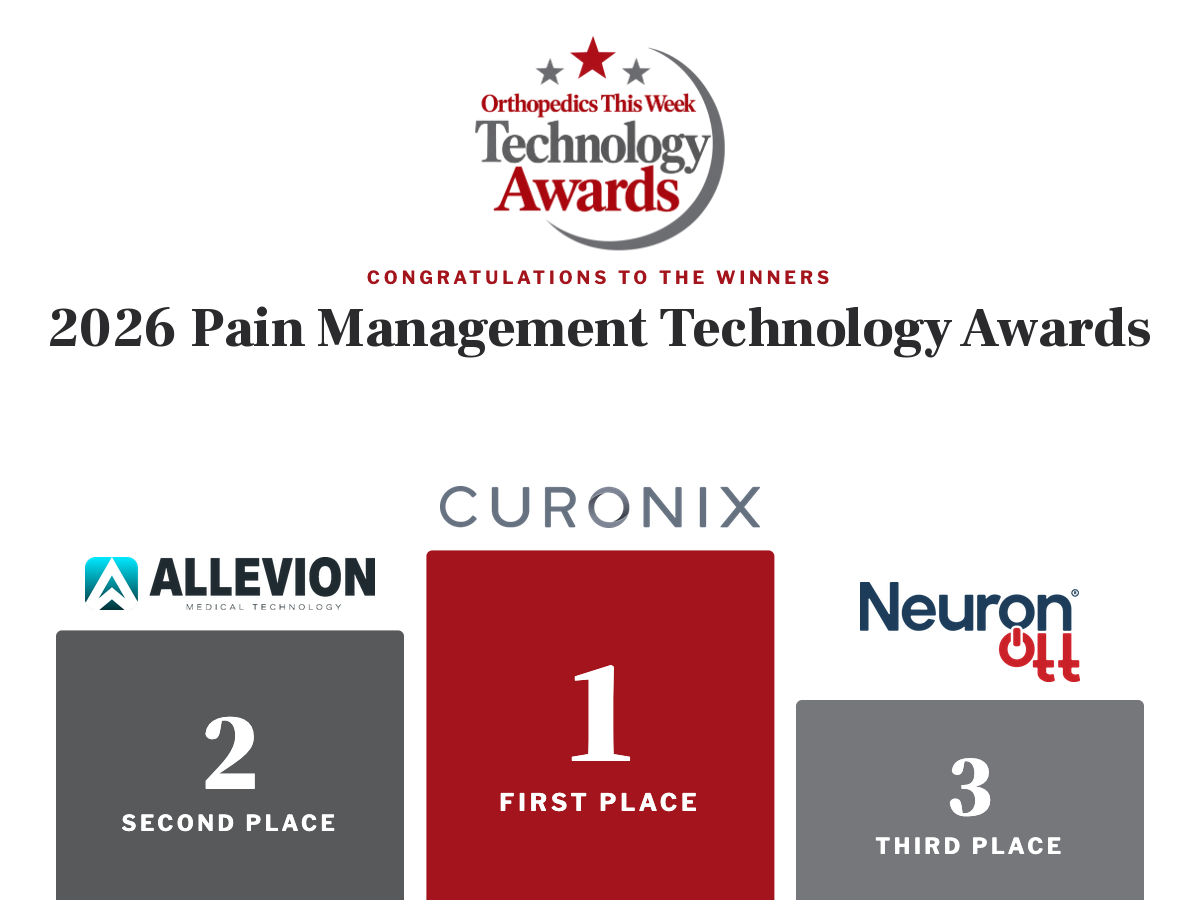
The three winners of this year’s Pain Management Technology Awards approach pain from different directions. One places a stimulation electrode through a needle. One gives surgeons a disposable kit for lumbar decompression. The winner targets peripheral nerves involved in pain around the knee, shoulder and elsewhere in the body.
Each year, Orthopedics This Week invites companies to submit technologies for review by physicians in the relevant subspecialty. This is the inaugural year for the pain management category, reflecting the growing overlap between pain interventions and orthopedic practice, particularly in persistent postsurgical pain. Judges score each entry on six criteria:
Innovation
Long-term significance
How well it solves a clinical problem
Whether it improves on the standard of care
Cost effectiveness
Whether the judges would use it themselves
Third Place: Neuronoff Injectrode
Neuromodulation typically requires a procedure to place a lead. Cleveland-based Neuronoff is developing an electrode that can be delivered percutaneously through a needle.
The Injectrode is delivered through an 18-gauge needle, about 1.3 millimeters in outer diameter. In a large-animal study, the company demonstrated the electrode working with an existing implantable pulse generator, potentially allowing practices to use hardware already in place.
Neuronoff describes the goal as a low-profile workflow that fits existing clinic schedules. The company is also developing a platform for short- and longer-term therapy without changing the underlying technology.
The Injectrode is not cleared by the FDA or available for sale in the United States. The company told the judges its 510(k) submission is in process and clinical trials are ongoing. Neuronoff closed a $4.5 million funding round in October 2025 to prepare for launch. In June, it implanted the first patient in a Department of Defense-funded trial for neurogenic bladder after spinal cord injury.
The entry scored highest in the category on creativity. Longer-term studies will show whether the electrode maintains position and performance in clinical use.

Second Place: Allevion Medical Vantage
Allevion Medical, based in Boca Raton, Florida, developed Vantage as a disposable kit for lumbar decompression.
The surgeon docks the instruments on the inferior border of the lamina, where an integrated guard slides underneath to protect the neural elements. A four-position drill guide directs bone removal, and an adjustable cap sets the maximum drill depth. Each kit includes disposable LED illumination.
Everything in the kit is sterile and single-use. The instruments do not require reprocessing between cases, and no reusable trays need to be turned over. Allevion designed the kit for hospitals and ambulatory surgery centers and says it reduces instrument preparation and setup time.
The FDA cleared Vantage through the 510(k) pathway in March 2026. The clearance establishes substantial equivalence to predicate devices; comparative outcomes against conventional decompression remain to be established.
Its strength is the design logic: depth control, neural protection and visualization built into the instruments.

First Place: Curonix Freedom PNS System
Consider a patient a year out from total knee replacement. The components are well fixed, the alignment is good, and the pain has not gone away. Further surgery may have little to offer, and long-term opioid use is a poor substitute.
Curonix, based in Pompano Beach, Florida, built its Freedom Peripheral Nerve Stimulator System for that patient. Freedom delivers stimulation directly to the nerve carrying the pain signal. At the knee, that can mean the saphenous nerve and its infrapatellar branch or the superior genicular nerves. At the shoulder, it can mean the suprascapular or axillary nerve.
The design is minimal. An electrode array and a small receiver are implanted beside the nerve, with no battery under the skin. The patient wears an external transmitter that powers the stimulator wirelessly, through up to 6 centimeters of tissue according to company testing. A trial period comes before permanent implantation, so physicians can confirm a patient responds first.
A 2024 FDA clearance expanded Freedom’s labeling to the craniofacial region, which Curonix describes as the first full-body clearance for a peripheral nerve stimulator. The company launched Freedom for craniofacial pain in January 2026.
Curonix reports substantial reductions in pain and pain medication use in knee and shoulder patients.
The judges ranked Freedom first in the category on long-term significance, clinical problem solving and improvement on the standard of care. It also cleared the test that matters most to a practicing physician: the judges would use it themselves. For orthopedic surgeons whose patients have run out of surgical answers, Freedom offers a non-opioid option with no implanted battery.
Pain management drew entries this year ranging from implants to software to care protocols. Thank you to every company that submitted. Each one put forward a serious idea about one of the most persistent problems orthopedic patients face.
Why This Matters
Two Perspectives
MBA Lens: Economic and industry impact
The Pain Management Technology Awards highlight innovations addressing persistent orthopedic pain. Neuronoff's Injectrode, with a $4.5 million funding round and 510(k) in process, aims for a low-profile, percutaneous neuromodulation workflow. Allevion Medical's Vantage, a disposable lumbar decompression kit with 510(k) clearance, targets operational efficiency in ASCs. Curonix's Freedom PNS System, with full-body FDA clearance, offers a non-opioid, battery-free solution for post-surgical pain, expanding market opportunities.
- Neuronoff's Injectrode seeks to streamline neuromodulation delivery, potentially leveraging existing hardware and clinic schedules.
- Allevion Medical's Vantage disposable kit reduces instrument reprocessing and setup time, enhancing efficiency for hospitals and ASCs.
PhD Lens: Clinical and outcomes impact
This year's pain management innovations include a percutaneously delivered stimulation electrode, a disposable lumbar decompression kit, and a battery-free peripheral nerve stimulator. Neuronoff's Injectrode, delivered via an 18-gauge needle, demonstrated function in large-animal studies with existing pulse generators, with clinical trials ongoing. Allevion Medical's Vantage provides controlled bone removal with neural protection and integrated illumination, cleared via 510(k) without comparative outcomes yet established.
- Curonix's Freedom PNS System delivers wireless stimulation to specific peripheral nerves, with an external transmitter powering an implanted electrode array and receiver.
- The Injectrode's long-term position and performance in clinical use require further study, while Vantage's comparative outcomes against conventional decompression are pending.
React:
Discussion
This is a fascinating development. In my practice we've seen similar outcomes with the revised protocol. The key differentiator seems to be patient selection criteria. Has anyone else noticed the correlation with BMI thresholds?
Great point. I'd push back slightly on the conclusion, the sample size in the cited study is too small to draw population-level inferences. That said, the directional signal is compelling and worth a larger RCT.
We implemented a similar approach last year. Early results are promising but we're still gathering 12-month follow-up data. Happy to share our protocol if anyone is interested.
Join the conversation
Orthopedic professionals are discussing this. Sign in and upgrade to read every comment and add your voice.