
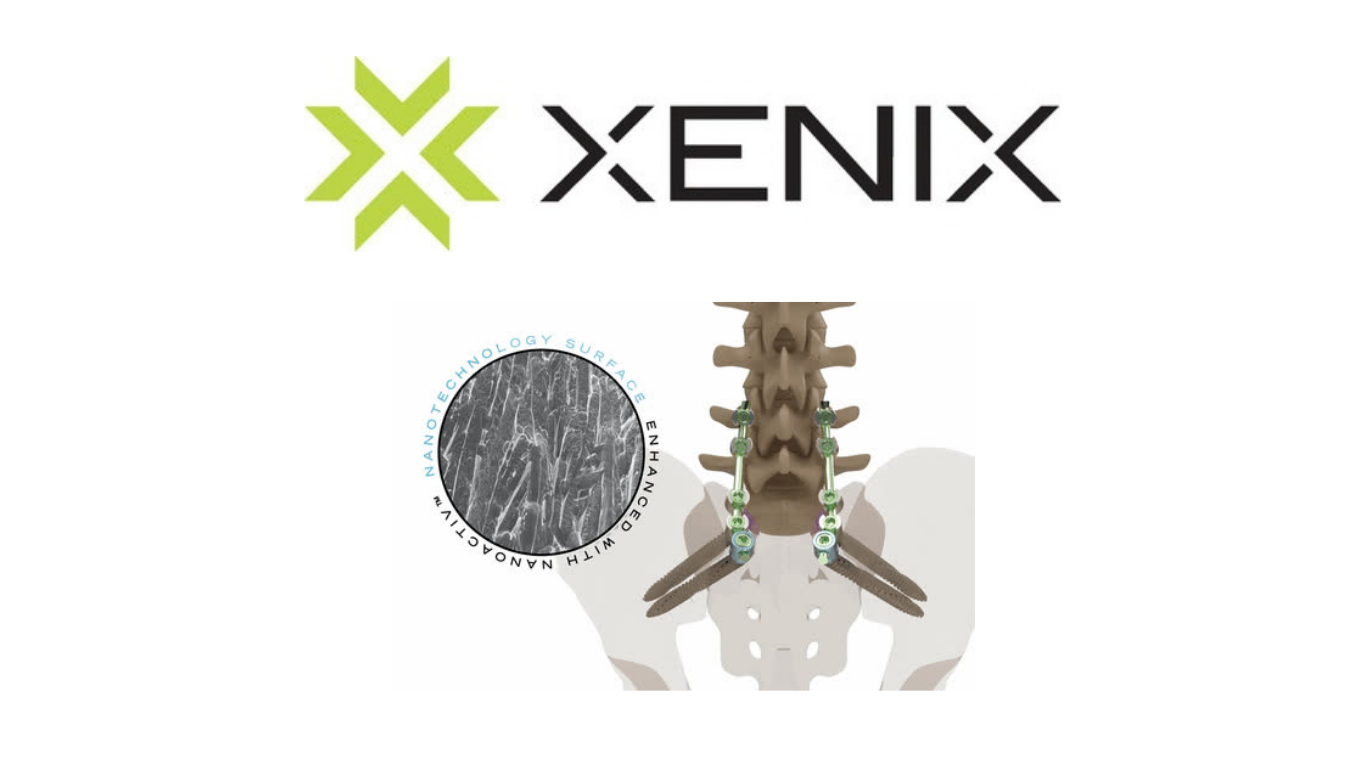
ORLANDO, Fla.--(BUSINESS WIRE)--Xenix Medical today announced FDA 510(k) clearance for its Riva Anchor Spinopelvic Fixation System, designed to facilitate fusion of the sacroiliac (SI) joint at the base of a posterior lumbar or thoracolumbar fusion construct.
Xenix Medical Announces FDA Clearance of the Riva® Anchor Spinopelvic Fixation System with NanoACTIV™ Surface Technology
2 min read Premium comments
FDA 510(k) clearanceSI jointXenix MedicalRiva Anchor Spinopelvic Fixation Systemposterior lumbar constructthoracolumbar fusion construct
"What sets the Riva Anchor apart is its NanoACTIV surface - the only spinopelvic system designated by the FDA to have an osteogenic effect."
The system is comprised of a Riva Anchor SI joint fusion implant that attaches to the Riva Posterior Pedicle Fixation System. It incorporates the company’s signature NanoACTIV surface technology and self-harvesting bone apertures to support postoperative bone growth and fusion. NanoACTIV is a proprietary combination of micro- and nano-scaled surface textures shown to exhibit specific osteogenic differentiation and an endogenous cellular and biochemical response, earning it an FDA nanotechnology designation.
“The addition of NanoACTIV surface technology to the rapidly-growing spinopelvic market segment cannot be overstated,” commented Ryan Phillips, President of Xenix Medical. “While competitive technologies attempt fusion or solely rely on stabilization, Riva Anchor is designed to create an environment for true arthrodesis due to NanoACTIV’s osteogenic properties. This is especially important since the SI joint fusion serves as the biomechanical foundation of the entire long fusion construct.”
Key Features of the Riva Anchor Spinopelvic Fixation System:
NanoACTIV surface technology
Self-harvesting bone apertures
Intended to be used with the company’s Riva® Posterior Fixation System
Accepts 5.5mm and 6.0mm rods
Dual-lead fully threaded implant
Designed to be implanted using navigation, fluoroscopy, or an open approach
"The need to provide stability at the distal end of a long spine fusion construct as well as fuse the SI joints is becoming more and more understood. This is due to the very high biomechanical forces at the end of the construct,” commented Todd Abel, MD, Neurosurgeon at the University of Tennessee Medical Center Knoxville. "The Riva Anchor system is an elegant solution that easily attaches to the base of a unitary posterior rod. I have used several of the existing systems, and there is a recurring issue of inconsistent fusion across the joint, causing haloing or loosening of the screws. What sets the Riva Anchor apart is its NanoACTIV surface - the only spinopelvic system designated by the FDA to have an osteogenic effect."
Xenix is preparing for limited commercial launch. Contact us at info@xenixmedical.com if you are interested in participating or would like additional information.
About Xenix Medical
Xenix Medical is a medical device company dedicated to developing innovative spinal fixation solutions that improve surgical outcomes and simplify the operative experience. Guided by the belief that The Science of Innovation drives better patient care, Xenix Medical is committed to advancing the standard of spinal surgery through thoughtful engineering unconstrained by industry norms.
Contacts
Company Contact
Ryan Phillips rphillips@xenixmedical.com
Author
TH
TJ Halvorson
The De Angelis Group | Orthopedics This Week | MSK Innovations
Why This Matters
Two Perspectives
MBA Lens: Economic and industry impact
Xenix Medical secured FDA 510(k) clearance for its Riva Anchor Spinopelvic Fixation System, targeting the rapidly growing spinopelvic market. This system aims to differentiate through its proprietary NanoACTIV surface technology, which the FDA designated as having an osteogenic effect. This unique feature positions Riva Anchor to potentially improve fusion rates at the critical SI joint, offering a competitive advantage over existing stabilization-focused solutions. Xenix is preparing for a limited commercial launch.
- The system's NanoACTIV surface technology provides a unique selling proposition in the competitive spinopelvic market.
- Strategic limited commercial launch indicates a controlled market entry to validate adoption and refine strategy.
PhD Lens: Clinical and outcomes impact
The Xenix Medical Riva Anchor Spinopelvic Fixation System received FDA 510(k) clearance, featuring NanoACTIV surface technology. This proprietary combination of micro- and nano-scaled surface textures is designed to promote osteogenic differentiation and an endogenous cellular and biochemical response, earning an FDA nanotechnology designation. The system aims to facilitate true arthrodesis of the SI joint, which is crucial for the biomechanical stability of long fusion constructs, addressing issues of inconsistent fusion seen with other systems.
- NanoACTIV technology is characterized by micro- and nano-scaled surface textures that induce osteogenic differentiation.
- The system's design, including self-harvesting bone apertures, supports postoperative bone growth and fusion at the SI joint.
React:
Discussion
This is a fascinating development. In my practice we've seen similar outcomes with the revised protocol. The key differentiator seems to be patient selection criteria. Has anyone else noticed the correlation with BMI thresholds?
Great point. I'd push back slightly on the conclusion, the sample size in the cited study is too small to draw population-level inferences. That said, the directional signal is compelling and worth a larger RCT.
We implemented a similar approach last year. Early results are promising but we're still gathering 12-month follow-up data. Happy to share our protocol if anyone is interested.
Join the conversation
Orthopedic professionals are discussing this. Sign in and upgrade to read every comment and add your voice.