
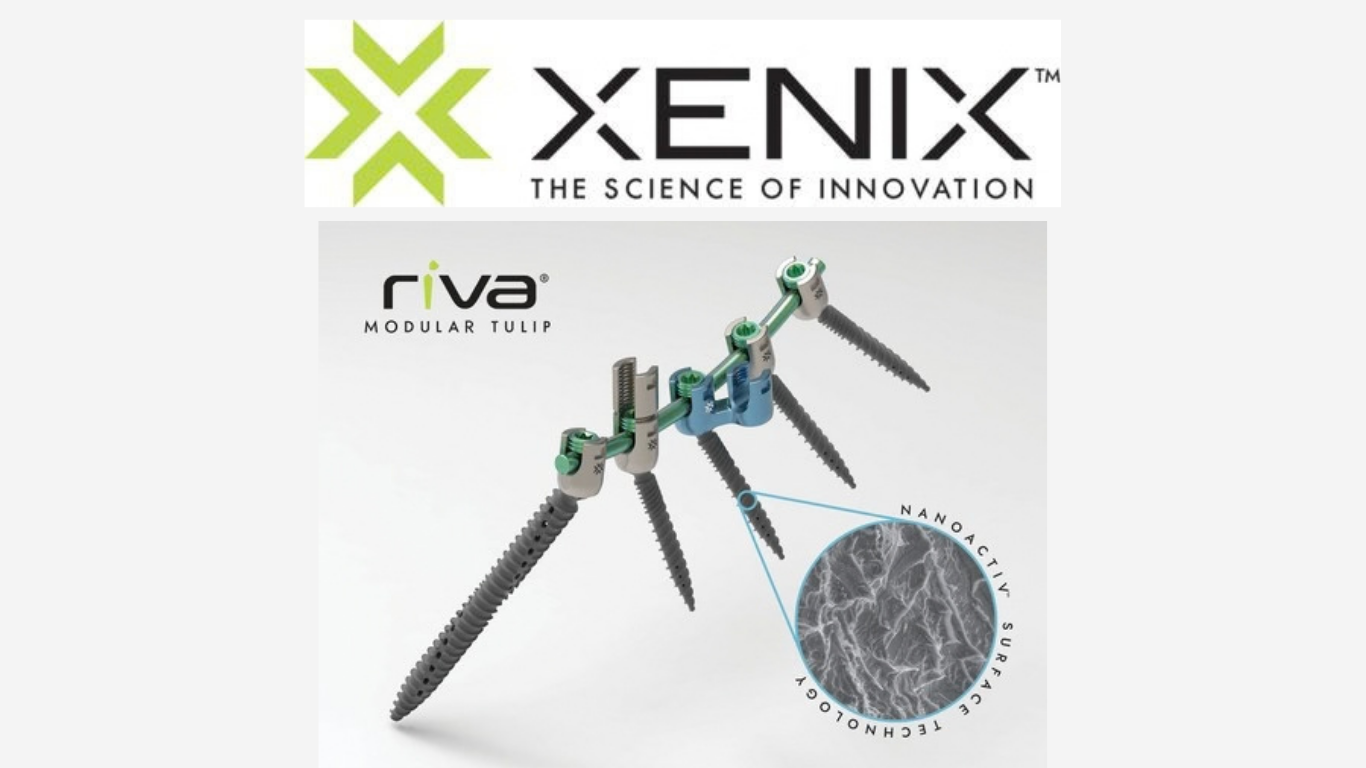
ORLANDO, Fla.--(BUSINESS WIRE)--Xenix Medical today announced FDA 510(k) clearance for the addition of NanoACTIV Surface Technology to the screw shanks of its Riva modular pedicle screw system, combining NanoACTIV’s osteogenic properties with the modularity and flexibility of the Riva spinal fixation technology.
Xenix Medical Announces FDA Clearance of NanoACTIV™ Surface Technology for Its Riva® Posterior Fixation System
2 min read Premium comments
pedicle screw510(k) clearanceXenix MedicalNanoACTIV Surface TechnologyRiva spinal fixation technologyosteogenicscrew shanks
“The addition of NanoACTIV to our Riva Posterior Fixation System finalizes the integration of our proprietary surface technology across our entire spine portfolio and paves the way for its application to future wrought titanium implants."
NanoACTIV is a proprietary surface modification process that creates a combination of micro- and nano-scaled surface textures shown to exhibit specific osteogenic differentiation and an endogenous cellular and biochemical response. NanoACTIV was previously cleared on the company’s additively manufactured (3D printed) titanium implants. With this clearance, the technology now extends to machined wrought titanium, after its osteogenic differentiation properties were shown to be equivalent on both materials. This expands NanoACTIV's application to more implant types, including those in other specialties.
Riva features a modular head design with audible and tactile confirmation of the head-to-shank connection. It is supported by a comprehensive portfolio of tulip head and screw shank configurations, enabling surgeons to tailor the construct to each patient’s needs, even for challenging anatomical variations or complex cases.
Today’s announcement completes the integration of NanoACTIV across the company’s spinal implant product line, which comprises:
Lux™ Expandable Lumbar Interbody System
Riva® Posterior Fixation System
Riva® Anchor Spinopelvic Fixation System
Solace® Sacroiliac Fixation System
NeoWave™ Interbody Fusion Systems
Ryan Phillips, President of Xenix Medical, commented, “The addition of NanoACTIV to our Riva Posterior Fixation System is a key step in our overall NanoACTIV strategy. It finalizes the integration of our proprietary surface technology across our entire spine portfolio and paves the way for its application to future wrought titanium implants. Our testing has also shown that the NanoACTIV surface has further capabilities beyond osteogenic differentiation that we believe will set it apart. That work is nearing completion, and we expect to share more shortly.”
Contact us at info@xenixmedical.com for additional information.
About Xenix Medical
Xenix Medical is a medical device company dedicated to developing innovative spinal fixation solutions that improve surgical outcomes and simplify the operative experience. Guided by the belief that The Science of Innovation drives better patient care, Xenix Medical is committed to advancing the standard of spinal surgery through thoughtful engineering unconstrained by industry norms.
Contacts
Company Contact
Ryan Phillips
rphillips@xenixmedical.com
Author
TH
TJ Halvorson
The De Angelis Group | Orthopedics This Week | MSK Innovations
Why This Matters
Two Perspectives
MBA Lens: Economic and industry impact
Xenix Medical secured FDA 510(k) clearance for its NanoACTIV Surface Technology on Riva modular pedicle screw shanks, completing integration across its spine portfolio. This strategic move expands NanoACTIV's application from 3D printed to wrought titanium, significantly broadening market opportunities for future implants and other specialties. The clearance enhances Xenix Medical's competitive position by offering advanced osteogenic properties across its versatile Riva system.
- Strategic integration of NanoACTIV across Xenix Medical's spine portfolio enhances product differentiation and market reach.
- Expansion to wrought titanium implants opens new market segments and future application opportunities beyond spine.
PhD Lens: Clinical and outcomes impact
Xenix Medical's Riva modular pedicle screw system now features FDA-cleared NanoACTIV Surface Technology on its screw shanks. This proprietary modification creates micro- and nano-scaled textures, demonstrating specific osteogenic differentiation and an endogenous cellular/biochemical response. The clearance extends NanoACTIV's proven osteogenic properties from 3D printed to machined wrought titanium, enabling broader application across various implant types and medical specialties.
- NanoACTIV is a proprietary surface modification creating micro- and nano-scaled textures that exhibit osteogenic differentiation.
- The technology's efficacy was demonstrated as equivalent on both 3D printed and machined wrought titanium, expanding its material application.
React:
Discussion
This is a fascinating development. In my practice we've seen similar outcomes with the revised protocol. The key differentiator seems to be patient selection criteria. Has anyone else noticed the correlation with BMI thresholds?
Great point. I'd push back slightly on the conclusion, the sample size in the cited study is too small to draw population-level inferences. That said, the directional signal is compelling and worth a larger RCT.
We implemented a similar approach last year. Early results are promising but we're still gathering 12-month follow-up data. Happy to share our protocol if anyone is interested.
Join the conversation
Orthopedic professionals are discussing this. Sign in and upgrade to read every comment and add your voice.