
SANTA CLARA, Calif., Sept. 28, 2026 (GLOBE NEWSWIRE) -- SI-BONE, Inc. (Nasdaq: SIBN), the global leader in developing procedural solutions to address clinical challenges associated with compromised bone, today announced U.S. Food and Drug Administration (FDA) 510(k) clearance for the iFuse Granite Onyx System (Onyx). This is SI-BONE’s first product addressing the problem of compromised bone which is intended for use outside the pelvis, expanding the market opportunity for the company’s 3D-printed bone integration platform.
SI-BONE Receives FDA 510(k) Clearance for iFuse Granite Onyx™, Extending Its Compromised Bone Franchise Beyond the Pelvis FDA Breakthrough Device Designated (BDD) platform engineered for durable fixation in low density bone
3 min read Premium comments
spinal fusionSI-BONE#pelvisFDA 501(k) clearanceiFuse Granite Onyx SystemOnyxcompromised bone
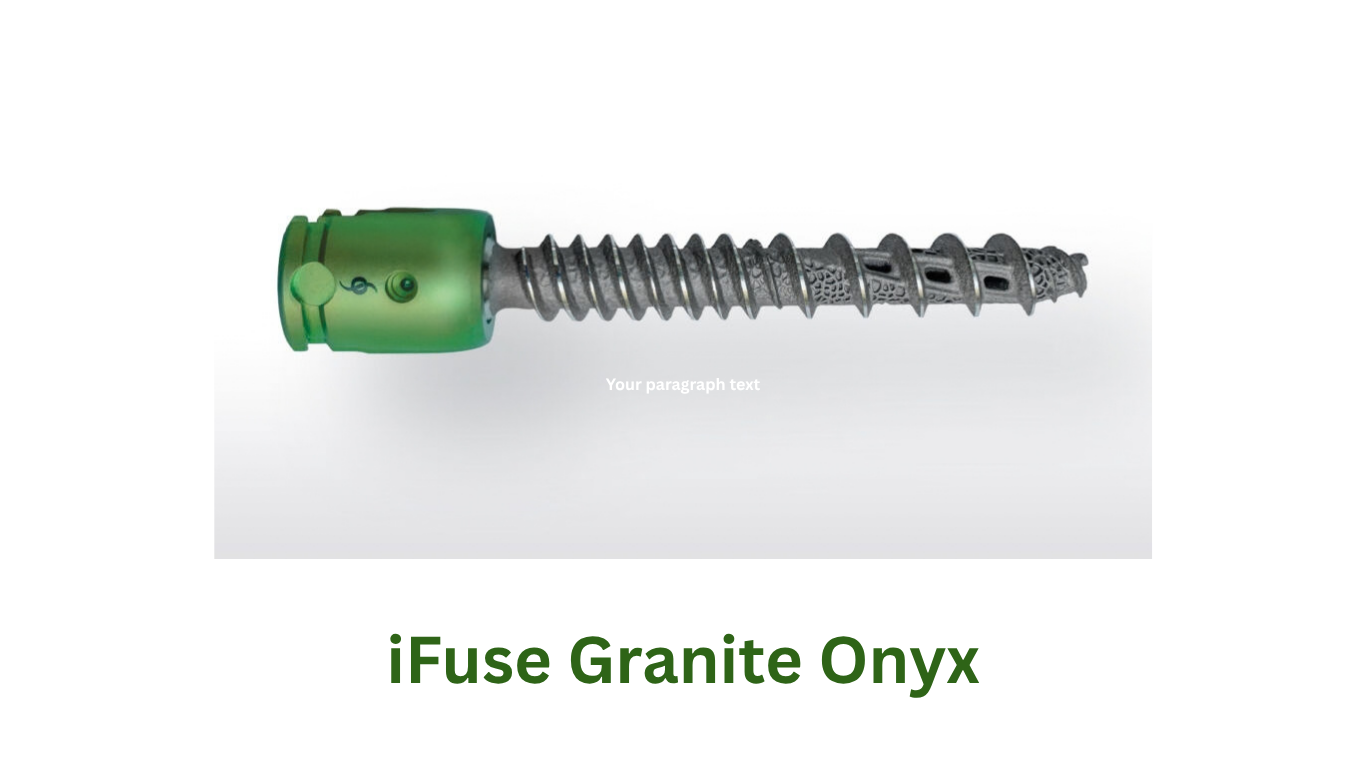
SI-BONE is redefining spinal fusion with Onyx, an innovation designed to address loosening at the upper and lower instrumented vertebrae (UIV and LIV, respectively) of a spinal fusion construct. Loosening occurs in the UIV and LIV in as many as 27% of fusion constructs.1,2 The loosening risk is elevated for patients with low bone density, contributing to higher revision rates and cost of care.1,3 Onyx was designed to address this issue in fusion procedures with the needs of patients with poor bone quality in mind.
Onyx doesn't just iterate on existing designs. It reimagines them. The technology is built on a bone-density-specific surface and anatomy-specific thread form. Onyx is designed to allow for rapid osseointegration and to reduce micromotion, with the goal of early fixation and reduced screw loosening as a result of the osseointegration.
“Loss of fixation due to screw loosening in spinal fusions at the UIV and LIV is an unmet clinical need that has driven the search for a better solution," said Han Jo Kim, M.D., Professor and David B. Levine, M.D. Endowed Chair in Spine Surgery at the Hospital for Special Surgery (HSS). "The Onyx system gives surgeons the opportunity to face our understanding of construct loosening with a novel innovation that translates into a meaningful step forward for our patients."
"Patients with poor bone quality have historically had limited options in spinal fixation, and they are the least able to tolerate a second operation should the fixation fail," said Gregory M. Mundis, Jr., M.D., Professor of Orthopedic Spine Surgery at Scripps Clinic and President of the San Diego Spine Foundation. "Onyx is designed around the mechanical realities of poor-quality bone, with a form factor intended to achieve early fixation where conventional technologies struggle. Having an option built for this population is a meaningful step for the patients who need it most."
"Onyx is our third platform designated as a breakthrough device that is addressing a known large unmet need in fusion procedures. Our team built this proprietary technology for the patients who historically have been the hardest to treat,” said Laura Francis, Chief Executive Officer at SI-BONE. “iFuse Bedrock Granite®, our first breakthrough designated device, proved what osseointegrative technology can do at the base of a multi-level construct. Onyx applies those same principles to spinal fusion and is the most technologically advanced system we have ever brought to market. We believe Onyx will allow us to provide additional products to the surgeons already using Granite and also expand our reach to a broader group of surgeons who will want to incorporate this technology in their spinal fusion procedures.”
References:
Arena JD, et al. J Neurosurg Spine. 2024.
Odland K, et al. Int J Spine Surg. 2025.
Yuan, et al. Global Spine J. 2023.
Forward-Looking Statements
This press release contains forward-looking statements within the meaning of the Private Securities Litigation Reform Act of 1995, including statements regarding the addressable market for iFuse Granite Onyx, its anticipated clinical and technical performance, and its expected commercialization. These statements are subject to risks and uncertainties that could cause actual results to differ materially, including those described in the company's filings with the Securities and Exchange Commission. SI-BONE undertakes no obligation to update any forward-looking statement.
About SI-BONE, Inc.
SI-BONE (Nasdaq: SIBN) is a global leader in developing procedural solutions to address clinical challenges associated with compromised bone. With expertise in biomechanical design and anatomy specific innovation, SI-BONE has built a technology platform with market-leading applications centered on the spinopelvic anatomy. SI-BONE continues to leverage the deep experience in addressing the challenges of low-density bone in the sacrum to develop unique technologies that are targeting new clinical adjacencies to help improve outcomes for patients with compromised bone. Since 2009, SI-BONE has supported physicians in performing over 150,000 procedures. A unique body of clinical evidence supports the use of SI-BONE's technologies, including four randomized controlled trials and over 190 peer reviewed publications.
For additional information on the company or the products, including risks and benefits, please visit www.si-bone.com.
iFuse Granite Onyx is a trademark of SI-BONE, Inc. iFuse Bedrock Granite and SI-BONE are registered trademarks of SI-BONE, Inc. ©2026 SI-BONE, Inc. All Rights Reserved.
Han Jo Kim, M.D. and Gregory Mundis, M.D. are paid consultants to SI-BONE, Inc. and have royalty interests in Onyx.
Investor Contact: Saqib Iqbal, investors@si-bone.com
Author
TH
TJ Halvorson
The De Angelis Group | Orthopedics This Week | MSK Innovations
Why This Matters
Two Perspectives
MBA Lens: Economic and industry impact
SI-BONE secured FDA 510(k) clearance for iFuse Granite Onyx, strategically expanding its compromised bone franchise beyond the pelvis. This innovation targets screw loosening in spinal fusion, a significant unmet need impacting up to 27% of constructs, especially in low bone density patients. The product aims to reduce revision rates and associated healthcare costs, leveraging SI-BONE's established 3D-printed bone integration platform to broaden its market reach and surgeon adoption.
- The clearance expands SI-BONE's market opportunity by targeting spinal fusion beyond the pelvis.
- Onyx addresses high revision rates and costs associated with screw loosening in low bone density patients.
PhD Lens: Clinical and outcomes impact
SI-BONE received FDA 510(k) clearance for iFuse Granite Onyx, a 3D-printed bone integration platform. This system is engineered to mitigate screw loosening at the upper and lower instrumented vertebrae in spinal fusion, particularly for patients with compromised bone density. Its design features a bone-density-specific surface and anatomy-specific thread form, aiming for rapid osseointegration and reduced micromotion to enhance early fixation.
- Onyx's mechanism involves a specialized surface and thread form to promote rapid osseointegration and reduce micromotion.
- It targets screw loosening in spinal fusion, a clinical challenge in up to 27% of constructs, particularly in low bone density patients.
React:
Discussion
This is a fascinating development. In my practice we've seen similar outcomes with the revised protocol. The key differentiator seems to be patient selection criteria. Has anyone else noticed the correlation with BMI thresholds?
Great point. I'd push back slightly on the conclusion, the sample size in the cited study is too small to draw population-level inferences. That said, the directional signal is compelling and worth a larger RCT.
We implemented a similar approach last year. Early results are promising but we're still gathering 12-month follow-up data. Happy to share our protocol if anyone is interested.
Join the conversation
Orthopedic professionals are discussing this. Sign in and upgrade to read every comment and add your voice.