
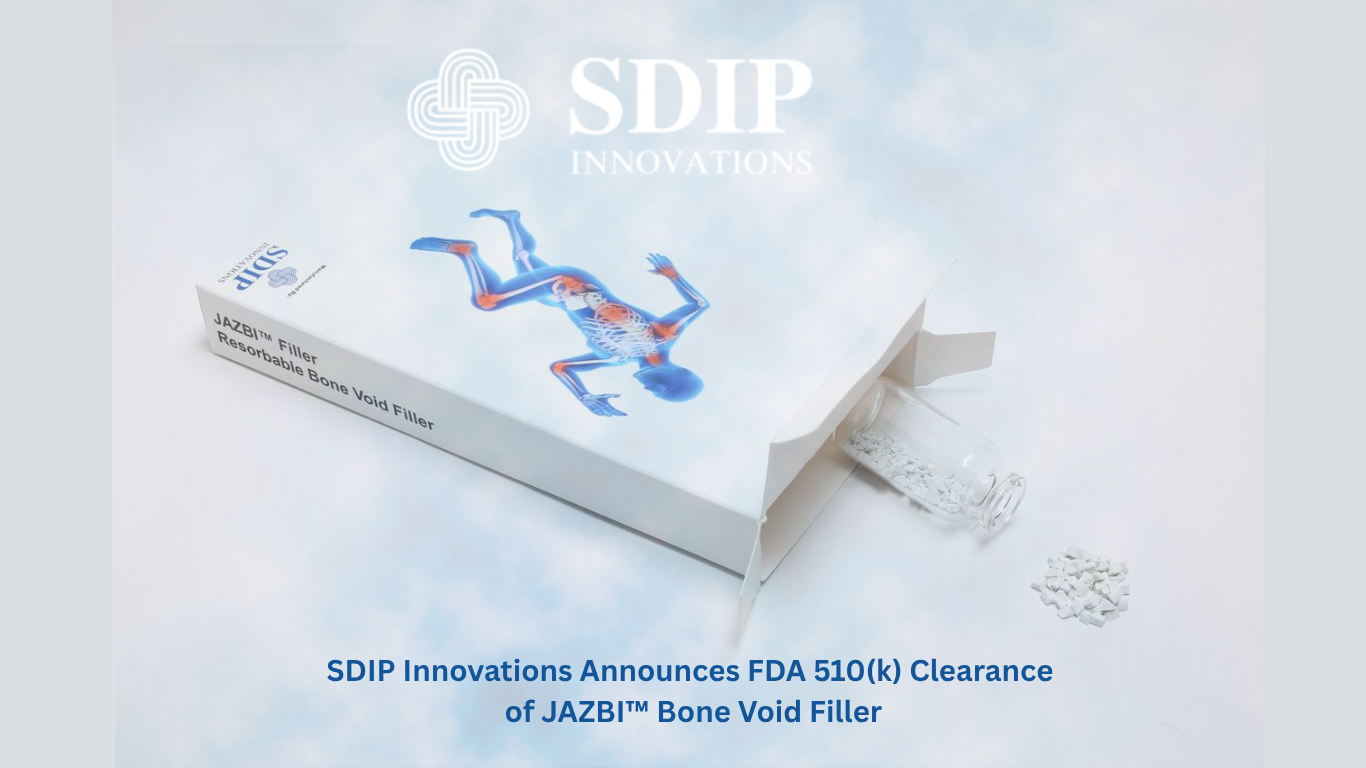
SDIP Innovations Pty Ltd, an Australian biomaterials company focused on regenerative technologies for musculoskeletal applications, announced that the FDA has granted 510(k) clearance for the JAZBI™ Bone Void Filler.
SDIP Innovations Announces FDA 510(k) Clearance of JAZBI™ Bone Void Filler, Marking the First Commercial Application of Proprietary JAZBI™ Biomaterial Technology
2 min read Premium comments
FDA 510(k) clearanceSDIP InnovationsJAZBI Bone Void Fillerregenerative
The clearance represents a significant milestone for the company and marks the first commercial application of the proprietary JAZBI™ biomaterial technology platform following nearly a decade of research, development and manufacturing investment.
JAZBI™ Bone Void Filler is a sterile, resorbable bone graft substitute intended to fill bony voids or gaps of the skeletal system that are not intrinsic to the stability of the bony structure. JAZBI™’s highly interconnected porous architecture provides an ideal environment for tissue infiltration and new bone formation. The material is designed to gradually resorb without creating inflammation and be replaced by new bone during the natural healing process. JAZBI™ conforms to the defect, creating a regenerative scaffold that supports biological healing, as the company claimed.
“The FDA clearance of JAZBI™ Bone Void Filler is an important milestone for SDIP and validates years of scientific, engineering and manufacturing development,” said Dr Maryam Parviz, Co-founder and CEO of SDIP Innovations. “We set out to create a biomaterial platform capable of supporting tissue regeneration while providing the flexibility to address a broad range of clinical needs. Achieving FDA clearance for the first JAZBI™ product is a major step toward realizing that vision.”
JAZBI™ core proprietary biomaterial, a novel resorbable polymer-ceramic composite, is the foundation of the follow-on products, the company claimed. "Every bone defect is unique, requiring a graft that can be adapted based on the patient's anatomy. Unlike brittle bone substitutes, JAZBI™ can be easily shaped intraoperatively.”, said Dr Manavitehrani, Co-founder and Chief Technology Officer of SDIP Innovations. “From material design through process development and manufacturing scale-up, our focus has been on building a platform technology capable of supporting a broad range of future regenerative products.”, he added.
According to the company, the underlying biomaterial has been engineered to enable tailoring of its physical, mechanical, and biological characteristics to different clinical requirements, creating a foundation for a broader portfolio of regenerative products. SDIP believes the JAZBI™ platform could ultimately support applications spanning orthopaedics, spine, dental and craniofacial surgery, as well as next-generation biomaterial-based drug delivery systems. The company is advancing additional products based on JAZBI™ technology and is focused on generating clinical evidence to support future commercial expansion.
About SDIP Innovations
SDIP Innovations Pty Ltd is an Australian medical technology company focused on the development and manufacture of advanced biomaterials for regenerative medicine and musculoskeletal applications. The company develops proprietary biomaterial technologies designed to support tissue regeneration and healing across orthopaedic, spine, dental and craniofacial applications. SDIP has established in-house design, development and manufacturing capabilities in Australia.
Author
TH
TJ Halvorson
The De Angelis Group | Orthopedics This Week | MSK Innovations
Why This Matters
Two Perspectives
MBA Lens: Economic and industry impact
SDIP Innovations secured FDA 510(k) clearance for its JAZBI™ Bone Void Filler, marking the first commercial application of its proprietary biomaterial platform. This regulatory milestone enables market entry for a resorbable bone graft substitute. The company's strategy involves leveraging this novel polymer-ceramic composite for broad musculoskeletal applications, aiming for future commercial expansion across orthopaedics, spine, dental, and craniofacial markets.
- The 510(k) clearance provides market access for SDIP's initial JAZBI™ product.
- SDIP plans to expand its JAZBI™ platform into diverse orthopaedic, spine, dental, and craniofacial markets.
PhD Lens: Clinical and outcomes impact
SDIP Innovations' JAZBI™ Bone Void Filler, a sterile, resorbable bone graft substitute, received FDA 510(k) clearance. Its novel polymer-ceramic composite features a highly interconnected porous architecture designed to support tissue infiltration and new bone formation. The material gradually resorbs without inflammation, facilitating replacement by new bone during the natural healing process, acting as a regenerative scaffold.
- JAZBI™ is a resorbable polymer-ceramic composite with a porous architecture for bone formation.
- The material is designed to resorb gradually and be replaced by new bone without inflammation.
React:
Discussion
This is a fascinating development. In my practice we've seen similar outcomes with the revised protocol. The key differentiator seems to be patient selection criteria. Has anyone else noticed the correlation with BMI thresholds?
Great point. I'd push back slightly on the conclusion, the sample size in the cited study is too small to draw population-level inferences. That said, the directional signal is compelling and worth a larger RCT.
We implemented a similar approach last year. Early results are promising but we're still gathering 12-month follow-up data. Happy to share our protocol if anyone is interested.
Join the conversation
Orthopedic professionals are discussing this. Sign in and upgrade to read every comment and add your voice.