
Studies demonstrate how artificial intelligence, personalized planning and navigation technologies are advancing patient-specific joint replacement
Advita Ortho Highlights New Research on AI-Generated Shoulder Digital Twins and Surgical Navigation at CAOS 2026
2 min read Premium comments
Advita Orthoartificial intelligenceCAOSAI generatedshoulder digital twinsknee proceduresankle proceduresshoulder procedures
GAINESVILLE, Fla., June 19, 2026 /PRNewswire/ -- Advita Ortho, a global medical technology leader, today announced the presentation of nine scientific studies at the 26th Annual Meeting of the International Society for Computer Assisted Orthopaedic Surgery (CAOS), highlighting new research on AI-generated shoulder digital twins, automated planning and surgical navigation across shoulder, knee and ankle procedures.
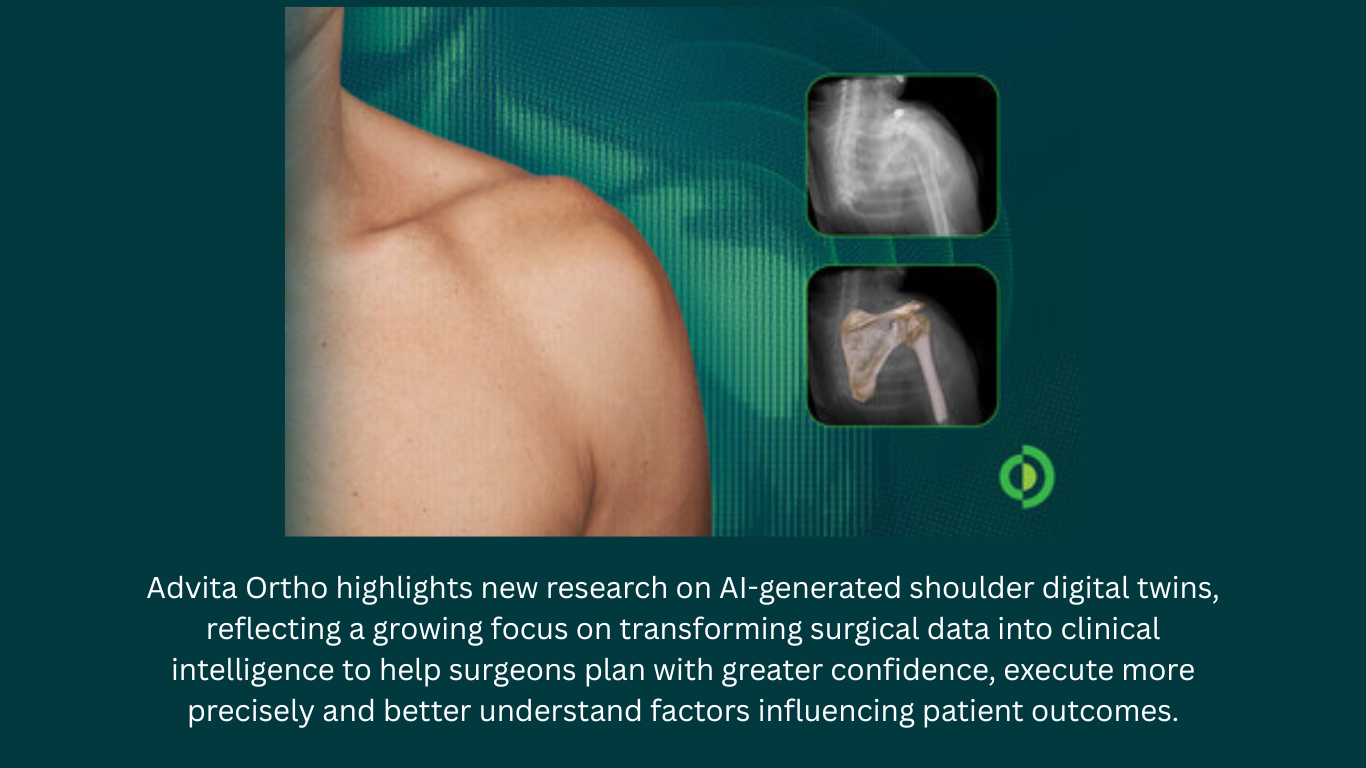
Advita Ortho highlights new research on AI-generated shoulder digital twins, reflecting a growing focus on transforming surgical data into clinical intelligence to help surgeons plan with greater confidence, execute more precisely and better understand factors influencing patient outcomes.
"AI is helping unlock new possibilities for personalized orthopedic care," said Laurent Angibaud, Senior Vice President of Advanced Surgical Technologies at Advita Ortho. "Our goal is to transform data into practical clinical insights that support surgeon decision-making, enhance confidence and ultimately improve patient care."
The research reflects a growing focus on transforming surgical data into clinical intelligence that is designed to help surgeons plan procedures with greater confidence, execute more precisely and better understand the factors influencing patient outcomes.
Among the featured presentations was research exploring new methods to assess the quality and reliability of AI-generated shoulder twins. As artificial intelligence becomes increasingly integrated into surgical workflows, the ability to evaluate model quality and identify areas of uncertainty can play an important role in building greater confidence in clinical decision-making. The work was recognized with the ISTELAR Emerging Research Best Technical Podium Award, underscoring the growing interest in technologies that support the responsible adoption of AI in orthopedic surgery.
Additional shoulder research evaluated the intraoperative accuracy of Advita GPS™, surgical navigation system, in complex arthroplasty cases involving augmented glenoid components, as well as the learning curve associated with navigated reverse total shoulder arthroplasty. Together, the findings add to a growing body of evidence supporting enabling technologies designed to enhance surgical precision while seamlessly integrating into surgical workflows.
In addition, new research on total ankle arthroplasty focused on automated bone segmentation for surgical planning and navigation, demonstrating the potential for AI-driven automation to streamline image processing and reduce manual planning requirements, while supporting patient-specific procedures.
Finally, findings were shared from multiple studies leveraging GPS-derived intraoperative data and machine learning outcomes to better understand dynamic knee alignment patterns, evaluate technology-enabled workflows and explore factors associated with clinical outcomes following joint replacement. The research examined functional alignment strategies in total knee arthroplasty and the role of soft tissue management in patients with severe varus deformity.
Collectively, the studies highlight the convergence of AI, navigation and data science to support more personalized planning and execution across the orthopedic care continuum.
"CAOS continues to be an important forum for advancing the science behind computer-assisted orthopedic surgery," said Angibaud. "We are proud to contribute research that helps move orthopedics forward with technologies designed to make personalized care more practical and accessible."
For more information, visit www.AdvitaAI.com.
About Advita Ortho
Advita Ortho is a global medical device company committed to advancing patients' lives through innovative orthopedic solutions. We specialize in high-quality implants and a comprehensive suite of integrated surgical technologies that are powered by data, artificial intelligence and machine learning. Offering trusted leadership and clinical expertise, Advita Ortho is uniquely positioned to advance mobility and improve lives worldwide. Learn more at www.advita.com and connect with us on LinkedIn, X and Instagram.
SOURCE Advita Ortho, LLC
Author
TH
TJ Halvorson
The De Angelis Group | Orthopedics This Week | MSK Innovations
Why This Matters
Two Perspectives
MBA Lens: Economic and industry impact
Advita Ortho showcased nine studies at CAOS 2026, emphasizing AI-generated shoulder digital twins and surgical navigation for shoulder, knee, and ankle procedures. This strategy aims to transform surgical data into clinical intelligence, enhancing surgeon confidence and precision. Such advancements could drive market adoption of personalized orthopedic care solutions, strengthening Advita's competitive position by streamlining workflows and improving patient outcomes.
- Advita's focus on AI and navigation technologies supports a strategy for market differentiation through personalized, data-driven surgical solutions.
- Integrating AI into planning and navigation workflows can enhance procedural efficiency and potentially reduce costs, influencing broader adoption and reimbursement.
PhD Lens: Clinical and outcomes impact
Advita Ortho presented nine scientific studies at CAOS 2026, detailing new research on AI-generated shoulder digital twins, automated planning, and surgical navigation across shoulder, knee, and ankle procedures. Research explored methods to assess AI-generated shoulder twin quality, earning the ISTELAR Emerging Research Best Technical Podium Award. Studies also evaluated intraoperative accuracy of Advita GPS™ in complex arthroplasty and learning curves for navigated procedures.
- Research focused on evaluating the quality and reliability of AI-generated shoulder digital twins and the intraoperative accuracy of navigation systems in complex shoulder arthroplasty.
- Additional studies covered AI-driven automated bone segmentation for ankle arthroplasty and machine learning applications to understand dynamic knee alignment and soft tissue management.
React:
Discussion
This is a fascinating development. In my practice we've seen similar outcomes with the revised protocol. The key differentiator seems to be patient selection criteria. Has anyone else noticed the correlation with BMI thresholds?
Great point. I'd push back slightly on the conclusion, the sample size in the cited study is too small to draw population-level inferences. That said, the directional signal is compelling and worth a larger RCT.
We implemented a similar approach last year. Early results are promising but we're still gathering 12-month follow-up data. Happy to share our protocol if anyone is interested.
Join the conversation
Orthopedic professionals are discussing this. Sign in and upgrade to read every comment and add your voice.