
Milestone reflects sustained surgeon adoption of efficient joint replacement systems across hospital and ambulatory settings
TJO Surpasses 50,000 Implants Placed, with 32% of Procedures Performed in ASCs
3 min read Premium comments
OTWPRjoint replacementKlassic® Knee implantsknee implantsTotal Joint Orthopedics
SALT LAKE CITY, UT [March 2, 2026] Total Joint Orthopedics, Inc. (TJO), an innovator in joint replacement solutions, today announced it has surpassed 50,000 total implants placed nationwide, including more than 38,000 Klassic® Knee implants.
In 2025, 32% of TJO procedures were performed in ambulatory surgery centers (ASCs), reflecting sustained surgeon adoption in environments where operational efficiency and procedural consistency are essential.
As joint replacement expands across sites of care and economic pressures intensify, surgeons are prioritizing systems that reduce complexity without compromising outcomes. And particularly in ambulatory environments, efficiency is operational: fewer trays and simplified workflows directly impact setup, sterilization demands, and turnover time.
TJO’s portfolio is built around an “Efficiency by Design” philosophy that prioritizes streamlined instrumentation, system consistency, and adaptability across hospital and ASC settings, without any compromise in survivorship or functional outcomes.
“The shift to ambulatory joint replacement isn’t slowing down, and the systems that win in ASCs won’t be the ones with the most trays – they’ll be the ones that enable surgical teams to maximize efficiency while achieving excellent patient outcomes. That’s what we’ve engineered from the beginning, and 50,000 procedures in, surgeons are proving it every day.” – Erin Hofmann.
“Ambulatory surgery centers are now our fastest-growing primary TKA setting,” comments Erin Hofmann, TJO’s CEO. “In those environments, efficiency is operational. Systems that simplify workflow and reduce tray burden earn their place in the OR. Surgeons stay with solutions that make their teams’ jobs easier while maintaining excellent outcomes.”
Of the 50,000 implants, more than 38,000 have been knee procedures, driven by adoption of the Klassic® Knee System and the Klassic® Revision Knee System across hospital and ambulatory environments.
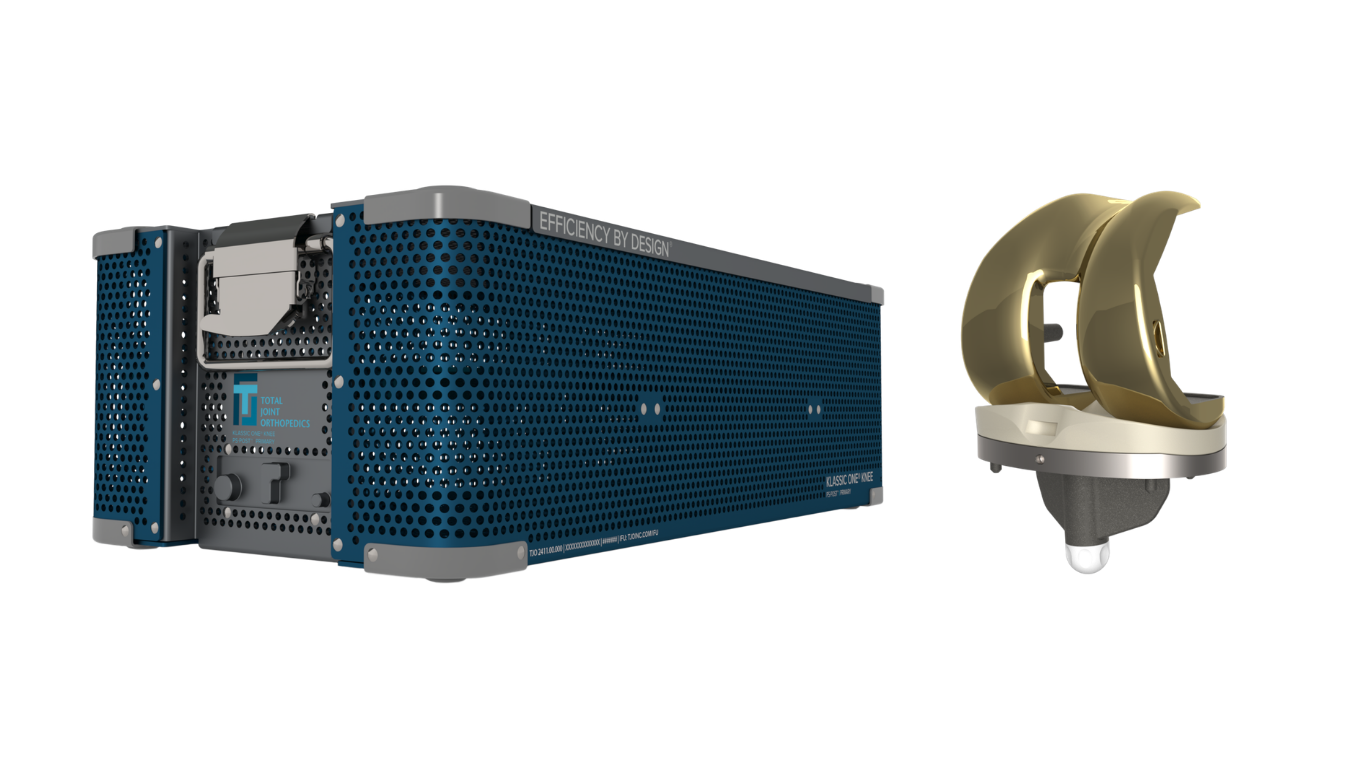
The Klassic® Knee System features the only modern universal femoral component on the market; a design that eliminates the need for left and right implants. This symmetric architecture enables streamlined instrumentation, reducing sterilization and storage burden while supporting faster setup and turnover times in high-volume ASC environments. Through the Klassic ONE® single-tray system, up to 90% of primary total knee procedures can be performed with a single instrument tray—delivering estimated per-case cost savings of up to $1,3503-5.
Ten-year clinical data on the Klassic® Knee demonstrates no compromise in survivorship or functional outcomes.1 In a comparative analysis, patient outcomes were similar across implant types, while the symmetric group demonstrated significantly improved radiographic patellar tracking, reinforcing the durability of the design philosophy.2
If you would like more information about this topic, please call 888.890.0102 or email sales@tjoinc.com.
###
About Total Joint Orthopedics, Inc.
Total Joint Orthopedics, Inc. (TJO) is a medical device company built to simplify joint replacement. As total joint arthroplasty moves increasingly into ambulatory surgery centers and value-driven care models, TJO’s Efficiency by Design® platform delivers long-term clinical performance through streamlined system architecture and reduced instrumentation complexity.
Its flagship Klassic® Knee System, supported by 10-year survivorship data, features a universal femoral design that eliminates left/right component redundancy and enables single-tray primary workflows.
Across its portfolio, including the Klassic HD® Hip and Klassic® Revision Knee Systems, TJO requires a maximum of three instrument trays per procedure—reducing sterilization burden, improving turnover efficiency, and aligning with the economic realities of modern joint care. To learn more, please visit tjoinc.com.
References
- Nielsen A, Law J, Homolka L, Forrester DA, Hofmann AA. Positive Clinical Outcomes at 10 Years with the Universal Femoral Component in Total Knee Arthroplasty. J Orthop. 2024 Dec 25;66:67-70. doi: 10.1016/j.jor.2024.12.026. eCollection 2025 Aug.
- Joshua P. Rainey, MD; Brenna E. Blackburn, PhD; Claire R. Kapron; Michael J. Archibeck, MD; Lucas A. Anderson; Christopher E. Pelt, MD. Radiographic and Clinical Comparisons of a Modern Symmetrical vs. Asymmetrical Implant Design in Primary TKA. J Arthroplasty. 2025 Feb 14:S0883-5403(25)00149-4. doi: 10.1016/j.arth.2025.02.021.
- Siegel GW, Patel NN, Milshteyn MA, et al. Cost analysis and surgical site infection rates in total knee arthroplasty comparing traditional vs. single-use instrumentation. J Arthroplasty. 2015;30(12):2271-74.
- Watters, et al. Analysis of procedure-related costs and proposed benefits of using patient-specific approach in total knee arthroplasty. J. Surg Orth Adv. 2011.
- Maathuis et al. Perioperative contamination in primary total hip arthroplasty. Clin Ortho Rel Res. 2005.
Author
TH
TJ Halvorson
The De Angelis Group | Orthopedics This Week | MSK Innovations
React:
Discussion
This is a fascinating development. In my practice we've seen similar outcomes with the revised protocol. The key differentiator seems to be patient selection criteria. Has anyone else noticed the correlation with BMI thresholds?
Great point. I'd push back slightly on the conclusion, the sample size in the cited study is too small to draw population-level inferences. That said, the directional signal is compelling and worth a larger RCT.
We implemented a similar approach last year. Early results are promising but we're still gathering 12-month follow-up data. Happy to share our protocol if anyone is interested.
Join the conversation
Orthopedic professionals are discussing this. Sign in and upgrade to read every comment and add your voice.