
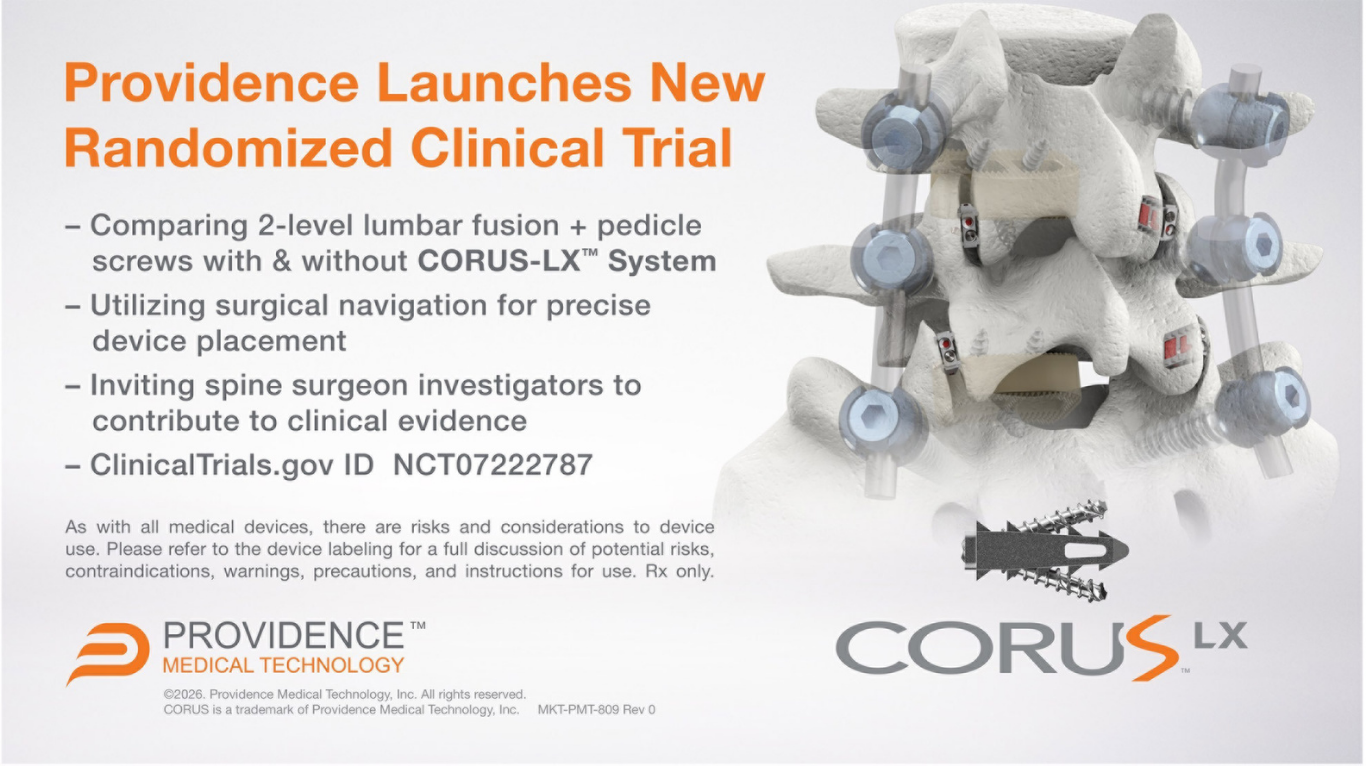
PLEASANTON, Calif., March 19, 2026 /PRNewswire/ — Providence Medical Technology, Inc., a pioneer in less invasive solutions for spine surgery, today announced enrollment of the first patients in its prospective, randomized controlled trial (RCT) evaluating the CORUS-LX System for the treatment of degenerative lumbosacral disease. This multi-center RCT will enroll subjects indicated for two-level interbody fusion with supplemental percutaneous pedicle screw fixation and posterior fusion. Subjects will be randomized to receive posterior fusion either with the CORUS-LX System or with the surgeon’s standard posterior fusion technique.
First Subjects Randomized in Clinical Trial Evaluating the Benefits of Total Segmental Fusion in Treating Degenerative Conditions in the Lumbar Spine
3 min read Premium comments
OTWPRCORUS-LX SystemProvidence Medical Technologyrandomized controlled trial
Dr. Kade Huntsman of the Huntsman Spinal Clinic in Salt Lake City, Utah, was the first clinical investigator to treat an enrolled subject with the study device. The case utilized a circumferential fusion approach, integrating lumbar interbody fusion with percutaneous pedicle screws and the CORUS-LX System for fusion bed preparation and supplemental posterior stabilization and fusion. Huntsman joins Dr. Mohsin Fidai and Dr. Vivek Mohan as early-enrolling investigators in the study, which aims to evaluate subjects through 2027.
The Lumbar Blueprint: Building on Insights from the FUSE Study
This study is designed to replicate the rigorous clinical validation established by Providence’s FUSE study, which was the largest prospective RCT to evaluate three-level cervical fusion. Evidence from FUSE demonstrated that adding CORUS PCSS to an anterior cervical fusion delivers clinically superior composite fusion rates to anterior fusion alone. This new trial seeks to provide similar high-level insights for the lumbar spine.
“The FUSE Study was a turning point for cervical spine surgery because it clearly demonstrated that tissue-sparing, supplemental posterior fixation improves patient outcomes for 3-level patients,” said Scott Lynch, Chief Product Officer of Providence Medical Technology. “We believe this new trial will demonstrate that the CORUS-LX System provides similar biological and mechanical advantages for the lumbar spine.”
A Superiority Trial
In a medical device market often focused on “non-inferiority,” Providence is pursuing a statistical superiority endpoint. The trial aims to establish a new benchmark for two-level lumbar treatment options by comparing a treatment arm (CORUS-LX + Interbody Fusion + Pedicle Screws) against the current gold standard (Interbody Fusion + Pedicle Screws alone). The hypothesis is that the CORUS-LX construct will be a superior option for patients requiring L4-S1 lumbar fusion. The primary endpoint is to demonstrate superior 12-month composite fusion rates, with additional data collection on patient-reported outcomes and return-to-work measures through 24 months.
New Technology Addresses Inadequate Fusion Bed Preparation
Percutaneous pedicle screws are commonly used to stabilize the spine as a part of lumbar fusion surgery. While they offer a less invasive approach, percutaneous pedicle screws can limit a surgeon’s ability to “decorticate” or prepare the bone for a solid fusion. The inability to thoroughly prepare the fusion bed can lead to higher rates of pseudarthrosis (failure to fuse), particularly in high-risk patients. Conversely, the CORUS-LX System provides a tissue-sparing solution that enables thorough decortication and precise bone graft delivery while providing the stability of a traditional screw. “Adding dedicated fusion implants in the facet joints provides more places for bones to fuse — both front and back of the spine,” said Dr. Huntsman. “We expect clinical results observed in the neck to extend to the lower back, with faster recovery and fewer fusion failures.”
Modernizing the Workflow: Precision via Surgical Navigation
A key component of the study involves using the CORUS-LX System with modern surgical workflows, specifically the surgical navigation systems from Medtronic and Globus Medical. By combining CORUS-LX with these leading navigation systems, surgeons can achieve high-precision placement of posterior implants through a tissue-sparing corridor.
About CORUS-LX
CORUS-LX is an integrated construct consisting of a stabilizer and two screws that is FDA-cleared for tissue-sparing posterior lumbar fusion and supplemental fixation. The system allows for extensive decortication and bone graft retention, serving as a dedicated fusion device that also provides significant stabilization.
About Providence Medical Technology, Inc.
Providence Medical Technology is a privately held medical device company focused on innovative solutions for cervical and lumbar spinal fusion. With a mission to improve clinical outcomes and reduce the economic burden of spine surgery, Providence is a leader in less-invasive, evidence-based surgical technologies. For more information, visit www.providencemt.com.
SOURCE Providence Medical Technology, Inc.
Author
TH
TJ Halvorson
The De Angelis Group | Orthopedics This Week | MSK Innovations
React:
Discussion
This is a fascinating development. In my practice we've seen similar outcomes with the revised protocol. The key differentiator seems to be patient selection criteria. Has anyone else noticed the correlation with BMI thresholds?
Great point. I'd push back slightly on the conclusion, the sample size in the cited study is too small to draw population-level inferences. That said, the directional signal is compelling and worth a larger RCT.
We implemented a similar approach last year. Early results are promising but we're still gathering 12-month follow-up data. Happy to share our protocol if anyone is interested.
Join the conversation
Orthopedic professionals are discussing this. Sign in and upgrade to read every comment and add your voice.