
The Cement Mantle vs a Distal Femoral Replacement
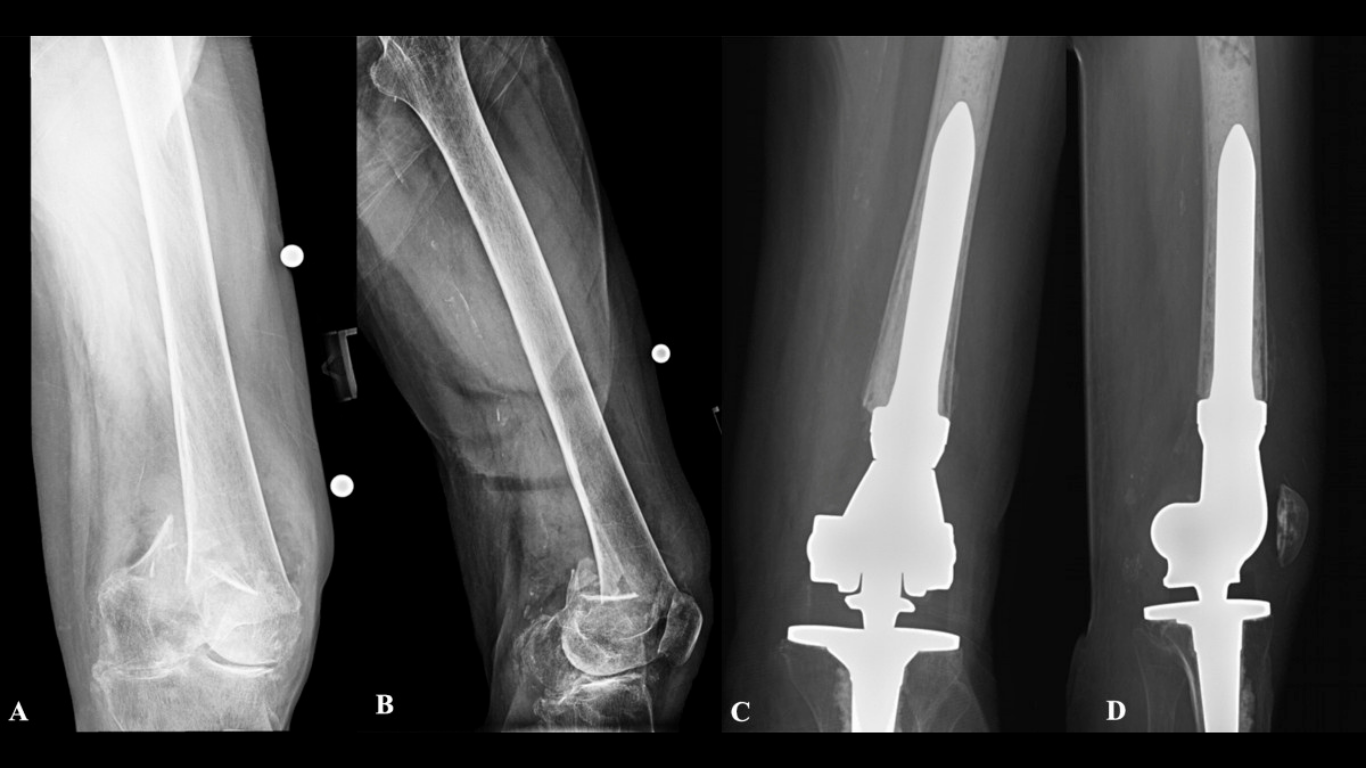
Once the domain of massive oncologic resections, distal femoral replacement (DFR) is now a go-to salvage move for complex non-oncologic disasters as well.
But when you’re building a megaprosthesis skyscraper on metaphyseal sand, will that cement mantle hold…or haunt you?
This newly published study poses the following question: does cement mantle grading correlate with implant survivorship in distal femoral replacements?
Measuring the Mantle
This retrospective study (2005–2022) collected data from 198 DFR patients — mean age 71, BMI 32.1 and nearly two-thirds women. The authors assessed:
- Femoral stem-to-construct ratio (radiographic measurements)
- Cement mantle quality using the classic Barrack grading system:
- Grade A – Cement Picasso
- Grade B – Respectable but not Instagram-worthy
- Grade C/D – “Let’s not zoom in too much”
Distribution? Grade A, 48 patients. Grade B, 100 and Grade C/D, 50 patients.
Now the fun part: does prettier cement equal longer implant life?
Radiographs Meet Reality
First interesting finding: Stem-to-construct ratio was smaller in Grade A mantles. Grade A: 1.2, Grade B: 1.5 and Grade C/D: 1.6. (P < 0.001)
So smaller ratios → better cement grades. Already you’re thinking: tighter fit, better fill, happier cement?
But then come the revision rates.
Overall revision rate: Grade A: 29.2%. Grade B: 25.0% and Grade C/D: 38.0%. Statistically? Not significant (P = 0.257).
Loosening Rates: Grade A: 4.2%. Grade B: 5.0% and Grade C/D: 14.0%. Again…Not statistically significant (P = 0.118).
So…Does the Mantle Matter?
Despite better cement, mantle grades being associated with a smaller stem-to-construct ratio, loosening and revision rates were comparable across all mantle grades.
You can craft a Barrack A masterpiece…and still end up revising it.
Meanwhile, a C/D that would make your fellowship director wince? It might hum along just fine.
What This Means in the OR
This study gently challenges the deep-seated belief that radiographic cement perfection guarantees longevity in DFR.
In megaprostheses — where forces are enormous, lever arms are unforgiving, and biology often isn’t ideal — mechanical survivorship appears to be multifactorial and not solely dependent on cement mantle aesthetics.
Yes, strive for good cement technique. Yes, aim for optimal stem fit. But maybe — just maybe — the mantle isn’t the crystal ball we thought it was.
Bottom Line
- Smaller stem-to-construct ratios correlate with better cement grades.
- Worse cement mantle grading did not significantly increase loosening risk.
- Nearly 30% revision rate overall reminds us: DFR is still a high-stakes game.
The cement mantle matters…but maybe not as dramatically as expected.
Origin Study Title: Does Cement Mantle Grading of Distal Femoral Replacements Correlate with Implant Survivorship?
Authors: Neeku Salehi, B.S.; Alan D. Lam, B.S.; Alexander Linton, M.D.; Alec Giakas, M.D.; Matthew B. Sherman, B.S.; David N. Kugelman, M.D.; Chad A. Krueger, M.D.
Author
Discussion
This is a fascinating development. In my practice we've seen similar outcomes with the revised protocol. The key differentiator seems to be patient selection criteria. Has anyone else noticed the correlation with BMI thresholds?
Great point. I'd push back slightly on the conclusion, the sample size in the cited study is too small to draw population-level inferences. That said, the directional signal is compelling and worth a larger RCT.
We implemented a similar approach last year. Early results are promising but we're still gathering 12-month follow-up data. Happy to share our protocol if anyone is interested.
Join the conversation
Orthopedic professionals are discussing this. Sign in and upgrade to read every comment and add your voice.