
19-01-2026 Schiedam, The Netherlands.
Cresco Spine Receives FDA 510(k) Clearance for the Spring Distraction System (SDSTM)
2 min read Premium comments
OTWPR510k clearanceCresco Spineearly onset scoliosisSpring Distraction System
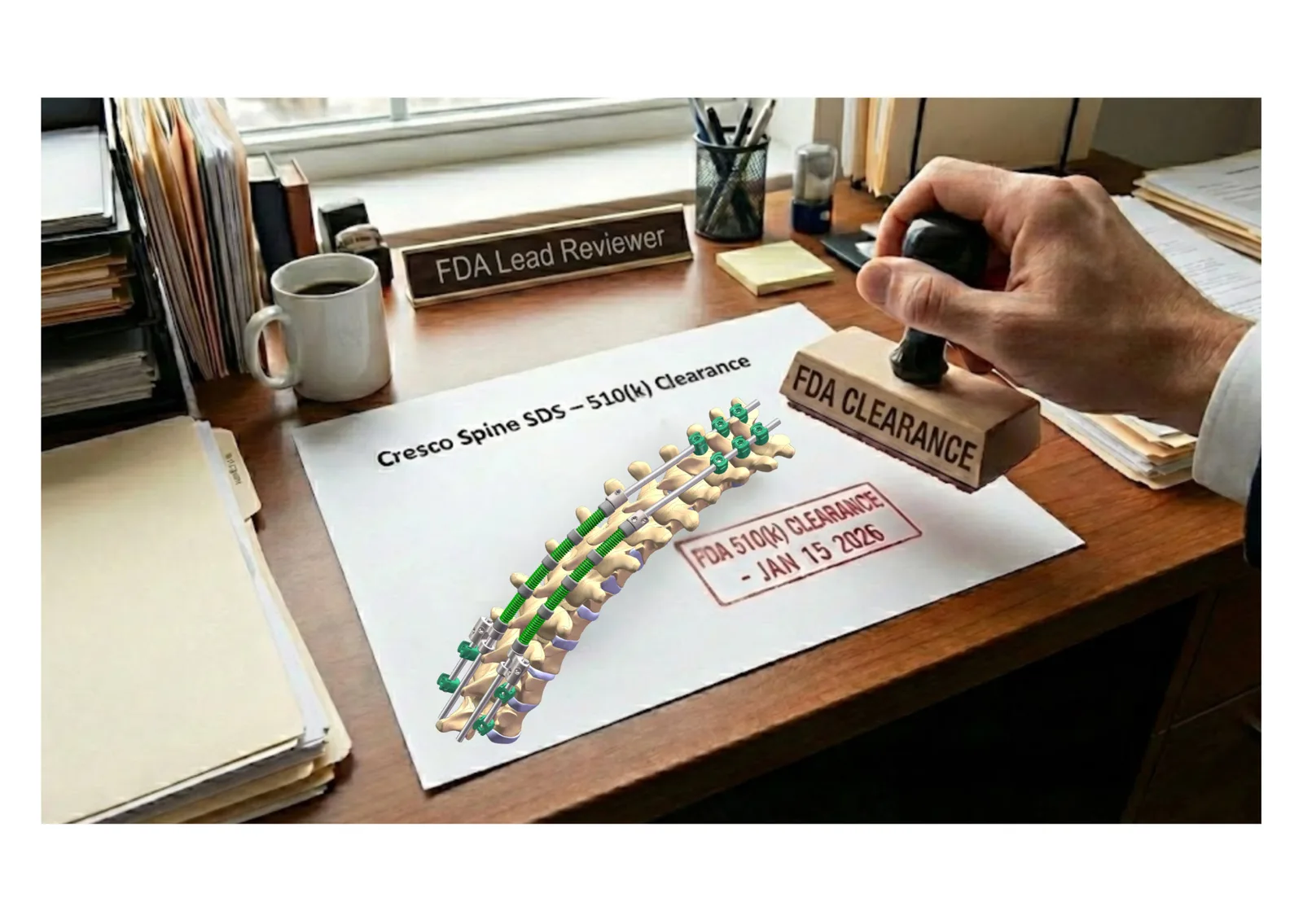
Cresco Spine today announced that the U.S. Food and Drug Administration has granted 510(k) clearance for the Spring Distraction System (SDSTM), a dynamic, growth-friendly implant for the treatment of early onset scoliosis.
Earlier in its regulatory trajectory, SDSTM received FDA Breakthrough Device Designation. Since the introduction of this program in 2015, fewer than 0.1 percent of all devices cleared through the 510(k) pathway have obtained this designation, underscoring both the unmet clinical need and the potential clinical relevance of the SDSTM technology.
Following Breakthrough designation, Cresco Spine entered together with R&D/regulatory partner BAAT Medical and the FDA in a highly structured and constructive regulatory process. Through a series of focused regulatory sprints, the parties worked iteratively toward a complete, high-quality submission dossier, enabling early scientific alignment and efficient resolution of key regulatory questions.
Dennis Magermans, Chief Executive Officer of Cresco Spine, stated:
“The Breakthrough Device pathway allowed us to engage with the FDA in a fundamentally different way. Instead of a linear, end-stage review, we worked in close, iterative collaboration through focused sprints, building a robust and complete dossier step by step. That process has been essential in reaching FDA 510(k) clearance with clarity and confidence.”
With FDA-clearance obtained, Cresco Spine will initiate a controlled release of the Spring Distraction System in a limited number of high-profile children’s hospitals first in the United States and Canada and at a later stage in Australia and New Zealand. This phased introduction is designed to ensure careful clinical adoption and to allow the first children outside the Netherlands to be treated with SDSTM.
René Castelein, Chief Medical Officer of Cresco Spine, commented:
“After several years of presenting consistent clinical results from the Netherlands, I am very pleased that colleagues in the United States and Canada can now apply this work in their own practice. This allows early onset scoliosis patients outside Europe to benefit from a growth-guiding approach that supports spinal and thoracic development without relying on repetitive lengthening procedures.”
The Spring Distraction System is a growth-friendly spinal implant that applies physiologic forces using a compressed helical spring, aiming to guide spinal development while preserving mobility and reducing the need for repeated surgical or outpatient lengthening procedures. This significantly minimizes the overall treatment burden for young patients and their families.
About Cresco Spine
Cresco Spine is a medical technology company dedicated to transforming the treatment of spinal deformities through dynamic, (growth-friendly) implant solutions. Its mission is to optimize surgical care for scoliosis by developing implant alternatives to rigid fixation.
More information is available at www.cresco-spine.com.
Author
TH
TJ Halvorson
The De Angelis Group | Orthopedics This Week | MSK Innovations
React:
Discussion
This is a fascinating development. In my practice we've seen similar outcomes with the revised protocol. The key differentiator seems to be patient selection criteria. Has anyone else noticed the correlation with BMI thresholds?
Great point. I'd push back slightly on the conclusion, the sample size in the cited study is too small to draw population-level inferences. That said, the directional signal is compelling and worth a larger RCT.
We implemented a similar approach last year. Early results are promising but we're still gathering 12-month follow-up data. Happy to share our protocol if anyone is interested.
Join the conversation
Orthopedic professionals are discussing this. Sign in and upgrade to read every comment and add your voice.