
FDA Clears Novel Antibacterial Tech for Limb Salvage System
In the high-stakes world of limb salvage surgery, where infection can turn a heroic reconstruction into a devastating setback, a small innovation might mark a big step forward.
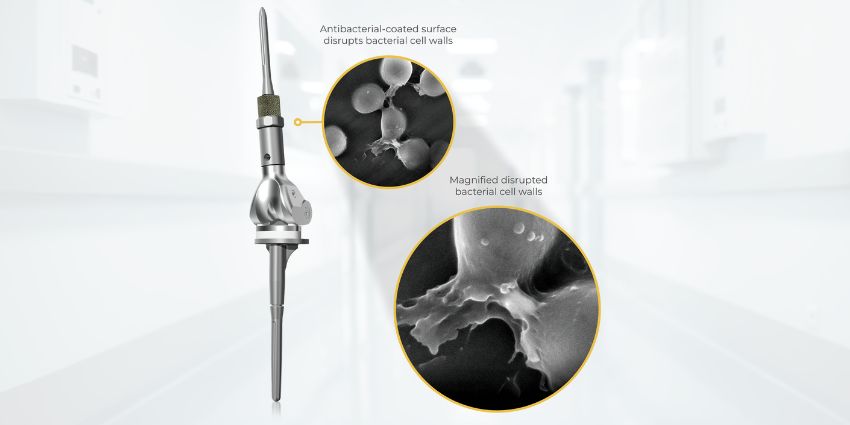
The newly cleared NanoCept coating, developed by the New Jersey-based Onkos Surgical, isn’t a traditional antibiotic surface treatment or drug delivery system. Instead, it’s a bacteria-reduction coating applied to cobalt-chromium components of the ELEOS limb salvage system.
According to the FDA summary, the coating is intended to “reduce bacterial contamination prior to implantation resulting from deposition in the operating room on the surface of the device components.”
Importantly, NanoCept doesn’t treat existing infections and doesn’t act within the body — it’s all about mitigating what happens in those critical few minutes between tray opening and implantation.
And those minutes matter.
Operating rooms are meticulously sterilized, but even transient airborne or contact-based contamination can spell disaster when large metallic implants are involved—especially in oncologic or complex revision settings.
In preclinical testing, the NanoCept technology showed an impressive 99.999% (5-log) kill rate against common OR bacteria. While its clinical impact hasn’t yet been evaluated in human trials, the coating represents a proactive approach to one of orthopedic oncology’s most stubborn complications: infection.
“The NanoCept Antibacterial Technology is an important addition to comprehensive bacterial contamination mitigation efforts in orthopaedic surgery,” said Steven Gitelis, M.D., Chief Medical Officer of Onkos Surgical and Director of Musculoskeletal Oncology at Rush University Medical Center.
He added, “The clearance of the ELEOS Proximal Tibia with NanoCept allows us to extend this technology to one of the most challenging anatomical sites for bone tumors and complex bone loss.”
The ELEOS system itself is indicated for resection and replacement of the proximal femur, distal femur, total femur, proximal tibia, and intercalary segments in skeletally mature patients — a broad portfolio aimed squarely at limb preservation in oncologic and complex reconstructive cases.
Last year, the NanoCept coating received a de novo classification, paving the way for broader FDA clearances like this one. Now, Onkos has turned that foundation into what may become a new infection-control standard for limb salvage prostheses.
While time and data will tell whether this antibacterial coating makes a measurable clinical difference, its concept — targeting the moment contamination occurs — offers a smart and timely tool in the orthopedic surgeon’s infection prevention arsenal.
Because sometimes, the best way to fight infection…is to stop it before it starts.
Author
Discussion
This is a fascinating development. In my practice we've seen similar outcomes with the revised protocol. The key differentiator seems to be patient selection criteria. Has anyone else noticed the correlation with BMI thresholds?
Great point. I'd push back slightly on the conclusion, the sample size in the cited study is too small to draw population-level inferences. That said, the directional signal is compelling and worth a larger RCT.
We implemented a similar approach last year. Early results are promising but we're still gathering 12-month follow-up data. Happy to share our protocol if anyone is interested.
Join the conversation
Orthopedic professionals are discussing this. Sign in and upgrade to read every comment and add your voice.