
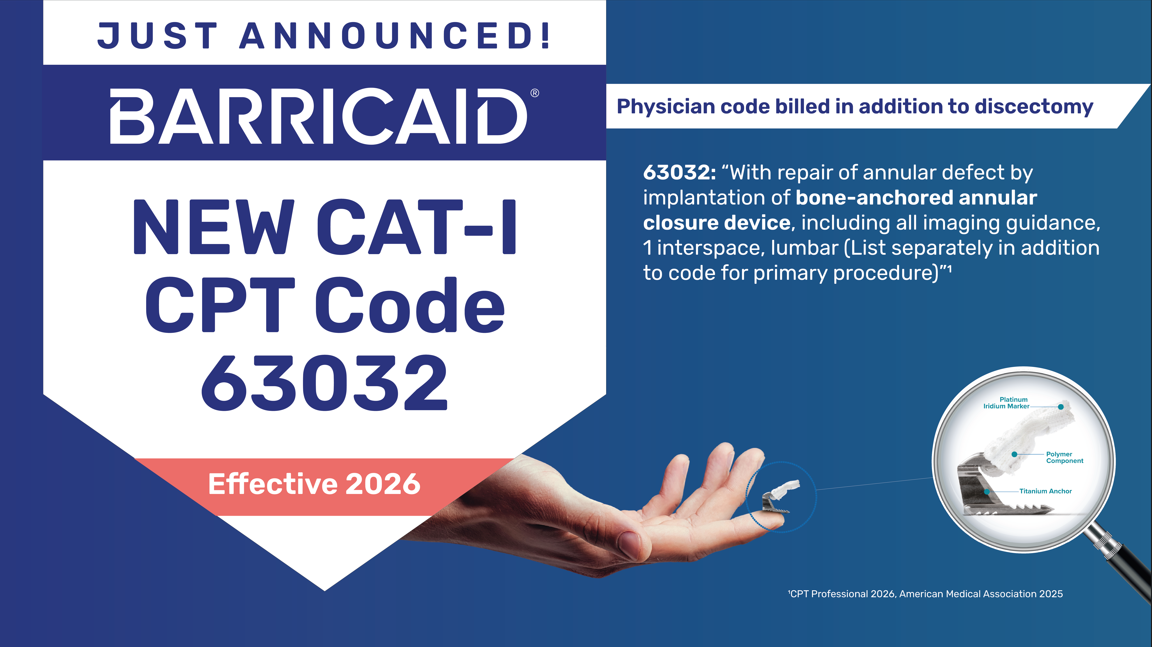
BOSTON, MA – October 24, 2025 (Via PR NewsWire) – Intrinsic Therapeutics, Inc., the makers of the Barricaid® Annular Closure Device, announced today that the American Medical Association (AMA) has published a new Category I CPT® code, 63032, for bone-anchored annular closure, effective January 1, 2026.
Intrinsic Therapeutics Announces that AMA Released CPT 2026 Code Set Including New CPT Code 63032 Describing Bone-Anchored Annular Closure, Effective January 1, 2026
2 min read Premium comments
OTWPR
This new add-on CPT code specifically describes the adjunctive placement of a bone-anchored annular closure device (Barricaid) following lumbar discectomy in patients with large annular defects. The CPT long descriptor reads: “with repair of annular defect by implantation of bone-anchored annular closure device, including all imaging guidance, 1 interspace, lumbar (list separately in addition to code for primary procedure).”
April Spillane, Vice President, Health Economics stated, “For more than twenty years, the spine community has sought effective solutions for discectomy patients at high risk of reherniation. This milestone marks a major step forward in advancing care for these patients. Surgeons will now be able to code for the specific work of repairing an annular defect and implanting Barricaid following a discectomy. It is my sincere hope that this development will increase patient access to Barricaid.”
With the ISASS 2025 guidelines now recommending annular closure for appropriately selected patients, Intrinsic urges surgeons and payors nationwide to update their systems to include this new code 63032.
Greg Lambrecht, the founder of Barricaid, went on to say, “This new CPT code is a recognition of the important advancement Barricaid represents in the standard care for discectomy patients. It is a result of enormous dedication by the team at Intrinsic, specialty societies, and the spine surgeon community. I couldn’t be happier for the patients that now have a pathway for treatment.”
About Barricaid
Barricaid is a proprietary annular closure medical device designed to reduce reoperations for reherniations by 81%* in lumbar discectomy patients with large annular defects. Barricaid has been implanted in nearly 13,000 patients and is supported by clinical studies across eight distinct patient populations, including two randomized controlled trials and six single-arm studies. A multicenter, Level I RCT demonstrating superior outcomes to discectomy alone was published in JAMA with five-year follow-up results.
*Some studies are outside FDA indications. Values at a minimum of 1-year post-op. Minimum study size: 20 Barricaid subjects.
Media Contact: Jake Tanner, VP of Marketing – 760-525-9739 – jtanner@barricaid.com
Barricaid is a registered trademark of Intrinsic Therapeutics, Inc.
CPT is a registered trademark of the American Medical Association (AMA).
Author
TH
TJ Halvorson
The De Angelis Group | Orthopedics This Week | MSK Innovations
React:
Discussion
This is a fascinating development. In my practice we've seen similar outcomes with the revised protocol. The key differentiator seems to be patient selection criteria. Has anyone else noticed the correlation with BMI thresholds?
Great point. I'd push back slightly on the conclusion, the sample size in the cited study is too small to draw population-level inferences. That said, the directional signal is compelling and worth a larger RCT.
We implemented a similar approach last year. Early results are promising but we're still gathering 12-month follow-up data. Happy to share our protocol if anyone is interested.
Join the conversation
Orthopedic professionals are discussing this. Sign in and upgrade to read every comment and add your voice.