
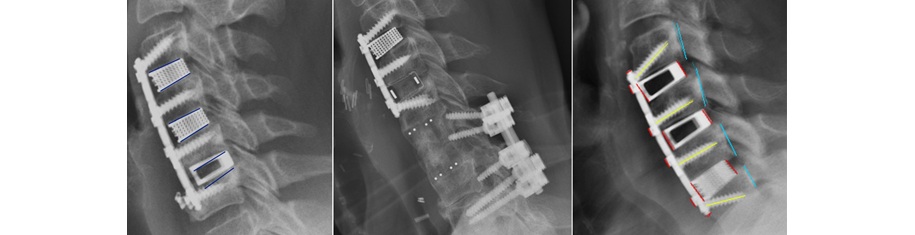
DRAPER, Utah, Sept. 11, 2025 /PRNewswire/ — Nexus Spine is excited to share pilot study results of a comparative radiographic assessment of ACDF outcomes in a series of patients who were selected for common risk factors of subsidence, instability, and delayed bone growth. Specifically, the patients were over 66 years of age, had poor bone quality, and/or required cervical fusion surgery at three or more contiguous levels. Each patient received a Nexus Spine Tranquil® cervical interbody cage at one or more spinal levels, and, as a control, some patients received one or more competing interbody devices at adjacent level(s).
Nexus Spine’s Patented Tranquil® Interbody Implants Achieve Exceptional Outcomes
2 min read Premium comments
Studies
Post-operative radiographic assessment of the treated levels at each of two weeks, six weeks, six months, and twelve months revealed that the levels treated with Nexus Spine’s Tranquil® interbody devices had no measurable subsidence. In contrast, the levels treated with the other interbody devices demonstrated measurable subsidence as soon as two weeks in more than 66% of the levels treated. Subsidence is a primary indicator of spinal instability and pain. Accordingly, the results of this study suggest that Nexus Spine’s patented technology amounts to a significant improvement over the competing devices.
Peer-reviewed publications demonstrate competitive devices that exhibit at least 3 mm of subsidence in more than 52% of patients. Nexus Spine’s Tranquil® interbody cages performed much better, with no subsidence.
This comparative study was independently designed and conducted by Dr. Peter Campbell, of Shreveport, LA, without funding, control nor input from Nexus Spine. Dr Campbell shared, “My radiographic outcomes made clear that Tranquil was the one device that ameliorated subsidence. Compared to other currently available devices on the market, Tranquil doesn’t subside.”
“If we can solve the key challenges for the highest-risk patients,” said David Hawkes, President of Nexus Spine, “then we can improve the universal standard of care.” David further explained, “Matching the stiffness of the host bone is key. This pilot study is very exciting because it demonstrates that our patented Tranquil® interbody implants are better at preventing subsidence. We are also looking at how much faster our devices provide stability. Subsidence and prolonged instability are both consequences of using an interbody that is too stiff.”
Among its vast patent portfolio, Nexus Spine holds U.S. Patent No. 12,279,967, entitled “Porous Interbody Spacer,” which has a priority date that extends back to 2015. This patent is available to view at https://patents.google.com/patent/US12279967B2/en.
Media Contact:
Contact@nexusspine.com
www.nexusspine.com
SOURCE Nexus Spine
Author
TH
TJ Halvorson
The De Angelis Group | Orthopedics This Week | MSK Innovations
React:
Discussion
This is a fascinating development. In my practice we've seen similar outcomes with the revised protocol. The key differentiator seems to be patient selection criteria. Has anyone else noticed the correlation with BMI thresholds?
Great point. I'd push back slightly on the conclusion, the sample size in the cited study is too small to draw population-level inferences. That said, the directional signal is compelling and worth a larger RCT.
We implemented a similar approach last year. Early results are promising but we're still gathering 12-month follow-up data. Happy to share our protocol if anyone is interested.
Join the conversation
Orthopedic professionals are discussing this. Sign in and upgrade to read every comment and add your voice.