
Throw Your Navigation Camera Away: The Visie Story
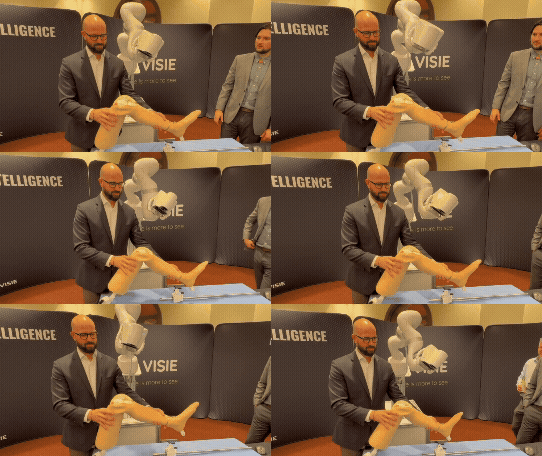
Orthopedic surgeons know better than anyone: precision isn’t a luxury—it’s the difference between success and complication. For years, surgical navigation systems have promised accuracy but delivered friction. Pins. Arrays. Manual registration. It’s time to move forward.
Enter Visie
Not a robotics company. Not just navigation. Not another AR overlay. Visie Inc. is a spatial computing company—and it’s rewriting what’s possible in the operating room.
“We live at the place where technology meets tissue,” says Visie CEO Doug Fairbanks. “You can’t buy what we’ve built. You have to invent it.”
Why Traditional Navigation Systems Fall Short
Human beings see the world in 3D through binocular disparity—our brains effortlessly combine the input of two eyes to perceive depth. Computers mimic this using stereography: two cameras capturing different angles to reconstruct a 3D image. It’s the same principle behind current navigation systems—and the same one used in self-driving cars.
But anyone who’s watched a Tesla glitch when lighting shifts or a shadow crosses the road knows: stereography has limits. Surgical environments are far less forgiving. Bright lights, reflective instruments, blood, and tissue movement introduce noise and uncertainty. In the OR, “close enough” isn’t good enough.
Another common approach is lidar, which uses lasers to measure depth by timing how long light takes to bounce off a surface. It works well at longer ranges, like in cars or drones—but at the close range of a surgical field, it becomes computationally intensive and highly susceptible to scatter. Lasers bounce unpredictably off wet or uneven surfaces—like bone, tissue, or instruments—introducing signal distortion and delay.
These aren’t minor flaws—they’re fundamental limitations.
A Smarter Way to See
Visie’s breakthrough: ultra-fast structured light scanning—real-time 3D modeling at sub-millimeter precision. This method projects patterns onto anatomy and captures how they deform to reconstruct 3D geometry with extraordinary fidelity.
Developed by founder Aaron Bernstein and Chief Engineer Michael Landry, this system isn’t licensed. It’s not borrowed. Every line of code, every hardware component is homegrown, purpose-built to function inside the operative field.
Visie achieves resolutions as fine as 200 microns—without slowing down. That’s the critical leap. Traditional structured light systems couldn’t keep up with surgery. Visie changed that. It’s fast. It’s accurate. And it works in real time.
The result? A system that doesn’t just scan—it understands. It recognizes femurs, tibias, skin boundaries, soft tissue—all without user input. It generates hundreds of thousands of anatomical data points in realtime. No arrays. No pins. No manual registration. Just surgical confidence.
From a Garage to the OR
The story starts in a garage, where Bernstein—driven by personal experience with epilepsy—dreamed of improving brain surgery. The scanner was clunky, affectionately nicknamed “the 1950s lunchbox,” but it held promise. When Fairbanks joined as CEO in 2022, he brought two decades of surgical navigation experience and a conviction: This could change everything.
The task was monumental. Funds were low. The product wasn’t ready. The market was skeptical.
Fairbanks raised $8.2 million on a promise: to help surgeons do surgery better.
They delivered.
From Demos to Data-Driven Surgery
At American Academy of Orthopaedic Surgeons (AAOS), surgeons were stunned. The system tracked bone. No pins. No arrays. Just results.
Then came the ultimate test: bone cuts.
Visie integrated its scanner into a robotic system and proved it could cut with surgical precision. While they have no intention of becoming a saw or robot company, they showed what others couldn’t: real-time, pinless tracking that performs under pressure.
Now, Visie is preparing for regulatory classification as a subcomponent—ready to plug into the world’s leading robotics and navigation platforms. It doesn’t replace surgical systems—it elevates them.
For Surgeons. For Patients. For What’s Next.
Fairbanks recalls long nights wondering if they’d make payroll. “Startups don’t run on money alone—they run on belief,” he says. “We knew the industry had been working with hand-me-down tools. It was our charge to build something better.”
Today, Visie is ready. Focused. Scaling. Their goal is clear: replace outdated stereo tracking with real-time spatial computing—and transform surgical guidance for good.
Because in the end, this wasn’t just a business plan. It wasn’t even a vision.
It was a calling. And maybe something more.
Author
Discussion
This is a fascinating development. In my practice we've seen similar outcomes with the revised protocol. The key differentiator seems to be patient selection criteria. Has anyone else noticed the correlation with BMI thresholds?
Great point. I'd push back slightly on the conclusion, the sample size in the cited study is too small to draw population-level inferences. That said, the directional signal is compelling and worth a larger RCT.
We implemented a similar approach last year. Early results are promising but we're still gathering 12-month follow-up data. Happy to share our protocol if anyone is interested.
Join the conversation
Orthopedic professionals are discussing this. Sign in and upgrade to read every comment and add your voice.